

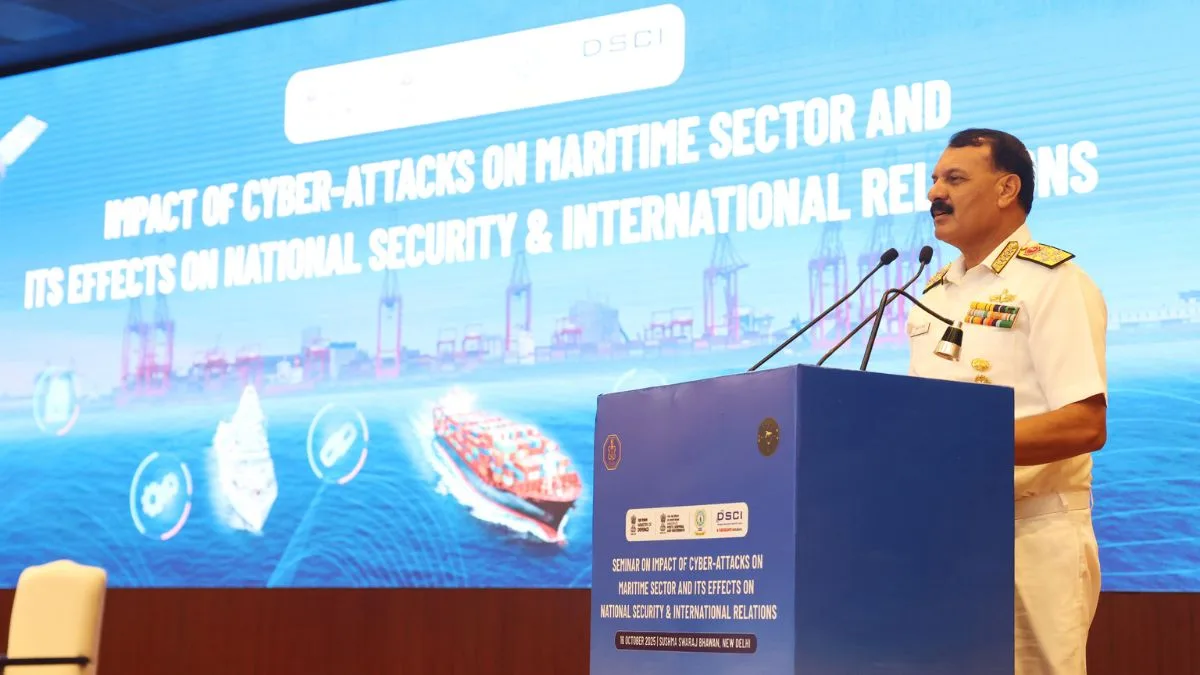
The CNS was giving the opening address at the seminar titled ‘Impact of Cyber Attacks on Maritime Sector and Its Effects on National Security and International Relations’ organised by the Indian Navy at the Sushma Swaraj Bhawan, here today.
Chief of Naval Staff Admiral Dinesh K Tripathi has warned that while the digital transformation of India’s naval assets is driving unprecedented efficiency, it also brings new security risks.
Addressing the growing role of the Internet of Things (IoT) in naval operations, he stated that “every vessel, every crane, every port terminal is now a floating computer network,” emphasizing that while IoT powers progress, the “weaponisation of everything” is what defines modern vulnerabilities.
The CNS was giving the opening address at the seminar titled ‘Impact of Cyber Attacks on Maritime Sector and Its Effects on National Security and International Relations’ organised by the Indian Navy at the Sushma Swaraj Bhawan, here today.
Stating that maritime horizons are widening, Tripathi said that the expansion is no longer just physical but is also unfolding through digital waves.
“Smart ports, AI-driven logistics, remote diagnostics, and autonomous navigation- in a way, the seas themselves are becoming data oceans. Information Technology (IT) and Operational Technology (OT) are underpinning almost every aspect of the maritime sector, ranging from machinery monitoring and collision avoidance to port operations and global fleet management,” he said.
The CNS said that while every vessel, every crane, every port terminal is now a floating computer network, running on the Internet of Things, he added that this digital revolution is bringing unprecedented efficiency, but also new vulnerabilities.
“Because while the Internet of Things is the trend that drives progress, the Weaponization of Everything is the one that defines risk,” he said.
Citing instances such as the 2021 Suez Canal blockage, the November 2023 cyberattack on DP World Australia, and earlier this year’s targeting of Iran’s shipping network by the Lab Dookhtegan group, the Chief of Naval Staff noted that nowhere is this threat more evident than in cyberspace—where a line of code can disable ships, an algorithm can disrupt navigation, and a few keystrokes can halt an entire port.
The CNS further highlighted that the 2024 Maritime Cybersecurity Report recorded over 50 billion firewall events globally, 1800 vessels targeted, and 178 ransomware incidents, each costing over half a million dollars on average.
“In cyber terms, these are not merely attacks on systems – they are strikes on the very arteries of the global economy. And let us not forget, the seas are our global commons. A cyber disruption at sea, or in any major port, therefore, does not remain confined to one nation’s boundaries. Its impact can ripple across supply chains, distort global markets, and even unsettle diplomatic equations,” he added.
Emphasizing the strategic significance of India’s maritime domain, the CNS highlighted that for a nation with 12 major ports, over 200 non-major ports, more than 11,000 km of coastline, and growing blue economy initiatives, the cyber implications are enormous.
Admiral Tripathi outlined two critical imperatives to strengthen maritime cyber resilience. The first, he said, is to embed cybersecurity into the very DNA of maritime operations from the outset, rather than treating it as an afterthought. Every digital system across the maritime supply chain, from design and induction to operationalisation, must be built on principles of resilience, redundancy, and robust safeguards.
The second imperative, he noted, is speed. Given the vast and interconnected nature of the maritime sector, spanning multiple ministries, agencies, ports, and international partners, rapid response and proactive measures will be India’s greatest asset in countering cyber threats.