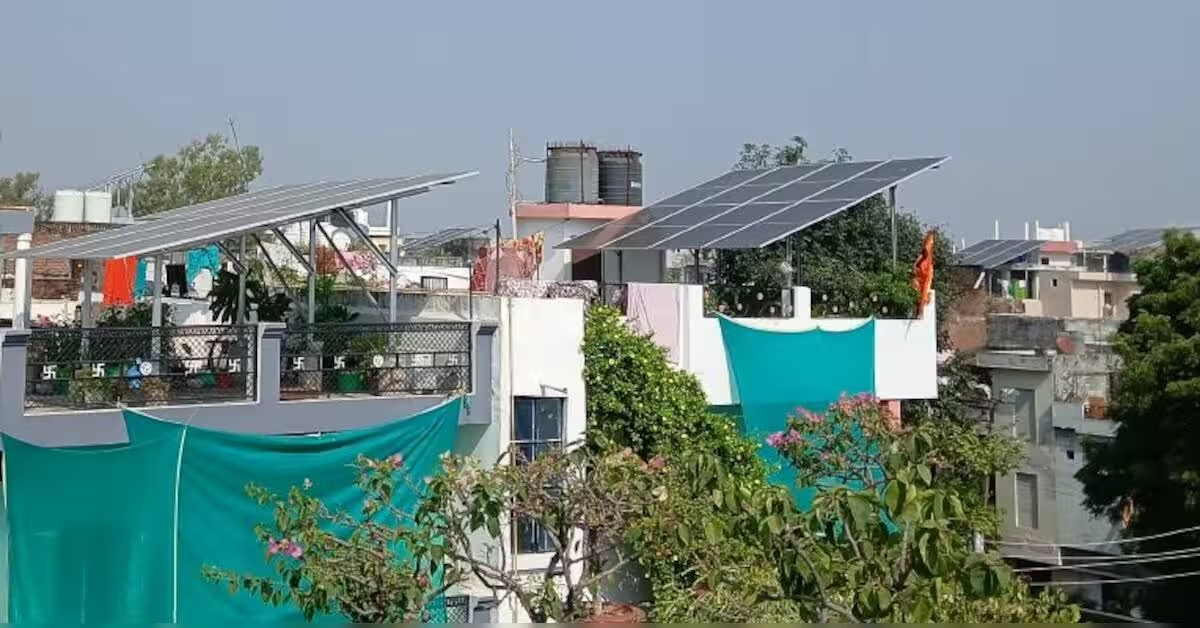

The Centre’s flagship rooftop solar scheme, PM Surya Ghar: Muft Bijli Yojana, is nearing the seven-million-household milestone, with 6.91 million households covered as of November 26, according to the latest data cited by the Ministry of New and Renewable Energy (MNRE).
The scheme has disbursed ₹37,989 crore in subsidies and added 20.2 gigawatts (GW) of rooftop solar capacity. With 3.09 million households still to be covered, the government has to accelerate installations to meet its March 2027 target.
Under the PM Surya Ghar scheme, residential consumers can receive central financial assistance of up to ₹78,000 for rooftop solar systems of up to 3 kilowatts (kW). The programme aims to reduce household electricity bills while expanding India’s renewable energy capacity.
Scheme is on track
The tool has recorded 4,57,561 scans in the three months since its launch on August 20. Of these, 98,110 users generated customised solar plans, while 46,369 contacted empanelled vendors, Moneycontrol reported, citing government data released on Thursday.
The tool allows households to generate customised rooftop solar plans, including estimates of installation costs, system capacity, payback periods and potential electricity savings.
At the Bharat Renewable Energy (BRE) Summit and Expo 2026 in Delhi on November 2, Prime Minister Narendra Modi said the scheme was adding nearly 1 lakh new households every six days. He also said it had reduced electricity bills by around 76 per cent.
State-wise installation trends
The national figures mask significant differences in implementation across states.
According to Solentra’s state-wise PM Surya Ghar dashboard, based on data from the National Portal for Rooftop Solar, Uttar Pradesh led with around 9.89 lakh installations as of November 27. Gujarat followed with 9.56 lakh and Maharashtra with 9.43 lakh. Together, the three states accounted for nearly half of the installations recorded in the dashboard.
Bihar and West Bengal, however, recorded conversion rates of just 17.6 per cent and 15.2 per cent. Delhi’s rate stood at 22.1 per cent.
The government estimates that installations across 10 million households could generate around 1,000 billion units of renewable electricity over their lifetime and reduce carbon dioxide equivalent emissions by 720 million tonnes over 25 years.