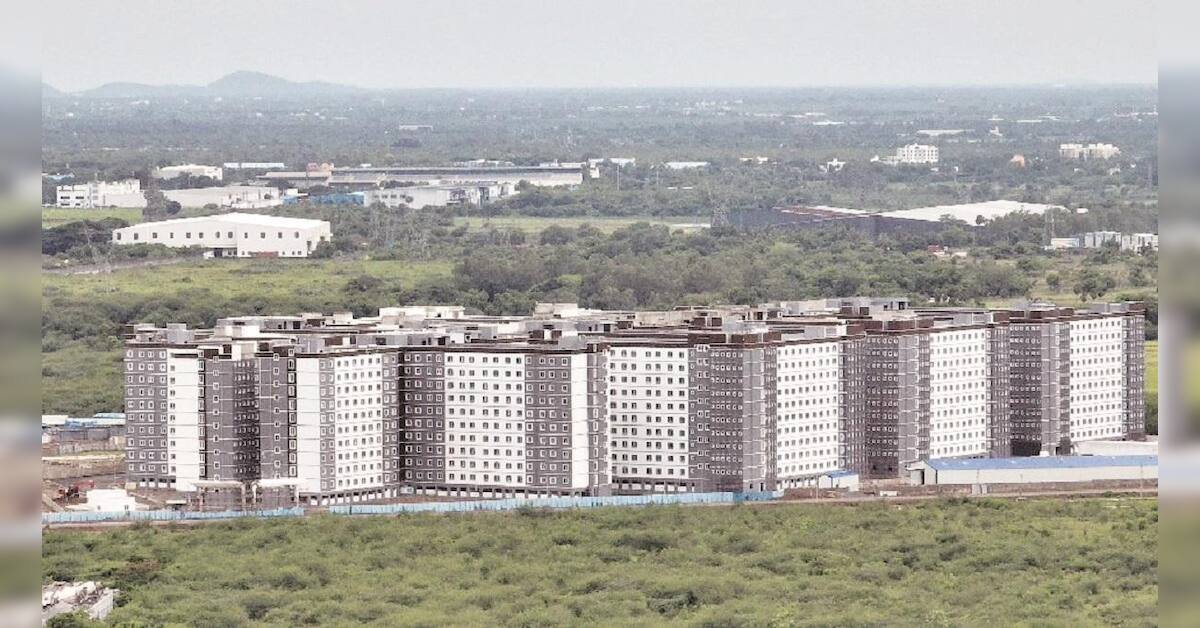

Housing markets in Delhi-NCR and Ahmedabad are witnessing higher levels of inventory overhang, or unsold units, compared with other leading residential markets, according to real estate consultancy Knight Frank’s Quarters to Sell (QTS) metric.
The metric, which measures the time required to absorb existing inventory at the average sales rate of the last eight quarters, showed that the time required to sell existing inventory has reached two years in both markets. Delhi-NCR’s QTS climbed from 7.3 quarters (equivalent to 1.8 years) to 8.0 quarters (equivalent to two years).
Ahmedabad recorded the highest inventory overhang among all major cities in Q3 2026, with its QTS rising from 7.8 quarters, equivalent to 1.95 years, in Q3 2025 to 8.2 quarters, equivalent to 2.05 years, in Q3 2026. The absorption period in NCR has lengthened as average sales eased by 8 per cent, primarily owing to demand moderation in the luxury housing category of ₹5-10 crore.
In Ahmedabad, strong new project launches have kept supply ahead of sales-driven absorption, lifting unsold inventory by 9 per cent compared with a modest 3 per cent increase in average sales. Overall, across the country’s eight leading residential markets, the average Quarters to Sell (QTS) edged up to 6.1 quarters, or 1.52 years, in Q3 2026 from an eight-year low of 5.8 quarters, or 1.45 years, recorded during the same period last year (Q3 2025). At 6.1 quarters, QTS remains significantly lower than the seven to eleven quarters recorded between 2018 and 2021.
Commenting on the trend, Gulam Zia, International Partner and Senior Executive Director – Research, Advisory, Infrastructure and Valuation, Knight Frank India, said, “Despite a marginal increase in Quarters to Sell, the Indian residential market, with an average QTS of 6.1 quarters, continues to demonstrate resilience. While NCR and Ahmedabad are witnessing longer absorption periods, QTS across the other six markets ranges from 4.3 to 6.4 quarters, signalling that the Indian residential market’s fundamentals remain sound.”
Among other major cities, Bengaluru recorded the sharpest rise in inventory overhang, with its QTS increasing from 4.6 quarters in Q3 2025 to 5.5 quarters in Q3 2026. Hyderabad and Pune also witnessed an increase in inventory overhang, with their QTS rising to 6.1 quarters and 4.7 quarters, respectively.
Meanwhile, Mumbai, Chennai and Kolkata recorded an improvement in their inventory absorption cycles. Kolkata had the lowest QTS among the eight markets at 4.3 quarters, down from 4.7 quarters a year ago, as sales outpaced new launches, reducing unsold inventory by 10 per cent. Mumbai’s QTS declined from 6.6 quarters to 6.4 quarters, while Chennai recorded a marginal improvement from 4.5 quarters to 4.4 quarters.