

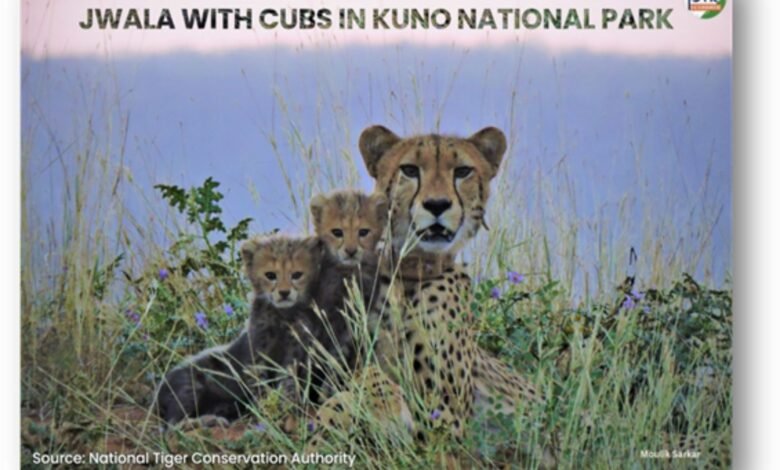
New Delhi । After a silence of more than seven decades, the swift footsteps of the cheetah are once again echoing across India’s grasslands. Under Project Cheetah, the world’s first intercontinental translocation of a large carnivore has emerged as a major conservation success, marking a historic milestone in global wildlife restoration.
Between 2022 and 2023, a total of 20 cheetahs were successfully relocated to India from Namibia and South Africa. Prime Minister Shri Narendra Modi personally released the first batch of eight cheetahs into Kuno National Park, Madhya Pradesh, on 17 September 2022, formally launching the ambitious project.
By December 2025, India is home to 30 cheetahs, including 12 adults, 9 sub-adults, and 9 cubs. Significantly, 19 of these cheetahs were born on Indian soil, reflecting successful adaptation and breeding in their new environment. The first India-born female cheetah, Mukhi, has now become a mother to five healthy cubs, symbolizing the project’s transition from reintroduction to long-term population recovery.
Beyond ecological restoration, Project Cheetah has also delivered tangible benefits to local communities. Around 450 “Cheetah Mitras” have been engaged as conservation ambassadors, while over 380 direct employment opportunities have been created in tracking, protection, tourism, and park management. Additionally, 5 percent of eco-tourism revenue is being shared with local communities, strengthening conservation-linked livelihoods.
Looking ahead, India aims to establish a self-sustaining metapopulation of 60–70 cheetahs across nearly 17,000 square kilometers by 2032, with the Gandhi Sagar Wildlife Sanctuary identified as the next major site for expansion. This long-term vision focuses on grassland restoration, prey augmentation, scientific monitoring, and community participation.
Project Cheetah represents more than the return of a lost species. It stands as a powerful statement of India’s commitment to biodiversity conservation, international cooperation, and science-based wildlife management. As cheetahs once again race across Indian landscapes, the project offers a global model of how extinct species can be responsibly restored—reviving ecosystems, empowering communities, and renewing hope for nature’s future.