


Artificial intelligence is entering a new phase as an unprecedented expansion of data centers, advanced chips and computing infrastructure prepares to reshape the technology landscape.
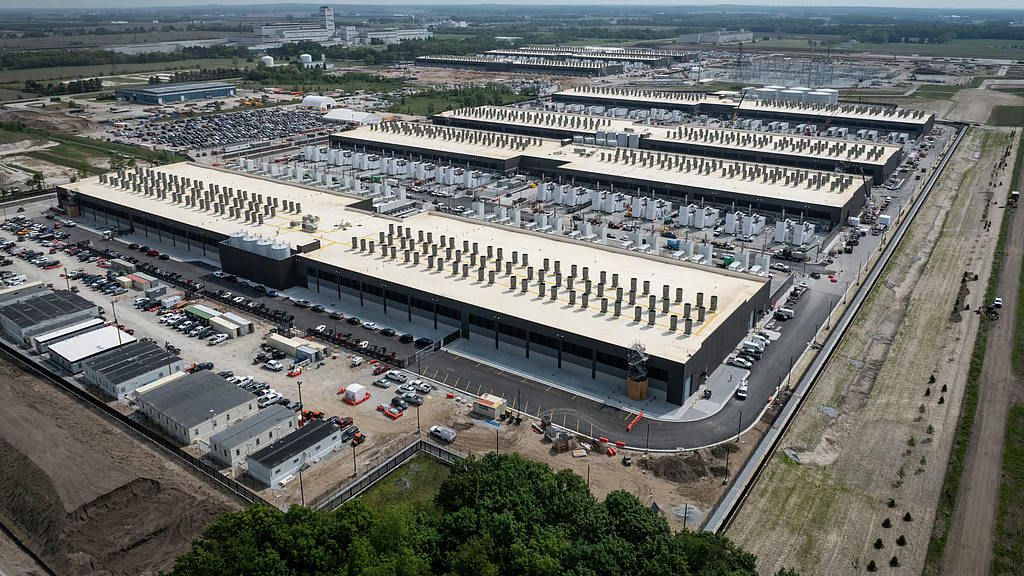
From the United States to the Persian Gulf, hundreds of large-scale data centers are under construction. Once operational, they are expected to deliver enormous amounts of computing power for developing and running increasingly capable AI systems.
The scale of the investment is prompting comparisons with some of history’s biggest infrastructure projects, while simultaneously raising concerns about energy consumption, water use, economic risks, employment and geopolitical competition.
AI Computing Power Set to Surge
Behind virtually every major advance in AI is a corresponding increase in computing power.
Research firm Epoch AI estimates that around 20 million AI chips are currently installed in data centers supporting AI worldwide. The number is expected to grow rapidly, potentially reaching approximately 200 million chips by the end of 2028.
That would represent roughly a 10-fold increase from current levels.
Technology leaders argue that greater computing capacity will allow AI systems to handle increasingly complex tasks and expand into areas that currently require significant human expertise.
Rob Wachen, co-founder of semiconductor company Etched, described the infrastructure expansion as one of the largest infrastructure buildouts in human history.
The Scaling Laws Driving the AI Race
The rapid expansion is based largely on the belief in AI scaling laws—the idea that AI capabilities generally improve as models receive more data, computing power and other resources.
This belief has encouraged technology companies to spend enormous sums on chips and data centers.
AI industry leaders increasingly argue that companies possessing the greatest computing capacity will have an advantage in developing the most capable AI systems.
Anthropic CEO Dario Amodei has predicted that if scaling trends continue, AI could eventually perform significant amounts of white-collar work.
Google DeepMind chairman Demis Hassabis has similarly suggested that AI could accelerate technological and economic transformation on a scale far beyond previous industrial revolutions.
Potential Breakthroughs in Science and Medicine
Scientists and technology executives expect the growing availability of computing power to accelerate research in areas including:
- Drug discovery
- Medical research
- Robotics
- Biological sciences
- Advanced engineering
- Scientific modelling
- Automation
AI systems are already demonstrating capabilities that would have been considered remarkable only a few years ago.
In recent years, AI systems have performed well on professional examinations, helped researchers investigate potential disease mechanisms and solved difficult mathematical problems.
The next generation of systems could potentially take on much more complicated research and professional tasks.
Data Centers Face Growing Energy Demands
The AI boom, however, comes with a substantial infrastructure cost.
According to SemiAnalysis, data centers consumed approximately 64 gigawatts of electricity globally last year. That figure could quadruple by the end of 2030.
The enormous energy requirements are becoming a major issue for governments and communities hosting data centers.
Large facilities can also consume significant amounts of water for cooling, while their construction can place pressure on local electricity grids and infrastructure.
In the United States, communities in several areas have raised concerns about the environmental impact of new data centers and the possibility of higher electricity prices.
An AI Infrastructure Investment Boom
Despite concerns, spending on AI infrastructure continues to accelerate.
According to IDC forecasts, global investment in AI infrastructure could exceed $1 trillion by 2029, compared with approximately $318 billion last year.
Amazon, Google, Microsoft, Meta and Oracle are among the companies investing heavily in data centers, AI chips and related infrastructure.
The massive spending has also prompted economists and investors to question whether companies can generate enough revenue from AI to justify the scale of investment.
Could AI Create an Economic Bubble?
The current AI infrastructure boom has similarities with earlier technology-driven investment cycles.
Economists point to historical examples such as:
- The 19th-century railroad boom
- Electrification in the early 20th century
- The dot-com boom of the late 1990s
In each case, enormous investments were followed by financial setbacks before the long-term benefits of the technology became fully apparent.
Economist Philippe Aghion, who won the 2025 Nobel Prize in Economic Sciences, has warned that AI could also develop a speculative bubble.
The central question is whether the economic value generated by AI will eventually justify the enormous infrastructure expenditure.
US and China Race for AI Dominance
The AI infrastructure expansion is also intensifying competition between the United States and China.
The United States currently has a substantial advantage. It has thousands of data centers, while American technology companies control a large share of the computing infrastructure used for AI.
China is attempting to narrow the gap by investing heavily in domestic semiconductors, data centers and AI research.
Companies including Huawei, ByteDance and Alibaba are increasing their AI-related investments, while Chinese startups such as DeepSeek and Moonshot AI have developed increasingly competitive AI models.
However, restrictions on access to advanced AI chips and semiconductor technology have complicated China’s efforts to rapidly expand its computing capacity.
The Rest of the World Risks Falling Behind
The competition is not limited to Washington and Beijing.
European countries are attempting to increase their AI infrastructure, while nations in the Persian Gulf, including Saudi Arabia and the United Arab Emirates, are investing billions of dollars in data centers and AI technology.
However, access to electricity, land, financing and regulatory approvals remains a challenge in many regions.
This has raised concerns about a growing global digital divide, in which countries with enormous computing infrastructure gain disproportionately from AI while developing economies struggle to access the technology.
United Nations technology envoy Amandeep Gill has warned that the concentration of computing capacity in a small number of countries and regions could leave much of the world behind.
AI Agents Could Transform Everyday Work
The expansion of computing power is also accelerating the development of AI agents—systems capable of completing multiple tasks with limited human intervention.
Companies are increasingly experimenting with AI for activities such as:
- Coding
- Customer service
- Research
- Report preparation
- Email management
- Data analysis
- Business operations
With additional computing resources, AI agents could potentially perform increasingly complicated sequences of tasks.
Google Chief Scientist Jeff Dean has envisioned a future in which hundreds of AI agents could independently develop and test scientific hypotheses, allowing researchers to focus on the most promising results.
Potential Impact on Jobs
The rapid development of AI is also generating concern about the future of employment.
Economists expect AI to eliminate some jobs while creating new ones.
Erik Brynjolfsson, director of Stanford University’s Digital Economy Lab, has warned that millions of jobs could disappear while millions of new jobs emerge—but the new positions may not resemble the jobs being replaced.
This could create significant challenges for workers who need to acquire new skills as AI becomes increasingly integrated into workplaces.
The Prospect of AI Improving AI
One of the most ambitious goals of the AI industry is recursive self-improvement—the possibility that AI systems could help design and improve future generations of AI with substantially less human intervention.
Google and other AI laboratories are already experimenting with systems that can generate and evaluate ideas for improving AI models.
If computing power continues to increase, researchers believe more parts of the AI development process could eventually be automated.
A Transformative Moment for Technology
The coming years could therefore represent a decisive period for artificial intelligence.
More chips, larger data centers and greater computing capacity could unlock breakthroughs in science, medicine, robotics and business, while bringing AI tools to hundreds of millions or potentially billions of people.
At the same time, the enormous infrastructure required to power this transformation creates serious challenges involving energy, water, investment, employment, regulation and geopolitical inequality.
The AI revolution may ultimately prove to be one of the most transformative technological shifts in history—but its success will depend not only on how powerful AI becomes, but also on whether the world can build and manage the infrastructure required to support it.