

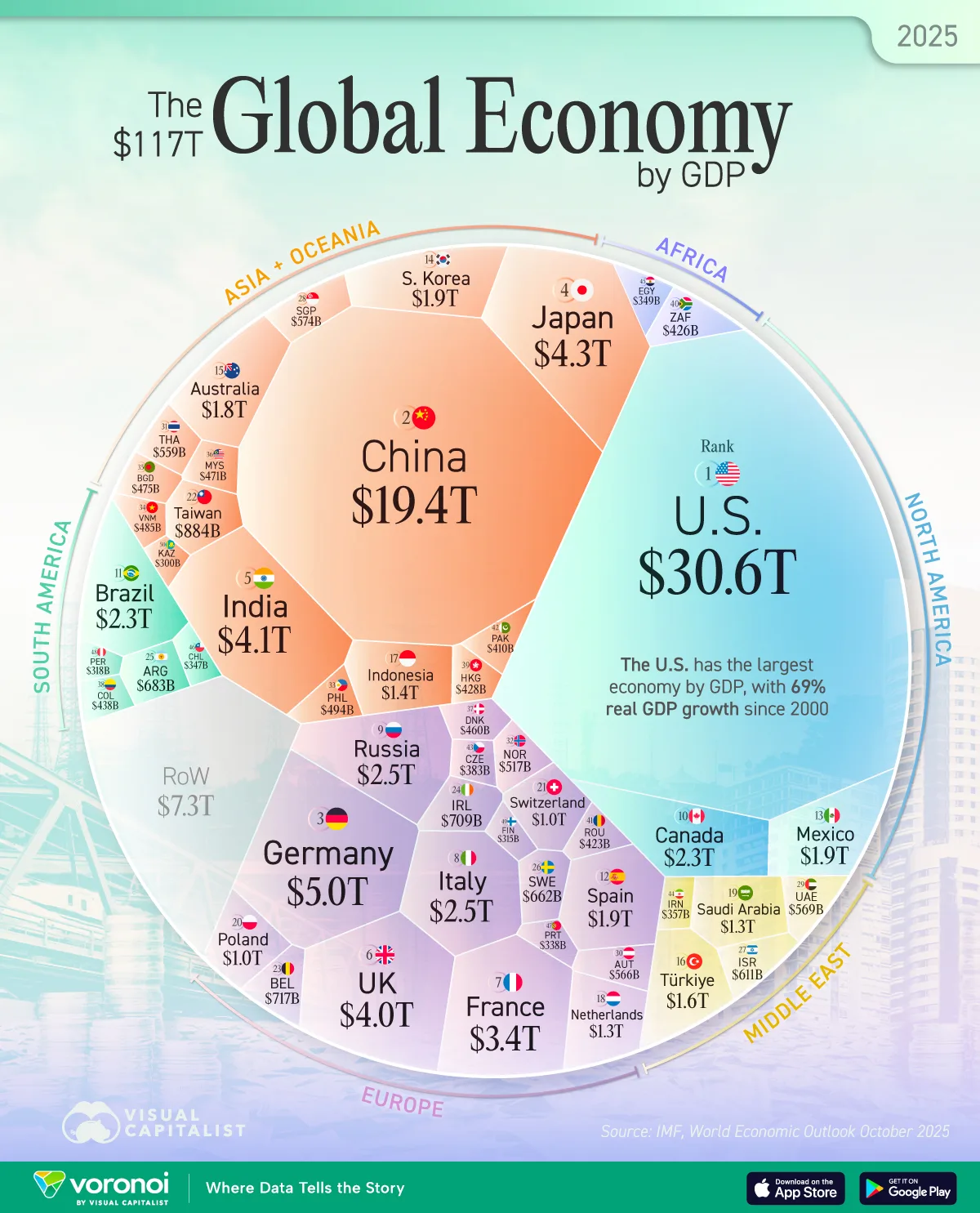
The global economy is projected to reach an estimated $117 trillion in 2025, highlighting both the dominance of established economic powers and the rapid rise of emerging markets, according to projections from the IMF’s latest World Economic Outlook. A new Voronoi-style visualization captures this vast economic landscape by ranking countries based on their gross domestic product (GDP).
The United States remains the world’s largest economy, with a GDP of $30.6 trillion in 2025. Despite its already massive scale, the U.S. economy is expected to grow by 2.0% this year, reflecting steady performance driven by consumer spending, innovation, and a resilient labor market. Notably, America’s economy alone is larger than the combined economies of China, Germany, and Japan, underlining its continued global economic influence.
China holds second place with a projected GDP of $19.4 trillion, maintaining solid momentum with 4.8% real GDP growth in 2025. Over the past 25 years, China’s economy has expanded by an extraordinary 585.7%, making it one of the most transformative economic success stories of the modern era.
In third place, Germany remains Europe’s largest economy at $5.0 trillion, though its growth outlook is subdued. With expected growth of just 0.2% in 2025, Germany continues to face structural challenges, including weak productivity growth and a prolonged decline in its manufacturing sector.
Japan ranks fourth with a GDP of $4.3 trillion, while India has climbed to fifth place at $4.1 trillion, marking a significant milestone in its economic journey. India is also among the fastest-growing major economies, with GDP projected to expand by 6.6% in 2025. Since 2000, India’s real GDP has grown by 364.1%, averaging 6.4% annually—more than triple the growth rate of the U.S. over the same period. If current trends continue, India is expected to surpass Japan to become the fourth-largest economy in the near future.
Among other major economies, the United Kingdom ($4.0T), France ($3.4T), Italy ($2.5T), Russia ($2.5T), and Canada ($2.3T) round out the global top ten. However, much of Europe has experienced relatively slow growth over the last quarter-century. Italy, for instance, has averaged just 0.4% annual GDP growth, while France has averaged 1.2%, reflecting long-term demographic and productivity challenges.
Overall, the 2025 global economic outlook underscores a world in transition: mature economies continue to dominate in size, while faster-growing nations—particularly in Asia—are steadily reshaping the balance of economic power.