

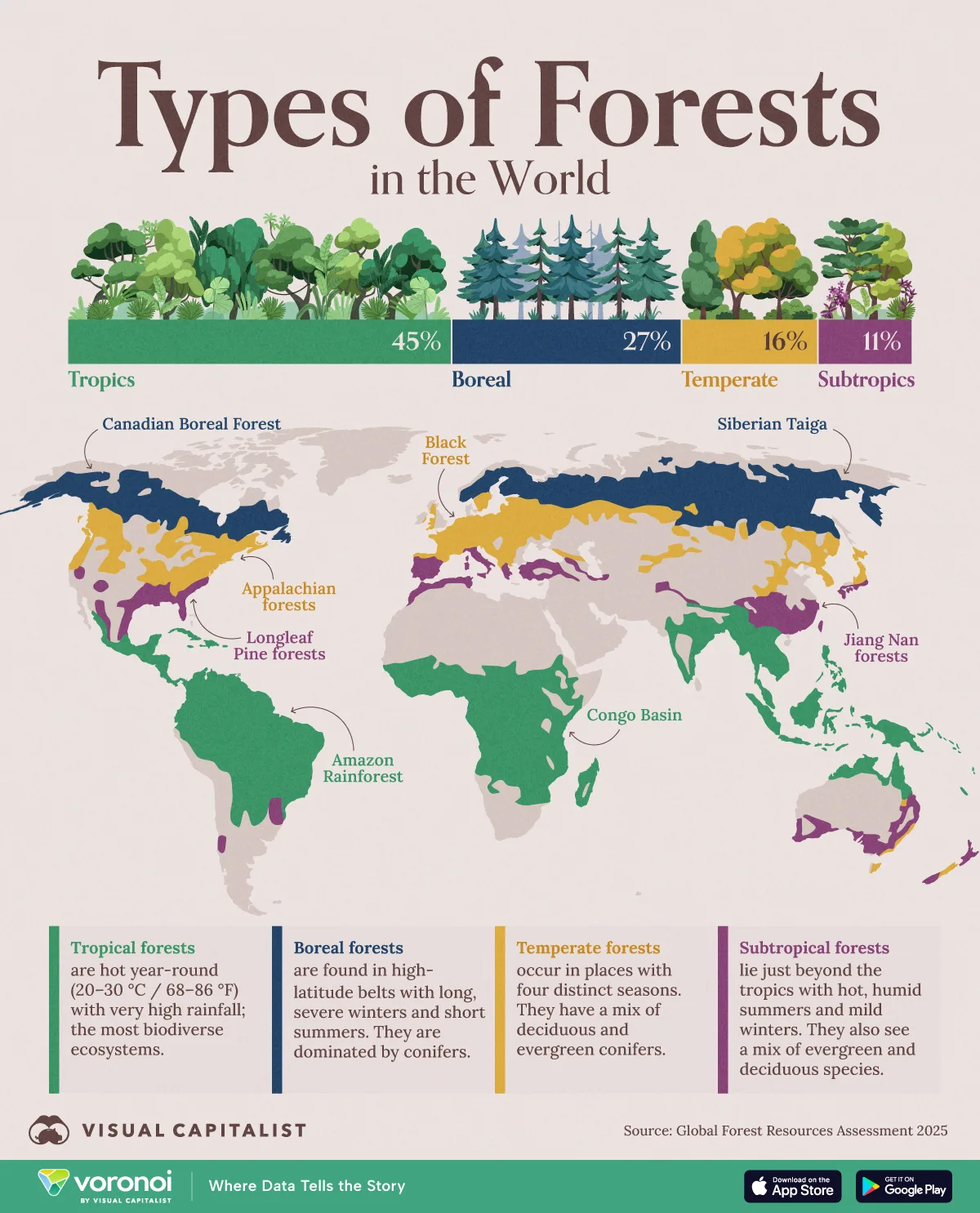
A new data visualization based on the UN Food and Agriculture Organization’s (FAO) 2025 Forest Resources Assessment has mapped the world’s forests into four major categories — tropical, boreal, temperate, and subtropical — highlighting their size, characteristics, ecological importance, and present challenges.
Forests cover about one-third of the Earth’s land area, playing a critical role in carbon storage, biodiversity conservation, regulation of rainfall patterns, soil protection, and stabilizing the planet’s climate. The assessment provides the most detailed breakdown to date of the composition and distribution of global forest ecosystems.
🔹 Tropical Forests: The Largest and Most Vulnerable
- Share of world forests: 45%
- Geographical concentration: Amazon Basin, Central Africa, Southeast Asia
- Climate: Hot and humid year-round, with abundant rainfall
- Ecology: Home to more than half of the planet’s plant and animal species
Tropical forests act as the world’s largest carbon sinks, absorbing massive amounts of CO₂ and helping to regulate global temperatures. They also support millions of people — including indigenous communities — through food, medicine, and livelihood resources.
However, they remain the most threatened forest type. The FAO report notes:
- Rapid deforestation
- Land conversion for agriculture, cattle ranching, palm oil and soy plantations
- Mining and infrastructure expansion
Brazil alone has lost 2.9 million acres of tropical forest since 2015, an area comparable to the size of Rwanda.
🔹 Boreal Forests: The Second-Largest Global Forest System
- Share of world forests: 27%
- Climate: Long, freezing winters and very short summers
- Location: Mostly across Russia, Canada and northern Scandinavia
Boreal forests — dominated by coniferous trees such as pine, spruce and fir — store more carbon underground (in soil and permafrost) than tropical forests store in biomass.
However, they are increasingly threatened by:
- Wildfires
- Rising temperatures in the Arctic
- Melting permafrost
Scientists warn that damage to boreal ecosystems could release large amounts of trapped carbon, accelerating global warming.
🔹 Temperate Forests: The Forests of Four Seasons
- Share of world forests: 16%
- Climate: Moderate temperatures, four distinct seasons
- Distribution: North America, Europe, East Asia and parts of South America
Temperate forests contain a mix of deciduous and evergreen species and play an important role in supporting wildlife, filtering water and maintaining soil moisture.
Although relatively stable compared to tropical forests, they face urban expansion, monoculture plantations, and pollution.
🔹 Subtropical Forests: Moist Forests Near the Tropic Borders
- Share of world forests: 11%
- Location: Southern China, Southeastern United States, Northern Australia, South Africa and parts of South America
- Features: Warm climates, seasonal rainfall and mixed vegetation types
These forests support considerable biodiversity and are valuable grazing and watershed regions. Their biggest threats include droughts, wildfires, land degradation and water scarcity — all intensified by climate change.
🌍 How Forests Are Used Around the World
The FAO assessment also reveals the primary purposes for which global forests are designated: Forest Objective Share of Total Forest Area 🌲 Production (logging & commercial use) 29% 💧 Soil & water protection 9% 🦋 Biodiversity conservation 12% 🏫 Social services 5% 🌍 Multiple use (combined objectives) 15% 🔧 Other 7% 🚫 No designation 4% ❓ Unknown (data gaps) 18%
The 18% “unknown” category raises major concerns regarding incomplete forest monitoring — mostly in regions without proper land registry systems.
🔥 Growing Environmental Concerns
Environmental researchers warn that:
- The loss of tropical and boreal forests poses direct threats to global climate stability.
- Many species are facing extinction due to rapid ecosystem degradation.
- Without stronger forest governance and conservation, the world may cross irreversible ecological tipping points.
🌱 Toward the Future: What Experts Recommend
Global experts emphasize:
- Strengthening environmental laws and forest governance
- Increasing funding for conservation and indigenous land protection
- Expanding sustainable forestry and climate-smart agriculture
- Improving global monitoring and data transparency
Conclusion
The new mapping of the world’s forests highlights not only the rich ecological diversity of forest systems, but also the growing threats they face from deforestation, climate change and industrialization. Protecting and restoring forests will be essential for global climate stability, biodiversity conservation and the well-being of future generations.