

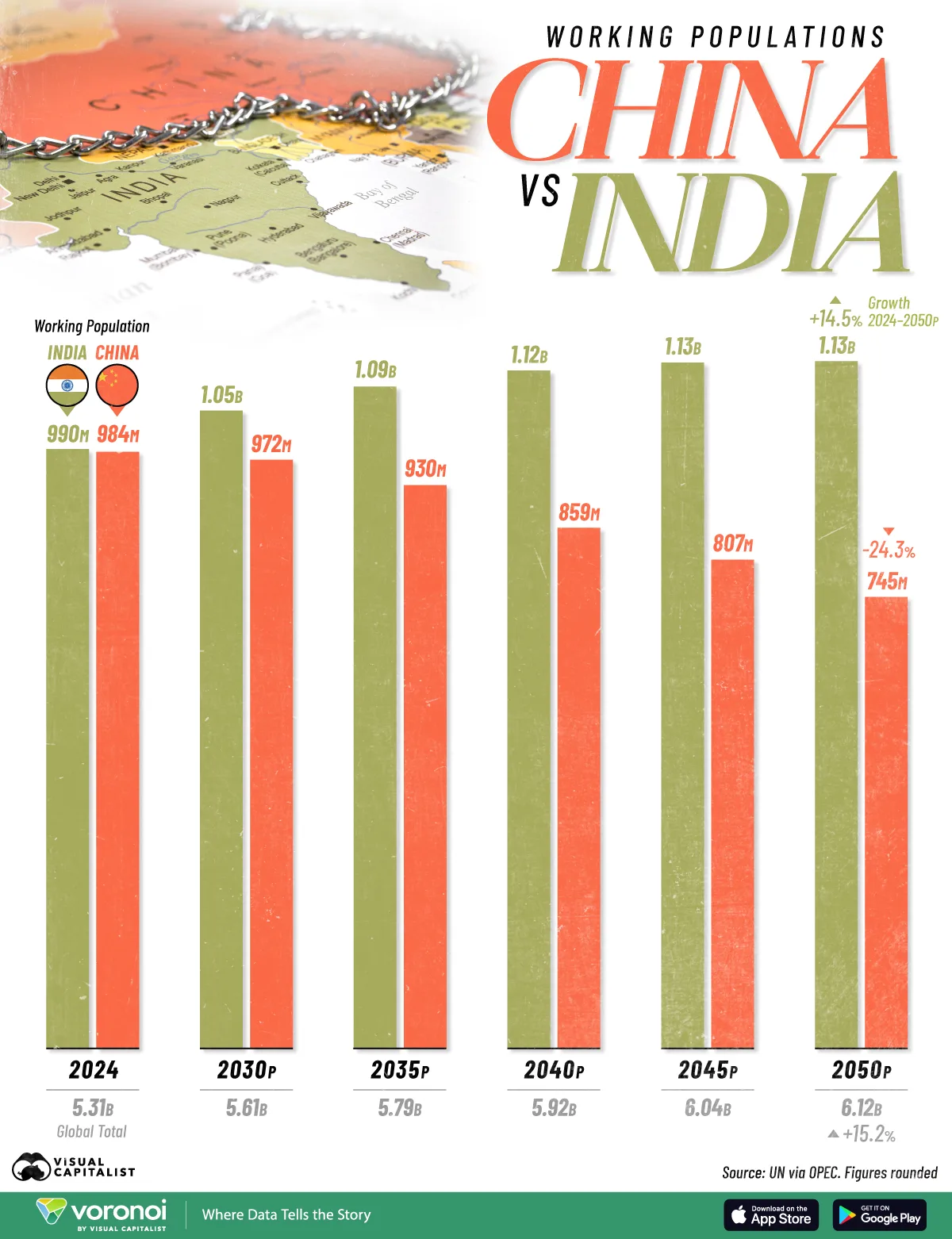
A profound demographic transition is reshaping the landscape of the global economy. New projections from the United Nations, compiled in OPEC’s World Oil Outlook 2025, show that India’s working-age population is on course to expand significantly through 2050—while China is expected to witness one of the sharpest labor-force contractions in modern economic history.
India Rising: Workforce Growth Exceeds Global Average
India’s working-age population (ages 15–64) is expected to grow from 990 million in 2024 to 1.134 billion by 2050, adding 144 million people, or 14.5%. This increase is equivalent to adding more workers than the entire current labor forces of Japan, Germany, and Russia combined.
The growth is fueled by:
- A younger demographic structure
- Higher fertility rates compared to other major economies
- Strong improvements in life expectancy and declining child dependency ratios
Economists say this expansion positions India to benefit from a demographic dividend—an opportunity where the share of working adults is far greater than dependents, boosting productivity and economic output.
China’s Workforce Decline: A Demographic Challenge with Global Implications
In contrast, China’s working-age population is projected to decline from 984 million in 2024 to 745 million in 2050, a loss of 239 million workers, or 24.3%. China’s labor force peaked in 2014 and has been steadily shrinking ever since.
Key drivers of the decline include:
- Decades of the one-child policy
- Persistent low fertility rates even after policy reversal
- Rapid aging and rising life expectancy
- Low immigration flows
The contraction is expected to increase labor costs, slow down industrial output, and place greater pressure on China’s pension and healthcare systems. A smaller workforce could also reduce China’s long-term growth potential, prompting companies to turn to alternative production hubs.
Global Labor Map is Being Redrawn
The world’s working-age population is projected to grow from 5.31 billion in 2024 to 6.12 billion in 2050—a rise of 15.2%. India alone will contribute nearly 18% of this global increase. Country/World 2024 (millions) 2050 (millions) Growth (millions) Growth % India 990 1,134 +144 +14.5% China 984 745 –239 –24.3% World 5,312 6,117 +805 +15.2%
Shift in Global Supply Chains
As China ages, its role as the world’s manufacturing powerhouse could gradually diminish. Many companies are already diversifying production into India, Vietnam, Indonesia, and Mexico to reduce dependence on China.
India’s expanding workforce, digitalization push, and growing domestic market are attracting increased interest from:
- Electronics manufacturers
- Automobile and electric-vehicle producers
- Pharmaceutical industries
- IT and business-services companies
Opportunity and Responsibility for India
Experts caution that India will benefit from its demographic advantage only if it can:
- Create millions of new jobs annually
- Improve education and technical training
- Increase female labor-force participation
- Expand infrastructure and energy security
If successful, India could emerge as the world’s primary engine of workforce-driven economic growth by mid-century.
China’s Strategy for the Future
To counter shrinking labor supply, China is expected to rely heavily on:
- Automation and robotics
- Artificial intelligence
- Productivity innovations
- Policies supporting elderly workers and raising retirement ages
While these measures may slow the decline’s economic impact, the demographic shift is long-term and irreversible.
Conclusion
The UN projections reveal a critical turning point:
🔹 India is becoming the world’s largest source of labor and human capital.
🔹 China is entering an era of aging and labor scarcity.
How both nations adapt—through policy, investment, and economic strategy—will play a defining role in shaping global trade, manufacturing patterns, and geopolitical influence in the decades ahead.