

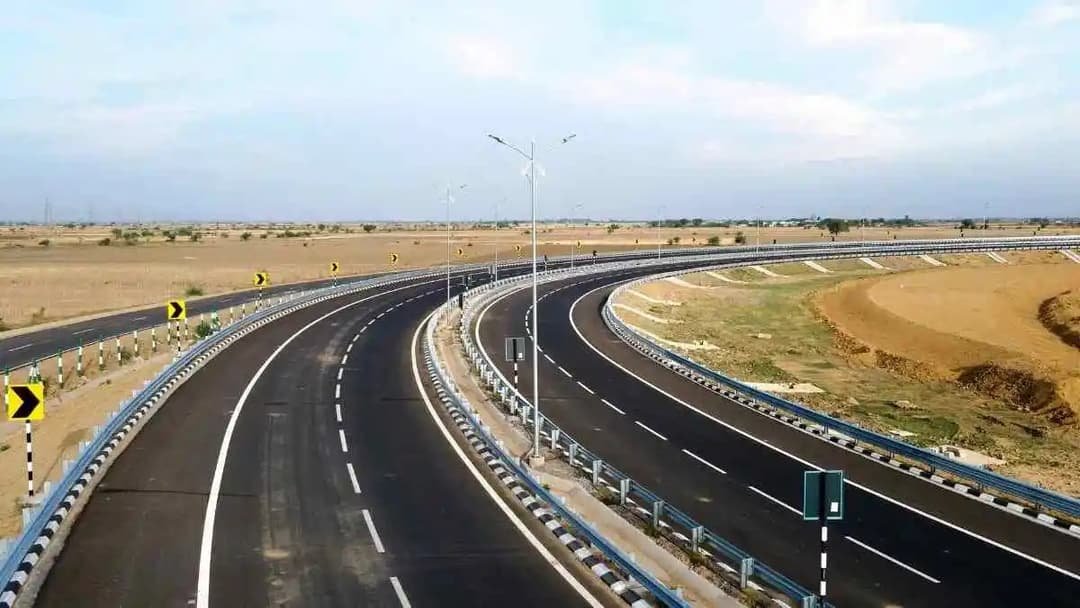
New Delhi — In a major push to strengthen infrastructure and regional connectivity, the Indian government has approved the construction of a four-lane, access-controlled highway linking key districts in the northern state of Uttar Pradesh. The decision was taken by the Cabinet Committee on Economic Affairs (CCEA), chaired by Prime Minister Narendra Modi.
The project involves upgrading a 101.5-kilometer stretch of National Highway 927 connecting the towns of Barabanki and Bahraich. The total cost is estimated at ₹6,969 crore (approximately $840 million USD), and the highway will be developed under the Hybrid Annuity Model (HAM), a public-private partnership framework commonly used in India.
Project Overview
The NH-927 corridor is designed to significantly improve traffic flow, road safety, and travel efficiency in one of Uttar Pradesh’s densely populated regions. Once completed, travel time between Barabanki and Bahraich is expected to be reduced to nearly one hour.
Key features include:
- Length: 101.515 km (63 miles)
- Configuration: 4-lane access-controlled highway
- Service Roads: Continuous parallel service lanes
- Bypasses: 48.28 km to divert traffic from populated areas
- Estimated Cost: ₹6,969.04 crore
- Civil Construction: ₹3,485.49 crore
- Land Acquisition: ₹1,574.85 crore
The upgraded highway will address existing issues such as sharp curves, congestion, and substandard road geometry, leading to safer and smoother travel.
Strategic Importance
The corridor will connect multiple national and state highways, including NH-27, NH-330B, and NH-730, improving regional mobility. It is also expected to enhance access to key infrastructure and economic hubs, including:
- Airports in Lucknow and Shravasti
- Several railway stations across both districts
- The Rupaidiha land port, a major gateway for India–Nepal trade
By improving connectivity to the Nepal border near Nepalganj, the project is likely to boost cross-border trade, particularly in agriculture, consumer goods, and logistics.
Economic and Social Impact
Officials estimate the project will generate significant employment during construction:
- 36.5 lakh (3.65 million) direct person-days
- 43 lakh (4.3 million) indirect person-days
The highway will also serve:
- 1 Special Economic Zone (SEZ)
- 2 Mega Food Parks
- 2 Aspirational (underdeveloped) districts
Improved infrastructure is expected to lower transportation costs, increase fuel efficiency, and attract investment into the region.
Integration with National Infrastructure Plan
The NH-927 project aligns with India’s ambitious PM GatiShakti initiative, which aims to integrate various modes of transportation—roads, railways, ports, and airports—into a unified logistics network.
By linking economic, social, and logistics nodes, the corridor will enhance the movement of goods and passengers while supporting long-term regional development.
Looking Ahead
Once completed, the NH-927 upgrade is expected to transform connectivity in eastern Uttar Pradesh, especially in underserved districts like Bahraich and Shravasti. The project is seen as a critical step toward modernizing India’s transport infrastructure and strengthening its position in regional trade, particularly with neighboring Nepal.
Officials say the highway will not only improve mobility but also act as a catalyst for economic growth, tourism, and investment across the region.