
New Delhi । As transatlantic relations face renewed strain, Europe is increasingly looking toward India as a reliable strategic and economic partner. Growing unease over U.S. policies—particularly former President Donald Trump’s repeated statements on Greenland and NATO—has left many European nations reassessing their global alliances. In this changing geopolitical landscape, India has emerged as a crucial alternative.
The 27-member European Union is now keen to deepen ties with New Delhi across trade, defense, technology, and tourism. This shift is not driven by sentiment alone. Europe’s outreach to India is rooted in economic necessity, supply-chain security, and shared democratic values. India’s fast-growing economy is a central attraction, but analysts say at least five major factors have compelled Europe to move closer.
1. Reviving the EU–India Free Trade Agreement
At the top of the agenda is the long-pending EU–India Free Trade Agreement (FTA). Both sides want to conclude negotiations that have stalled for years. The deal is expected to open markets, reduce trade barriers, and strengthen supply chains in critical sectors such as clean technology, pharmaceuticals, and semiconductors. With the India–U.S. FTA currently in limbo, Europe sees an opportunity to move ahead decisively.
2. Securing Global Supply Chains
Disruptions caused by global conflicts and geopolitical tensions have exposed Europe’s dependence on limited suppliers. India is viewed as a stable and scalable partner that can help diversify supply chains, reduce risk, and ensure long-term economic resilience.
3. Strengthening Security Cooperation
The proposed agreements go beyond trade. Europe and India aim to enhance cooperation in maritime security, counterterrorism, and cyber defense. Talks are also expected to begin on an information security agreement, reflecting shared concerns over digital threats and regional stability.
4. Boosting Mobility and Talent Exchange
Both sides are planning to sign a Memorandum of Understanding on a comprehensive mobility framework. This would ease the movement of seasonal workers, students, researchers, and highly skilled professionals, while also promoting collaboration in research and innovation.
5. Shared Democratic Values in a Fragmented World
European leaders have emphasized that India’s role is not only economic but also strategic. EU foreign policy chief Kaja Kallas recently told the European Parliament that India is becoming essential to Europe’s economic strength and global outlook. She stressed that in a world under pressure from wars, coercion, and economic fragmentation, two major democracies cannot afford hesitation.
Symbolism and Timing
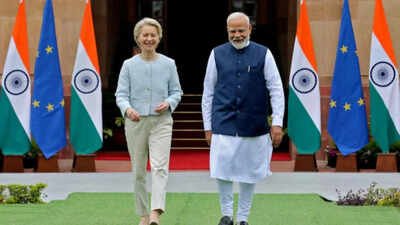
Highlighting the growing closeness, India has invited top European Union leaders as chief guests for its Republic Day celebrations on January 26. The following day, January 27, will see the 16th India–EU Summit, signaling a renewed push to elevate the partnership.
As Europe navigates uncertainty in its traditional alliances, India’s rising economic power, strategic autonomy, and democratic credentials make it a natural partner. For both sides, the moment represents not just a diplomatic reset—but a long-term bet on each other’s future.