

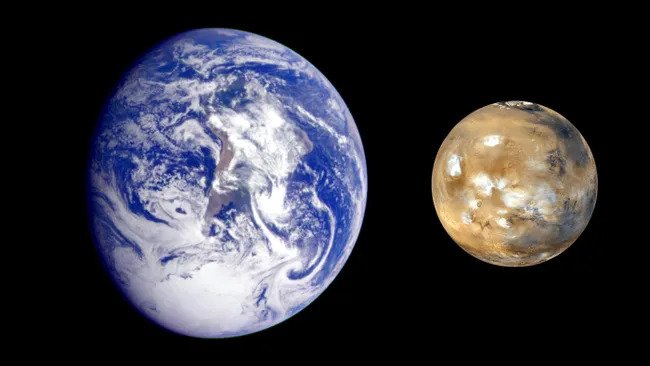
A new scientific study has revealed that time on Mars ticks slightly faster than on Earth — a difference that could complicate future human missions to the Red Planet. According to researchers, clocks on Mars run ahead by about 477 microseconds (0.477 milliseconds) every Earth day, a much larger discrepancy than the time difference measured on the Moon.
This finding confirms a key prediction of Albert Einstein’s theory of general relativity, which states that time moves differently depending on the strength of gravity. In regions where gravity is stronger, time slows down; where gravity is weaker, it speeds up. Because Mars has weaker gravity than Earth, time there flows a bit faster.
As humanity prepares for an era of deep-space exploration — with NASA’s Artemis program paving the way for long-term lunar bases and eventually missions to Mars — keeping accurate time across multiple worlds is becoming a pressing challenge. Scientists are now exploring the idea of creating a standardized clock system for each planetary body, including Mars, the Moon, and even deep space.
Such timing systems will be crucial for navigation, communication, and possibly the creation of an interplanetary internet. Without precise timing, spacecraft and astronauts could face serious navigational errors and communication delays.
The study’s findings highlight that even tiny differences in timekeeping can have major consequences when operating across vast cosmic distances. As we prepare for the future of space travel, understanding and adapting to the flow of time on other worlds may be as important as building rockets themselves.