


AB-PMJAY has financed more than 13.25 crore hospital admissions, providing financial protection worth ₹2.03 lakh crore
New Delhi: The Ayushman Bharat–Pradhan Mantri Jan Arogya Yojana (AB-PMJAY) has emerged as a major pillar of India’s public health protection system, providing financial assistance to economically vulnerable families for secondary and tertiary healthcare.
Launched on September 23, 2018, the scheme has completed eight years of implementation. As of September 21, 2026, more than 48.51 crore people had Ayushman cards, covering nearly 33 per cent of India’s population, according to the Press Information Bureau (PIB).
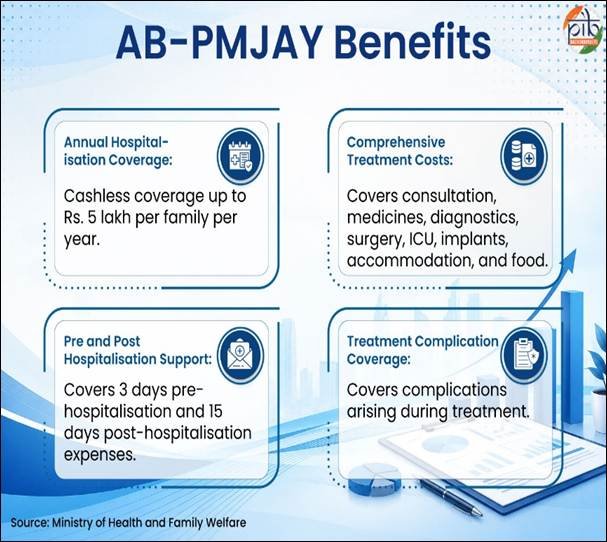
Under AB-PMJAY, eligible families receive cashless hospitalisation cover of up to ₹5 lakh per family per year. As of August 31, 2026, the scheme had financed nearly 13.25 crore hospital admissions through a network of more than 38,000 empanelled public and private hospitals. The government estimates that these hospital admissions have provided financial protection worth approximately ₹2.03 lakh crore to beneficiaries.
Cashless treatment across 27 medical specialties
AB-PMJAY is designed to protect families from the burden of high medical expenses. The scheme provides cashless healthcare services for 1,961 procedures across 27 medical specialties.
The government has also expanded the scheme to cover additional vulnerable groups.
In March 2024, coverage was extended to families of Accredited Social Health Activists (ASHAs), Anganwadi Workers (AWWs) and Anganwadi Helpers (AWHs). By September 21, 2026, more than 44.81 lakh Ayushman cards had been issued to beneficiaries in these categories.
On September 11, 2024, the government further expanded the scheme to cover all citizens aged 70 years and above, regardless of their socio-economic status. The expansion is estimated to cover around 6 crore senior citizens. By September 21, 2026, more than 1.36 crore Ayushman Vay Vandana Cards had been issued.
Focus on vulnerable rural and urban households
Beneficiaries under AB-PMJAY are identified primarily using deprivation and occupational criteria based on the Socio-Economic and Caste Census (SECC) 2011. Families previously covered under the Rashtriya Swasthya Bima Yojana (RSBY) are also included.
In rural areas, eligibility is based on specified deprivation criteria. These include households living in a single room with kutcha walls and roof, families without an adult member aged between 16 and 59 years, female-headed households without an adult male member in the same age group, households with a disabled member and no able-bodied adult, Scheduled Caste and Scheduled Tribe households, and landless households whose main source of income is manual labour.
In urban areas, the scheme covers specified occupational categories, including ragpickers, domestic workers, street vendors, cobblers, construction workers, plumbers, masons, labourers, painters, welders, security guards, sanitation workers, gardeners, tailors, transport workers, drivers, rickshaw pullers, shop workers, delivery assistants, electricians, mechanics, washermen and watchmen.
Additional categories have also been brought under the scheme through specific initiatives. These include Building and Other Construction Workers and their dependents, road accident victims covered under PM-RAHAT, transgender persons covered under the SMILE initiative, eligible children covered under PM CARES for Children, identified waste pickers and sanitation workers under the NAMASTE scheme, and Particularly Vulnerable Tribal Groups (PVTGs) covered under PM-JANMAN.
Ayushman Bharat helps patients access timely treatment
The PIB backgrounder highlights the case of 65-year-old Birmati from Haryana’s Jind district, who suffered a serious fracture of the femoral neck, the part of the thigh bone connecting the hip to the leg.
Through Ayushman Bharat, she received timely surgery and treatment worth ₹44,140 at a district orthopaedic and maternity hospital without having to bear the treatment cost herself.
The case illustrates how the scheme is intended to provide timely and affordable hospital care to economically vulnerable beneficiaries.
₹9,500 crore budget estimate for AB-PMJAY in 2026-27
AB-PMJAY is a Centrally Sponsored Scheme. The Centre-State funding ratio is generally 60:40, while it is 90:10 for the North-Eastern states, Himachal Pradesh, Uttarakhand and the Union Territory of Jammu and Kashmir.
For Union Territories without a legislature, the Central Government provides 100 per cent of the funding. In Union Territories with a legislature, the Centre and the UT share funding in a 60:40 ratio.
The budget estimate for AB-PMJAY for 2026-27 is ₹9,500 crore.
Ayushman Arogya Mandirs strengthen primary healthcare
Public health coverage under Ayushman Bharat extends beyond hospitalisation. Ayushman Arogya Mandirs (AAMs) are designed to bring comprehensive primary healthcare services closer to communities.
These centres provide services beyond maternal and child healthcare, including screening and management of diseases, oral healthcare, eye care, ear-nose-and-throat (ENT) services and mental healthcare. They also provide essential medicines, diagnostic services and primary-level emergency and trauma care.
Ayushman Arogya Mandirs also serve as community outreach centres for frontline health workers and ASHAs. They support health awareness activities, patient screening and community-level health monitoring.
Citizens can also connect with specialists at district, state and national hospitals through e-Sanjeevani, the government’s telemedicine platform.
As of September 17, 2026, more than 50 crore teleconsultations had been conducted through AAMs and other centres. More than 540 crore visits had also been recorded at AAMs.
ABDM builds India’s digital health infrastructure
The Ayushman Bharat Digital Mission (ABDM), launched in September 2021, is aimed at developing an integrated and citizen-centric digital health ecosystem.
At the centre of this digital infrastructure is the Ayushman Bharat Health Account (ABHA), which provides individuals with a digital health identity. Health records and other healthcare information can be linked to the ABHA ecosystem, enabling greater interoperability between citizens, healthcare facilities, doctors and other service providers.
As of September 17, 2026, more than 97.61 crore ABHA IDs were active, with over 119.95 crore health records linked to accounts.
Women accounted for 49.74 per cent of ABHA users, men 50.26 per cent and other genders 0.01 per cent. The platform also had more than 5.78 lakh verified healthcare facilities and nearly 11 lakh registered healthcare professionals.
ABDM also includes the Healthcare Professionals Registry, Health Facility Registry, Unified Health Interface and other digital health services designed to connect healthcare providers and citizens through a common digital ecosystem.
PM-ABHIM strengthens critical care and disease surveillance
The government launched the PM-Ayushman Bharat Health Infrastructure Mission (PM-ABHIM) on October 25, 2021, following the experience of the COVID-19 pandemic.
With an outlay of ₹64,180 crore for 2021-2026, the mission focuses on strengthening health infrastructure, disease surveillance and health research capacity across rural and urban areas.
Under PM-ABHIM, the government has planned support for 23,224 rural health and wellness centres in 10 high-priority states, establishment of 13,736 urban health and wellness centres across states, 3,389 Block Public Health Units in 11 high-priority states, 744 Integrated Public Health Laboratories across districts, and 631 Critical Care Hospital Blocks in districts with populations above five lakh.
Four pillars supporting public health coverage
The Ayushman Bharat framework brings together four major components addressing different parts of the healthcare system.
AB-PMJAY provides financial protection for eligible beneficiaries requiring secondary and tertiary hospital care. Ayushman Arogya Mandirs bring comprehensive primary healthcare closer to communities. ABDM provides the digital infrastructure for health identities and health records, while PM-ABHIM strengthens physical health infrastructure, laboratories, disease surveillance and critical care capacity.
Together, these initiatives are designed to strengthen the continuum of healthcare—from primary care and digital health services to hospital treatment and resilient health infrastructure—and advance India’s goal of expanding public health coverage.
Source: Press Information Bureau, Government of India, “Moving Towards Public Health Coverage – Ayushman Bharat–Pradhan Mantri Jan Arogya Yojana.”