

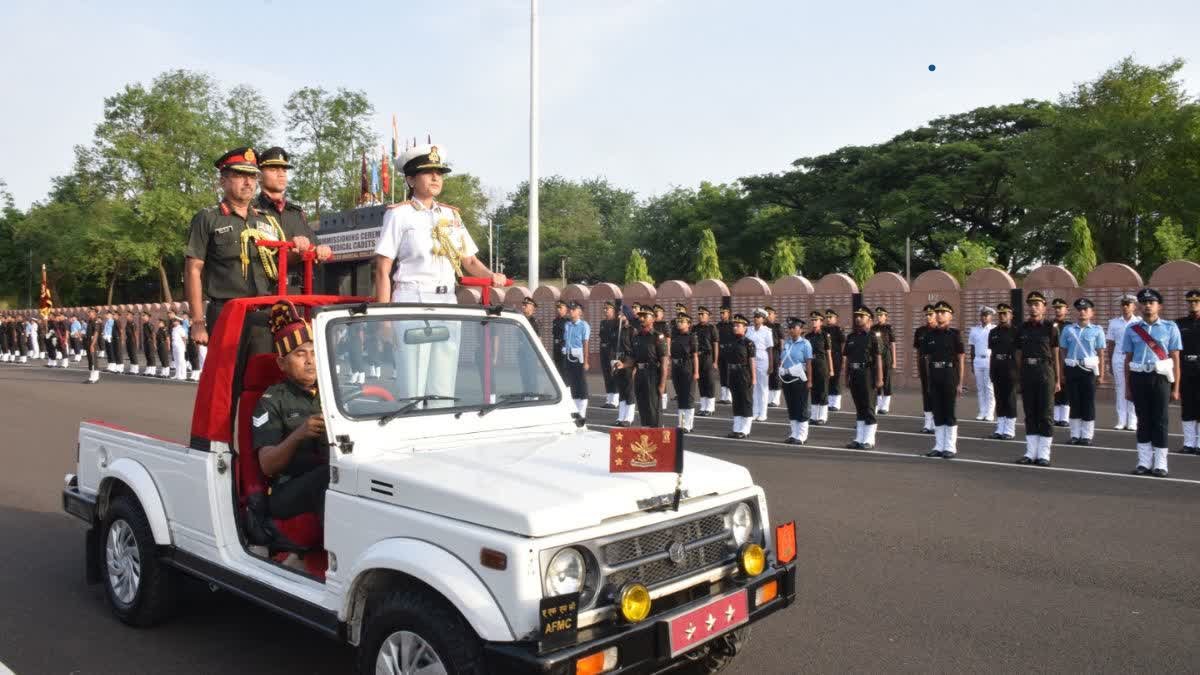

From military surgeon to the first woman Director General of the Armed Forces Medical Services, Surgeon Vice Admiral Arti Sarin speaks about military healthcare, innovation, AI, battlefield medicine and opportunities for women in the armed forces
New Delhi: From serving as a military surgeon to becoming the first woman Director General of the Armed Forces Medical Services (DG AFMS), Surgeon Vice Admiral Arti Sarin has built a distinguished career at the intersection of medicine, leadership and military service.
Recently honoured with the Param Vishisht Seva Medal (PVSM) by President Droupadi Murmu, Sarin has played an important role in strengthening healthcare for serving personnel, veterans and their families. She has also focused on technology, digitisation, training, research and innovation to prepare military medicine for future challenges.
In an extensive interaction, Sarin spoke about her journey, the changing nature of battlefield medicine, mental health, artificial intelligence, humanitarian missions, healthcare for veterans and the growing role of women in the armed forces.
Q: President Droupadi Murmu recently honoured you with the Param Vishisht Seva Medal. What was your first reaction?
Arti Sarin: I was extremely happy when I heard the news. I see this honour as recognition of the entire service. It belongs to my team and to all those across the three services who have worked hard to provide the best possible medical care to soldiers, sailors, airmen, their families and veterans.
Q: As the first woman Director General of the Armed Forces Medical Services, did you ever imagine reaching this position?
Arti Sarin: No. When I entered college, I had never imagined that I would eventually follow this path.
I simply enjoyed my work and continued progressing in my career. When I became Commandant of the Armed Forces Medical College, someone wrote a very memorable poem saying that although the girls’ hostel was very close to the Commandant’s office, it had taken 38 years for a woman to reach that office.
Q: Medicine is often described as a calling. How do you view yourself as a medical professional serving in the armed forces?
Arti Sarin: It is certainly a calling. As a child, like everyone else, I had certain aspirations. I wanted to become a doctor because I liked helping people.
Initially, the goal is to study well, clear the required stages and become a doctor. During internship, the focus shifts towards learning. It is a period when you can ask questions and develop your skills.
When you join the Armed Forces Medical Services and receive your first posting, you may be sent to a small or remote station with limited resources. You learn to think collectively, make decisions and work with what is available.
The goals may change at different stages of your career, but the central objective remains the same — to provide the best possible care to the patient, whether you are working in a hospital, a field hospital, a remote location, at sea or at a distant air base.
Q: The armed forces and medical services have changed significantly over the past four decades. What has been the biggest change?
Arti Sarin: The medical field has changed tremendously across the world, particularly over the past decade.
We have two broad responsibilities. One is our peacetime responsibility, which involves providing healthcare to serving personnel — including those requiring treatment, rehabilitation or specialised care.
We also have a responsibility towards veterans and the families of personnel.
Therefore, we need to maintain excellent and modern medical facilities because our soldiers deserve the very best healthcare.
Q: Why did it take so long for the armed forces to appoint the first woman DG AFMS?
Arti Sarin: Women have been part of the Armed Forces Medical Services since the 1950s.
Our first woman Major General was Major General Nirmala Huzha, who became a Major General in 1987 and commanded the 900-bed Command Hospital in Lucknow.
In 2004, Surgeon Vice Admiral Punita Arora became the first woman three-star officer and went on to become Commandant of AFMC and Director General Medical Services of the Navy.
She was followed by Air Marshal Padma Bandopadhyay, another three-star woman officer who became Director General Medical Services of the Indian Air Force.
So women have consistently been given responsibilities. Sometimes appointments depend on vacancies, timing and other circumstances. I feel fortunate that I received this opportunity.
Q: What is the difference between civilian hospitals and military medical facilities?
Arti Sarin: If you ask me, there isn’t a huge difference in terms of medical care.
However, as armed forces doctors, we are privileged to wear two highly respected uniforms — the white coat and the military uniform.
We also bring certain aspects of military training into healthcare, particularly leadership, discipline and the ability to function effectively as a team.
Q: As warfare changes rapidly, how is AFMS adapting to new types of injuries and battlefield medical care?
Arti Sarin: We are focusing on a combination of trauma care and remote care.
We are improving our systems for casualty evacuation, point-of-care treatment and prolonged casualty care.
One of our priorities is reducing evacuation time. We are also strengthening training through cross-training so that personnel can perform tasks beyond their primary roles when required.
We are also providing Battlefield Nursing Assistant training, which prepares soldiers to provide immediate assistance and basic care to their injured colleagues.
Q: How does AFMS support the mental health of injured soldiers?
Arti Sarin: Our training focuses on both physical and mental resilience.
We have different training modules designed to build these qualities, and such training is conducted periodically throughout an individual’s career.
The objective is to ensure that personnel are prepared not only physically but also psychologically for demanding operational environments.
Q: AFMS has increasingly embraced research and innovation. Which areas are you most excited about?
Arti Sarin: We have recently received greater opportunities to expand our research and innovation activities.
We have been working with institutions including ICMR, IIT Madras, IIT Kanpur, IIT Delhi and the Indian Institute of Science in Bengaluru.
I cannot disclose the specific areas because research subjects are not normally revealed before the appropriate stage.
We are also working with DRDO, and we are waiting for the results of several projects.
Q: What lessons did AFMS learn from the COVID-19 pandemic?
Arti Sarin: COVID-19 taught us that even if we are completely prepared, we can face situations that are unprecedented and where we may initially know very little about the threat or how best to deal with it.
The most encouraging aspect was the human response.
Doctors, nurses and allied healthcare professionals stepped forward and gave their best even though they knew they could also be exposed to risk.
We also received tremendous support from our non-medical colleagues in the armed forces. Whenever we needed them, they provided logistical support, while we focused on providing medical support.
Q: Is there a particular COVID-19 experience that has stayed with you?
Arti Sarin: Yes. During the peak of the second wave in 2021, I was the Commanding Officer of INHS Asvini, a 875-bed hospital.
At that time, oxygen shortages were affecting the entire country. We had anticipated the possibility and planned ahead.
Arranging an oxygen supply from Jamnagar was a major effort for me and my hospital, and our non-medical colleagues in Jamnagar played an important role.
The oxygen reached us within 24 hours.
It remains a powerful reminder that when people are determined to accomplish something and work together, extraordinary results are possible.
Q: What new initiatives are being planned for veterans’ healthcare and welfare?
Arti Sarin: Veterans are being looked after very well.
We have enormous respect for people who have devoted their lives to serving the country.
The individual services have their own departments and cells, now led by senior officers, which address different aspects of veterans’ welfare.
Q: What would you tell young women who want to join the armed forces but are concerned about safety and challenges?
Arti Sarin: I would tell every young woman that if I had to make the choice again, I would do exactly the same thing.
For a doctor or medical officer, this is one of the best career options, regardless of whether you are a man or a woman.
AFMS is an organisation where there is no discrimination based on gender.
Students can join AFMC or enter the services as medical graduates through the Short Service Commission. There are opportunities to pursue postgraduate education.
Those on Permanent Commission can pursue super-specialisation and subsequently take on leadership responsibilities and progress to higher ranks.
Q: AFMS has played a major role in humanitarian missions. Could you share a memorable experience?
Arti Sarin: Apart from its role during peace and conflict, the Armed Forces Medical Services has always contributed to humanitarian assistance and disaster relief, commonly referred to as HADR missions.
We have been doing this for many years.
One important example is the 60 Para Field Hospital, part of the Army Medical Corps under the Indian Army’s 50 Para Brigade.
It has a long and distinguished history. The unit served in Korea during the 1950s and provided medical services there for four years.
Its contribution continues to be remembered in South Korea, including through memorials and other commemorations.
The mobile field hospital has also been deployed during the earthquake in Türkiye, during Operation Brahma in Myanmar, and with the Indian Navy during Operation Sagar Bandhu.
It was also deployed to Sri Lanka during the floods in December 2025.
More recently, the team travelled to Venezuela with a complete hospital and established the facility shortly after arriving.
Q: How did growing up in a Navy family influence your journey?
Arti Sarin: My father was in the Navy, and I grew up in Visakhapatnam. Those were some of the most memorable years of my childhood.
I feel very fortunate to have grown up in a safe environment that felt like being part of a very large family. I also attended a wonderful school.
At home, there was never a sense that we were making some extraordinary sacrifice for the country. It was simply a way of life.
Serving the country meant living with discipline, being punctual and maintaining a professional appearance. Those qualities became part of me.
When I eventually thought about choosing a career, the decision became easier.
There were also young women doctors around me. I remember Surgeon Lieutenant Mala Pandey, who was my senior. Seeing her as a young doctor was probably one of the moments that influenced me and made me think that I wanted to follow a similar path.
Q: What inspired you to specialise in radiation oncology and Gamma Knife surgery?
Arti Sarin: Gamma Knife surgery and oncology treatments are highly precision-based.
The focus is on achieving the best possible outcome for the patient while minimising long-term side effects.
The same principles of precision, speed and decision-making can be applied in operational environments, humanitarian missions and situations where critical decisions have to be made very quickly.
Q: What gives you the greatest satisfaction today?
Arti Sarin: I have been able to introduce a lot of technology and strengthen the preparedness of my hospitals.
I have changed several training practices and introduced new systems, particularly digitisation.
It gives me great satisfaction that I have been able to make even a small contribution towards improving the Armed Forces Medical Services and providing better healthcare to soldiers, sailors and airmen.
They truly deserve it.
Q: How will AI shape the future of military medicine?
Arti Sarin: Artificial intelligence will be particularly useful in areas such as diagnostics, pathology and radiology.
It can draw attention to issues that might otherwise take considerable time to identify and can significantly improve efficiency.
AI can also reduce the amount of administrative and clerical work doctors have to perform.
This would allow doctors to spend more time with patients — examining them, speaking with them and understanding their needs — rather than spending excessive time on paperwork.
Q: Do you believe women will one day command all three services?
Arti Sarin: Yes, absolutely.
Women are already being trained and provided with opportunities.
I am confident that this will happen, and I look forward to the day when we see women occupying the highest positions in all three services.
Q: How can India address the growing burden of lifestyle diseases?
Arti Sarin: Non-communicable diseases such as diabetes, hypertension, cardiovascular disease and cancer are major concerns.
The answer is to move from a reactive approach to a proactive approach.
Prevention, healthy lifestyles and changes in daily habits can help reduce the burden of several diseases.
This needs to begin early — even at the school level.
Children should particularly be made aware of obesity, which is becoming an increasingly important health concern in India.
Q: What is your message on increasing cancer awareness in India?
Arti Sarin: We need to change our lifestyles.
We should avoid carcinogenic substances such as tobacco and educate people about their harmful effects.
Awareness needs to be created across society so that people understand the long-term health risks associated with these substances.
Q: How is military medicine preparing for modern warfare challenges such as drones and cyber threats?
Arti Sarin: Technology is being examined for applications such as logistics, delivery of blood and medicines, and potentially evacuating personnel.
At present, using drones to safely evacuate a person remains challenging because of weight limitations.
We are therefore studying developments and technologies being adopted by other countries and assessing how they may be adapted for our own requirements.
A vision centred on soldiers and better healthcare
Surgeon Vice Admiral Arti Sarin’s career reflects the changing role of military medicine — from traditional battlefield healthcare to advanced trauma care, remote medicine, digital healthcare, AI, research, innovation and humanitarian assistance.
Her emphasis remains firmly centred on one objective: ensuring that soldiers, sailors, airmen, veterans and their families receive the best possible medical care.
Her journey also highlights the expanding opportunities for women in the armed forces and the possibility of women taking on increasingly senior leadership roles across India’s defence services.