
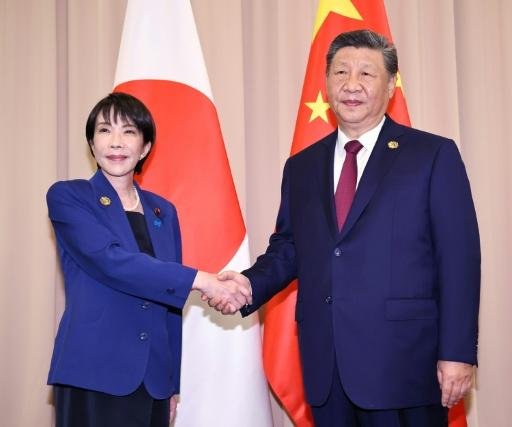
Gyeongju, South Korea – Japan’s new Prime Minister Sanae Takaichi said on Friday she raised “serious concerns” about China’s actions in the South China Sea, as well as the situations in Hong Kong and Xinjiang, during her first meeting with Chinese President Xi Jinping.
Speaking on the sidelines of the APEC summit in South Korea, Takaichi described the talks as “candid,” saying it was important for both sides to engage in direct dialogue despite deep differences.
“We expressed serious concerns regarding actions in the South China Sea, as well as the situations in Hong Kong and the Xinjiang Uyghur Autonomous Region,” she told reporters.
President Xi, according to Chinese state media, urged Japan to maintain a “correct understanding” of China and to uphold the principles of peaceful and cooperative bilateral relations. He also called on Japan to “adhere to clear provisions on major issues such as history,” a reference to longstanding disputes over Japan’s wartime past.
Takaichi, known for her strong stance on China and support for Taiwan, said she also raised issues including Chinese export controls on critical materials such as rare earths, the detention of Japanese citizens in China, and the need to ensure the safety of Japanese nationals living there.
She further mentioned discussing the Senkaku Islands—known as the Diaoyu Islands in China—where both nations regularly face maritime confrontations.
“Regarding Taiwan, there was some discussion from the Chinese side,” Takaichi said. “I stated that for regional stability and security, maintaining good cross-strait relations is important.”
The meeting marked the first direct encounter between Xi and Takaichi since she became Japan’s first female prime minister. Analysts described the discussion as “frosty but necessary,” given Takaichi’s reputation as a China hawk and her close ties to former Prime Minister Shinzo Abe.
Japan has been bolstering defense cooperation with the United States, hosting around 60,000 U.S. troops and expanding its military spending to 2 percent of GDP—two years ahead of schedule. Earlier this week, Takaichi hosted former U.S. President Donald Trump aboard an American aircraft carrier in a show of alliance solidarity.
Despite ongoing tensions, both leaders signaled a willingness to keep communication channels open. “Overall, stability remains a shared priority,” said Yee Kuang Heng, professor at the University of Tokyo’s Graduate School of Public Policy.
Takaichi Raises ‘Serious Concerns’ with Xi Over South China Sea, Hong Kong, and Xinjiang



advertisement


Letest Post