

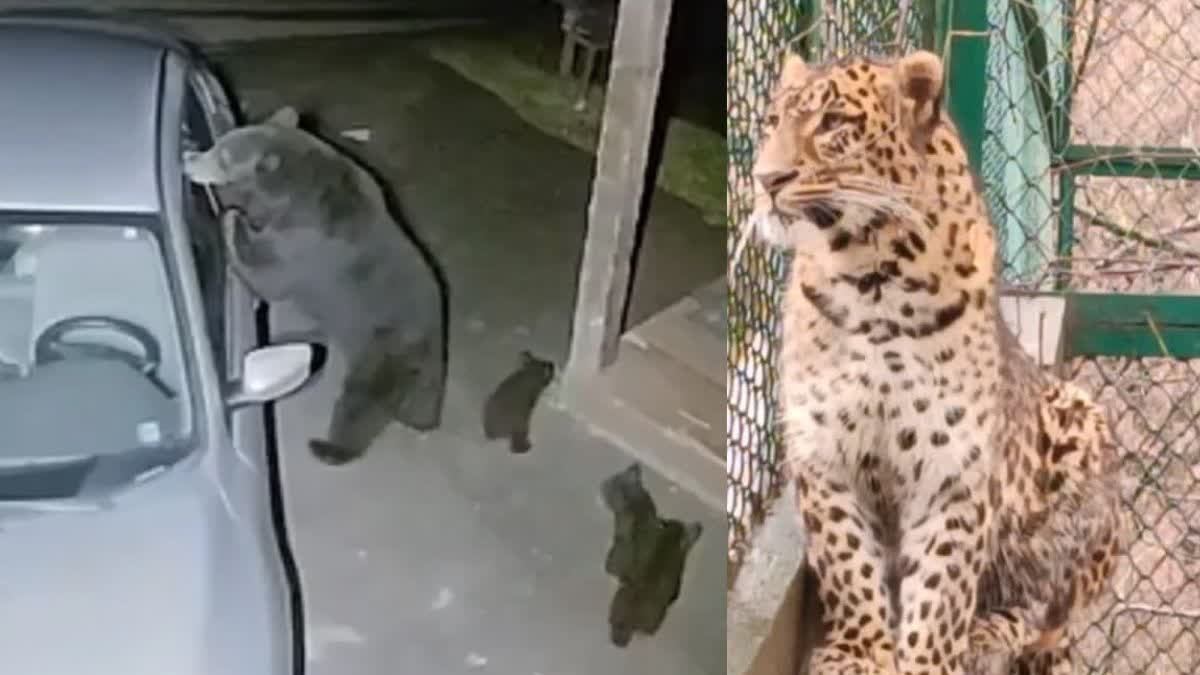

Srinagar, Jammu & Kashmir, India: Human-wildlife conflict has emerged as one of the most serious environmental and public safety challenges in Jammu & Kashmir, with official records revealing more than 17,200 incidents between 2020 and July 2025. The increasing encounters between people and wild animals have resulted in over 100 fatalities and approximately 1,100 injuries, raising concerns among conservationists, government officials, and local communities.
According to data compiled by the Jammu & Kashmir Wildlife Protection Department, the majority of attacks have involved Asian black bears and common leopards, particularly in the Kashmir Valley and parts of the Jammu region.
Habitat Loss Driving Wildlife Toward Human Settlements
Officials say the rise in conflicts is largely due to:
- Rapid land-use changes
- Shrinking forest habitats
- Habitat degradation
- Reduced natural food sources
- Expansion of human settlements near forests
- Increasing human activity inside forest ecosystems
As natural habitats continue to shrink, wild animals are increasingly entering villages, orchards, agricultural fields, and even urban neighborhoods in search of food.
In a report submitted to the National Green Tribunal (NGT), the Wildlife Protection Department described human-wildlife conflict as one of the region’s most significant conservation challenges.
The report noted that Asian black bears and leopards are responsible for most attacks on humans, while also causing substantial damage to standing crops and livestock.
North Kashmir Reports Highest Number of Incidents
Official figures obtained from the department indicate that:
- More than 8,000 incidents occurred in North Kashmir, accounting for nearly half of all reported cases.
- South Kashmir recorded over 6,600 incidents, with Shopian district alone reporting more than 2,900 cases.
- Central Kashmir documented approximately 630 incidents during the same period.
Government statistics also show that during the last two financial years, authorities registered 15,661 human-wildlife conflict cases.
Although reported incidents declined from 9,301 cases in 2023–24 to 6,360 cases in 2024–25, fatalities and injuries continued to occur.
Casualty Statistics
2023–24
- 18 people killed
- 137 people injured
2024–25
- 14 people killed
- 213 people injured
Daily Life Disrupted in Rural Communities
The impact extends far beyond official statistics.
Residents living near forests have significantly changed their daily routines:
- Orchard owners avoid entering apple orchards during early mornings and after sunset.
- Farmers harvesting maize, walnuts, and other crops often travel in groups to reduce the risk of bear attacks.
- Families remain cautious throughout the fruit-growing season when bears descend from higher forests in search of food.
Emergency Wildlife Rescue Operations Intensified
Wildlife officials regularly respond to emergency calls involving bears entering:
- Homes
- Schools
- Cowsheds
- Commercial buildings
Similarly, leopards are increasingly being reported inside villages, towns, and the outskirts of cities.
To improve emergency response, the Wildlife Protection Department has significantly strengthened its rescue infrastructure.
Authorities have established approximately 50 wildlife control rooms operating 24 hours a day across the Union Territory.
These facilities are equipped with:
- Tranquilizer guns
- Capture nets
- Rescue cages
- Veterinary medicines
- Rescue vehicles
- Specialized response teams
Rapid Response Teams now operate across vulnerable districts to safely capture dangerous animals, relocate them to suitable habitats, and prevent attacks whenever possible.
Government Expands Prevention Measures
Over the past five years, authorities have implemented several initiatives aimed at reducing conflict, including:
- Installing capture cages in vulnerable locations.
- Conducting habitat improvement projects.
- Expanding wildlife rescue centers.
- Launching public awareness campaigns in high-risk villages.
According to the Forest, Ecology and Environment Department, officials organized 553 awareness programs, reaching approximately 6,923 people over five years.
Compensation for Victims
The administration has also provided financial assistance to victims and their families.
Official records show:
- ₹40.5 lakh paid as ex gratia compensation in fatal cases.
- More than ₹1.34 crore provided to individuals injured in wildlife attacks over the last five years.
Recent Incidents Highlight Continuing Risk
Several recent incidents demonstrate the ongoing danger.
Earlier this month, a man was killed by a wild animal while working in an orchard in Kulgam district, only days after wildlife officials rescued a leopard that had entered a nearby residential area.
In June, a worker was injured by an Asian black bear while performing night-duty at the Royal Springs Golf Course in Srinagar.
During the current fruit season, wildlife teams also responded to numerous reports of Asian black bears entering orchards and residential neighborhoods in Ganderbal, Kupwara, and Baramulla districts.
Using tranquilizers and specialized cages, officials safely captured several animals and relocated them back into nearby forests.
Seasonal Patterns Increase Encounters
Wildlife officials explained that conflicts increase significantly during the fruit-bearing season, when bears descend from higher elevations searching for food.
Most bear-related emergencies occur between spring and autumn, when:
- Apple orchards become attractive food sources.
- Maize fields provide additional feeding opportunities.
- Villages located near forests become particularly vulnerable.
Leopards present a different challenge.
Officials report that many leopards have adapted to living near human settlements, where stray dogs and domestic animals provide an abundant food source.
Experts Call for Long-Term Solutions
Wildlife researcher Mansoor Sofi said the growing conflict reflects increasing pressure on natural ecosystems.
He explained that land-use changes, habitat degradation, and climate change have placed enormous stress on wildlife habitats.
According to Sofi, long-term solutions should focus on:
- Scientific monitoring
- Habitat restoration
- Community participation
- Conflict mitigation strategies
rather than relying solely on rescue operations and compensation.
He stressed that:
“Sustainable coexistence requires protecting both wildlife and local communities simultaneously.”
Scientists Warn Conflict Could Increase Further
Irfan Jeelani, an ornithologist and founder of the Birds of Kashmir group, warned that human-wildlife encounters are likely to become even more frequent.
He attributed the trend to:
- Conversion of agricultural land into fruit orchards.
- Expansion of orchards along forest edges.
- Fencing within forests that disrupts traditional wildlife movement corridors.
Meanwhile, Professor Khurshid Ahmad Shah, Head of the Department of Wildlife Sciences at Sher-e-Kashmir University of Agricultural Sciences and Technology (SKUAST-Kashmir), said many leopards have successfully adapted to living close to urban populations.
According to Shah, some leopards now breed near human settlements and primarily prey on stray dogs, while orchards provide year-round cover and food opportunities.
Alia Mir, Education Officer and Program Head at Wildlife SOS Jammu & Kashmir, emphasized that rescue operations alone cannot solve the crisis.
She explained that human-wildlife conflict is a complex landscape management challenge driven by the interaction of:
- Wildlife behavior
- Human activities
- Changing land use
- Availability of food resources
She called for stronger cooperation among government agencies, local communities, scientists, and frontline wildlife staff, along with improved training, scientific monitoring, awareness campaigns, and better management of food sources that attract wild animals.
American Perspectives
Dr. Emily Carter, a wildlife ecologist from Montana, said the rising number of encounters reflects a global conservation challenge.
“When forests become fragmented and natural food sources decline, animals inevitably move closer to human communities. Long-term coexistence depends on habitat restoration, scientific planning, and public awareness—not simply relocating animals after conflicts occur,” Dr. Carter said.
Michael Reynolds, a conservation policy expert from Colorado, stressed that protecting both wildlife and people requires coordinated action.
“Successful conservation must balance ecological protection with community safety. Investments in wildlife corridors, early-warning systems, rapid response teams, and local education can significantly reduce human casualties while preserving biodiversity,” Reynolds noted.
Looking Ahead
As Jammu & Kashmir continues to witness increasing interactions between people and wildlife, authorities are expanding rescue operations, public awareness campaigns, and habitat management initiatives. Conservation experts agree that while emergency responses remain essential, lasting solutions will depend on restoring natural habitats, improving scientific wildlife management, and fostering peaceful coexistence between humans and wildlife in one of India’s most ecologically sensitive regions.