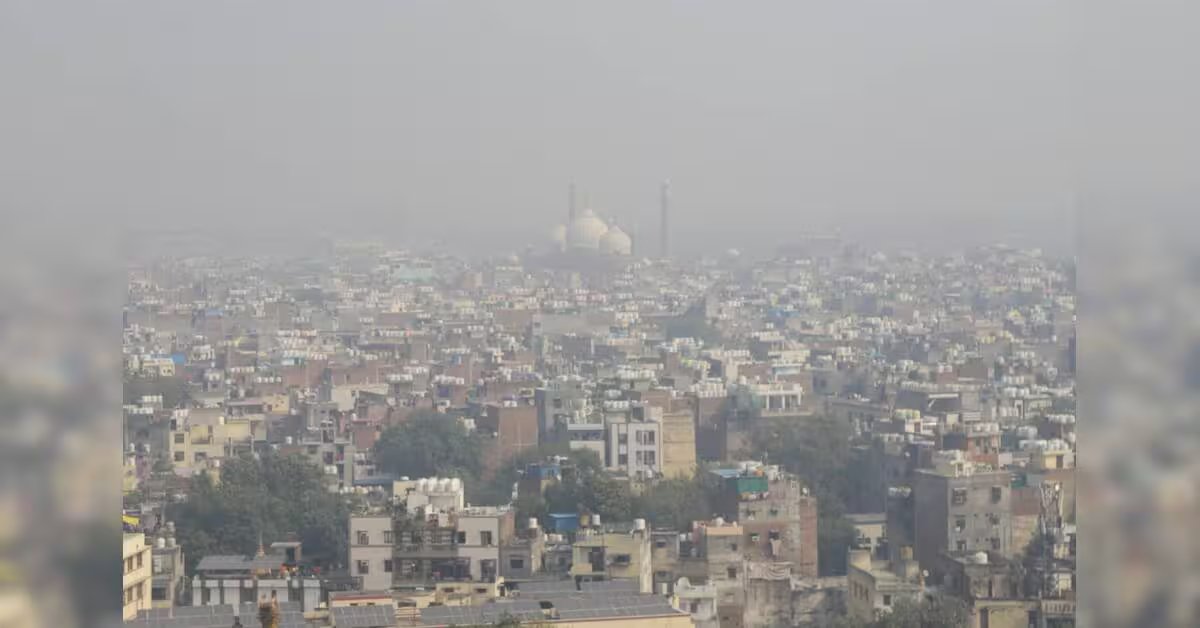

Delhi recorded its cleanest air this month on Tuesday, with the Air Quality Index (AQI) settling at 204 in the ‘poor’ category, offering some respite after days of deteriorating air quality, though the relief is likely to be short-lived.
The last time the national capital recorded a lower AQI was on October 31, when the index stood at 117 in the ‘moderate’ category. Tuesday’s reading was the lowest recorded in November, making it the least polluted day of the month so far.
The relatively better air quality on Tuesday was partly due to favourable meteorological conditions, the Air Quality Early Warning System said.
Northwesterly winds reaching speeds of up to 15 kmph and a mixing depth of around 1,500 metres helped disperse pollutants.
Mixing depth refers to the height up to which pollutants can disperse and mix in the atmosphere. A lower mixing depth restricts the vertical movement of pollutants, leading to their accumulation closer to the ground and potentially worsening air quality.
Of the 58 air quality monitoring stations that recorded data, 31 were in the ‘poor’ category, 26 recorded ‘moderate’ air quality and one station, Sirifort, was in the ‘very poor’ category with an AQI of 303.
The national capital has remained shrouded in haze and elevated pollution levels through much of November, with air quality deteriorating during both the pre- and post-Diwali period. Tuesday’s reading offered some respite from the prolonged spell of poor air quality.
PM2.5 remained the dominant pollutant in the city. Particulate matter 2.5 refers to fine inhalable particles measuring 2.5 micrometres or less in diameter. These particles can penetrate deep into the lungs and even enter the bloodstream, posing risks to human health.
According to the Air Quality Early Warning System, secondary organic aerosols were the largest contributor to Delhi’s real-time PM2.5 concentration on Tuesday, accounting for 32.2 per cent of the estimated pollution load.
Biomass burning, which includes stubble burning and the use of domestic solid biofuels such as wood and dung cakes, contributed 18 per cent, while waste burning accounted for 15.7 per cent and vehicular emissions for 14.5 per cent.
Secondary inorganic aerosols contributed 11.9 per cent, followed by coal combustion at 2.9 per cent, firecrackers at 2.3 per cent, industrial sources at 1.7 per cent and road dust and soil at 0.7 per cent, the system’s estimates showed.
However, the respite is likely to be temporary, with the Air Quality Early Warning System forecasting that Delhi’s air quality may deteriorate to the ‘very poor’ category on Wednesday and remain in the category on Thursday.
The predicted maximum mixing depth over Delhi is around 1,500 metres on November 17 and 1,400 metres on November 18.
The ventilation index, which indicates the atmosphere’s capacity to disperse pollutants, is also expected to decline from around 6,200 square metres per second on Tuesday to 4,000 square metres per second on Wednesday, the system said.
A ventilation index below 6,000 square metres per second, coupled with an average wind speed of less than 10 kmph, is considered unfavourable for the dispersion of pollutants, the Air Quality Early Warning System said. Such conditions restrict the movement of polluted air, allowing pollutants to accumulate and potentially push the AQI higher.
Meanwhile, Delhi’s AQI stood at 238 at 8 am on Tuesday, in the ‘poor’ category, according to the Central Pollution Control Board (CPCB).
Of the 58 monitoring stations that recorded data in the morning, 32 were in the ‘poor’ category, 16 in the ‘moderate’ category and 10 in the ‘very poor’ category. Sirifort recorded the worst air quality, with an AQI of 333.
According to the CPCB’s classification, an AQI between zero and 50 is considered ‘good’, 51 and 100 ‘satisfactory’, 101 and 200 ‘moderate’, 201 and 300 ‘poor’, 301 and 400 ‘very poor’, and 401 and 500 ‘severe’.