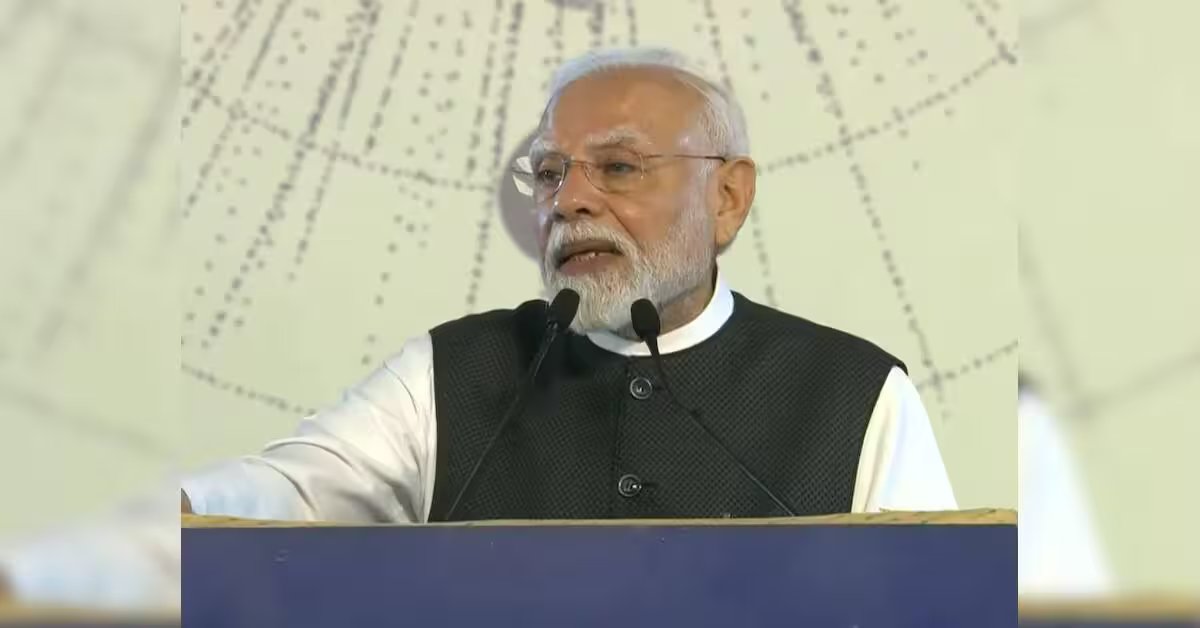

Prime Minister Narendra Modi on Friday said his government’s opening up of India’s space sector to private players has enabled young people to develop and launch rockets, place satellites in orbit, and undertake initiatives that had never been seen in the country before.
Addressing a gathering after inaugurating the COSMOS-Mysuru Planetarium in Karnataka, he said India’s space programme had made progress in several areas, including solar observation, space docking and human spaceflight. He also referred to the use of satellite technology in agriculture, railway operations and the safety of fishermen.
Private participation and India’s space missions
PM Modi cited the Aditya-L1 mission, India’s first space-based solar observatory, and Chandrayaan-3, which made India the first country to land a space vehicle near the Moon’s south pole.
“With Aditya-L1, India has acquired its first solar observatory in space. Just last year, India became the fourth nation in the world to demonstrate the capability for docking and undocking in space,” he said.
PM Modi also referred to Group Captain Shubhanshu Shukla’s visit to the International Space Station (ISS), where he conducted scientific experiments. The experience gained from the mission, he said, is contributing to the country’s human spaceflight programme, Gaganyaan.
Satellite technology used in public services
PM Modi also spoke about the application of space technology in services on the ground.
He said Indian Space Research Organisation (Isro) had developed a satellite communication system for fishermen, allowing boats equipped with receivers to receive alerts during storms and enabling their movements to be monitored for safe returns to shore.
He cited the real-time train tracking system developed by Indian Railways and ISRO, which allows passengers to check train locations and arrival times.
Satellite data is also used under the Pradhan Mantri Fasal Bima Yojana (PMFBY), where information collected from fields is combined with satellite imagery to estimate crop yields. These estimates are used to determine farmers’ insurance claims.
“In short, while our satellites are reaching great heights in space, they are simultaneously being used to improve the lives of people here on Earth,” Modi said.
Shivakumar seeks Centre’s support for Mekedatu project
Karnataka Chief Minister D K Shivakumar, also present at the event, seized the opportunity to urge the Prime Minister to help the state secure the necessary clearances for the Mekedatu balancing reservoir project.
Addressing the gathering, Shivakumar said Karnataka wanted the Union government to grant the final forest clearance for the project. He also sought legal support from the Centre.
“The Supreme Court has delivered a clear verdict that Mekedatu has to be built in Karnataka, and no one can stop it. We want you to help us legally. We want the Union Government to grant final clearance on the forest clearances that have been done. It is a vital balancing reservoir,” he said, urging the Centre and the state government to work together on the project.
PM inaugurates COSMOS-Mysuru Planetarium
PM Modi inaugurated the COSMOS-Mysuru Planetarium on the University of Mysore campus, at the foothills of Chamundi Hills. The facility is India’s first LED dome planetarium.
Built by the Indian Institute of Astrophysics, the planetarium has a 15-metre tilted dome comprising around 6,150 panels and 4.2 crore individual LEDs. Its LED panels can be controlled in real time, unlike conventional planetariums that use projectors to display images on a passive dome, according to the Prime Minister’s Office.
The facility is designed to support astronomy education and training. It also houses exhibition halls, an astronomy museum, a lecture hall, a training centre and interactive outdoor exhibits.
Calling it a facility dedicated to young people and citizens, PM Modi said: “I just had the opportunity to watch a show inside it, and it was a truly remarkable experience.”
He also referred to India’s performance at the International Olympiad on Astronomy and Astrophysics. Five Indian students participated in the latest edition held in Vietnam, with four winning gold medals and one securing a silver medal, he said.