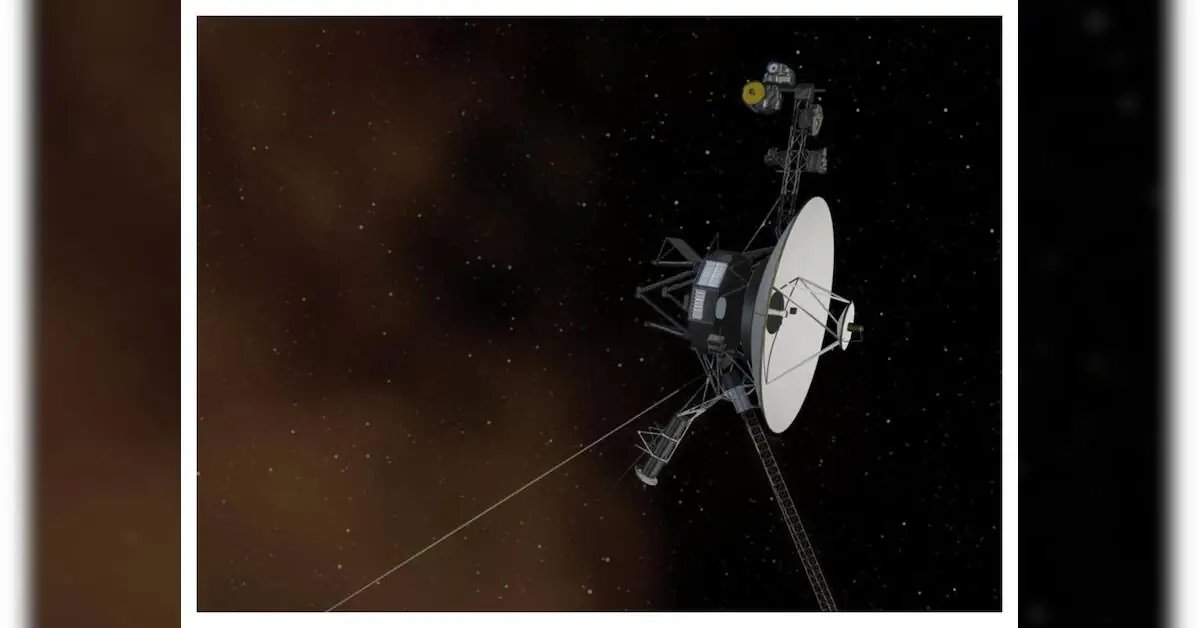

The probe will reach the landmark on Wednesday, November 18, at a distance of about 25.9 billion kilometres from Earth. A light-day is the distance light travels in 24 hours. At Voyager 1’s distance, even a radio signal travelling at light speed would take a full day to reach the spacecraft.
A mission that refuses to stop
Voyager 1 was launched on September 5, 1977, to study the outer planets. It flew past Jupiter and Saturn, sending back images and data that helped scientists understand these distant worlds.
But the spacecraft kept going.
In 2012, Voyager 1 became the first human-made object to enter interstellar space, the region beyond the Sun’s protective bubble of particles and magnetic fields.
Nearly 50 years and counting
Voyager 1 was never expected to operate for this long. Its extended journey has turned it into one of humanity’s longest-running space missions and a test of how long spacecraft can survive in the harsh conditions of deep space.
Its twin, Voyager 2, is also in interstellar space but is expected to reach the one-light-day milestone around 2035.
When distance becomes a communication problem
Voyager 1’s one-light-day milestone also illustrates the growing challenge of communicating with probes operating at such extreme distances.
A radio signal sent from Earth will take about 24 hours to reach Voyager 1. If the spacecraft receives a command and responds immediately, mission controllers will have to wait another day for that signal to return. A simple exchange could therefore take roughly 48 hours.
Voyager 1 is moving at 61,000 km/h, yet it will take about 40,000 years to come within 1.7 light-years of Gliese 445, the next star on its path. It will pass the star, not reach it.
Keeping a 1970s spacecraft alive in interstellar space
The milestone comes as engineers fight to keep Voyager 1 running. Its plutonium-powered generators weaken every year, so Nasa has been switching off equipment to stretch the mission, deciding which instruments and systems can stay on.
In September, the team completed a major power-saving move nicknamed the “Big Bang”. It shut down three devices and handed their jobs to lower-power alternatives. In October, a brief communications interruption was fixed after about 48 hours.
A message to the universe, carried for generations
Voyager 1 is also carrying something that makes its journey more than a scientific expedition. Attached to it is the Golden Record, a collection of sounds, music, images and greetings from Earth, meant to tell any alien civilisation that finds it something about humanity.
The disc holds greetings in 55 languages, along with natural sounds, music and images of life on Earth.
The chances of anyone finding it are slim. But the record shows what the mission was about: sending a small piece of humanity into a universe too large to comprehend.
How far can Voyager 1 go?
The one-light-day milestone does not mean Voyager 1 is approaching the end of its journey. Voyager 1 will keep moving through interstellar space long after its instruments stop functioning and contact with Earth is lost.
Its power supply will eventually end the mission, but distance will not stop the spacecraft. Voyager 1 will continue drifting through the galaxy, carrying the Golden Record long after its final signal has been received.
Nearly five decades after launch, Voyager 1 is still exploring, still surprising and still travelling farther than any machine humanity has built.