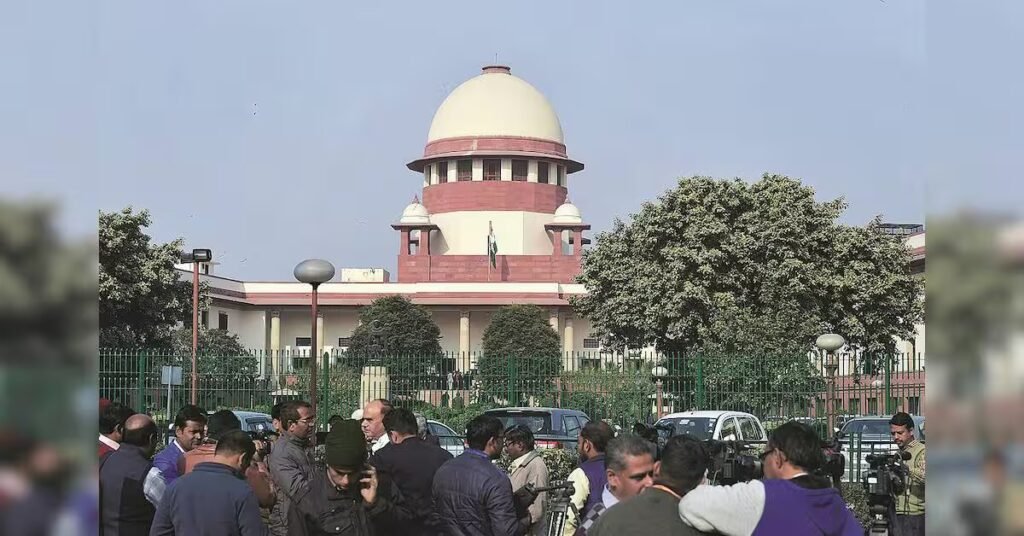
The Supreme Court on Monday suspended the life sentence of Irfan Siraj Pada, a convict in the 2002 Godhra train burning case, on medical grounds, taking note of his prolonged incarceration and serious heart ailments.
A Bench of Justices MM Sundresh and PB Varale granted the relief after the Gujarat government confirmed that Pada’s medical condition was factually correct. The state had opposed the plea, citing the gravity of the crime and his conduct in prison, but acknowledged that he was receiving treatment for his cardiac ailments.
“In this application, primarily we find that the argument for bail is on medical grounds. The state submits that the condition of petitioner is factually correct. In view of the factual scenario, we are inclined to grant suspension of sentence on medical grounds,” the Bench said.
The order suspends Pada’s sentence while his appeal against the conviction remains pending. It does not amount to an acquittal or overturn the findings of the courts below.
State cites serious charges and conduct in prison
Gujarat standing counsel Swati Ghildiyal told the court that the case involved serious offences and submitted jail records to show that Pada had not maintained good conduct during his incarceration.
The state maintained that Pada was part of a mob armed with a sword that pelted stones at and damaged the railway coach. He was convicted of murder and criminal conspiracy, with both the trial court and the Gujarat High Court returning concurrent findings of guilt.
In an affidavit opposing the bail plea, the state described the offence as one of the gravest in nature. It said a mob of around 900 people, armed with deadly weapons, had attacked a passenger train, resulting in the deaths of 59 people, including women and children, who were burnt alive in the S-6 coach.
“The gravity of the offence and its impact on society are material considerations which weigh heavily against the grant of bail,” the state submitted.
The incident took place on February 27, 2002, when the S-6 coach of the Sabarmati Express, carrying passengers returning from Ayodhya, was set on fire near Godhra railway station. The mob allegedly bolted the compartment doors from outside, pelted the coach with stones and then set it ablaze. The incident triggered widespread communal violence across Gujarat.
Defence seeks relief on medical grounds
Pada’s counsel, senior advocate S Nagamuthu and advocate Qurratulain, told the court that the application was not based on the merits of the conviction but solely on his medical condition.
Nagamuthu submitted that Pada suffered from serious heart ailments and had spent more than 18 years in prison. The state confirmed that he was undergoing treatment in custody, including specialised care at a government super-speciality institute.
The Supreme Court took note of the undisputed medical condition while deciding the plea.
Parole violation and disciplinary action cited
The state also relied on Pada’s past conduct to oppose the application. It told the court that he had been released on parole for 14 days in October 2019 but failed to surrender at the end of the period.
According to the state, he remained absconding for 372 days and was brought back to prison in October 2020 after being arrested in connection with another case registered in Gujarat.
Jail authorities had described his conduct as “not good”, the state submitted. In September this year, Pada allegedly used abusive language against prison staff and attempted to attack a jail official with a carrom board. Following the incident, his canteen facility was withdrawn for three months.
The state further informed the court that his remission plea had been rejected while his appeal was pending. However, he had been granted interim bail on three occasions in the past to attend family functions, each time under police escort.
According to the state, Pada has served 18 years and three months in prison.
Conviction and pending appeal
Pada filed the bail application as part of his appeal against the Gujarat High Court’s October 2017 order, which upheld his conviction and life sentence.
A special trial court had convicted 31 people in March 2011 in connection with the train burning. Eleven were initially sentenced to death, while the remaining 20 were awarded life imprisonment. The court acquitted 63 other accused.
In October 2017, the Gujarat High Court commuted the death sentences of the 11 convicts to life imprisonment and upheld the life sentences imposed on the other 20. Appeals challenging the convictions have been pending before the Supreme Court.
The latest relief to Pada has been granted specifically on medical grounds, with the court taking into account his serious cardiac condition and lengthy period of incarceration.