

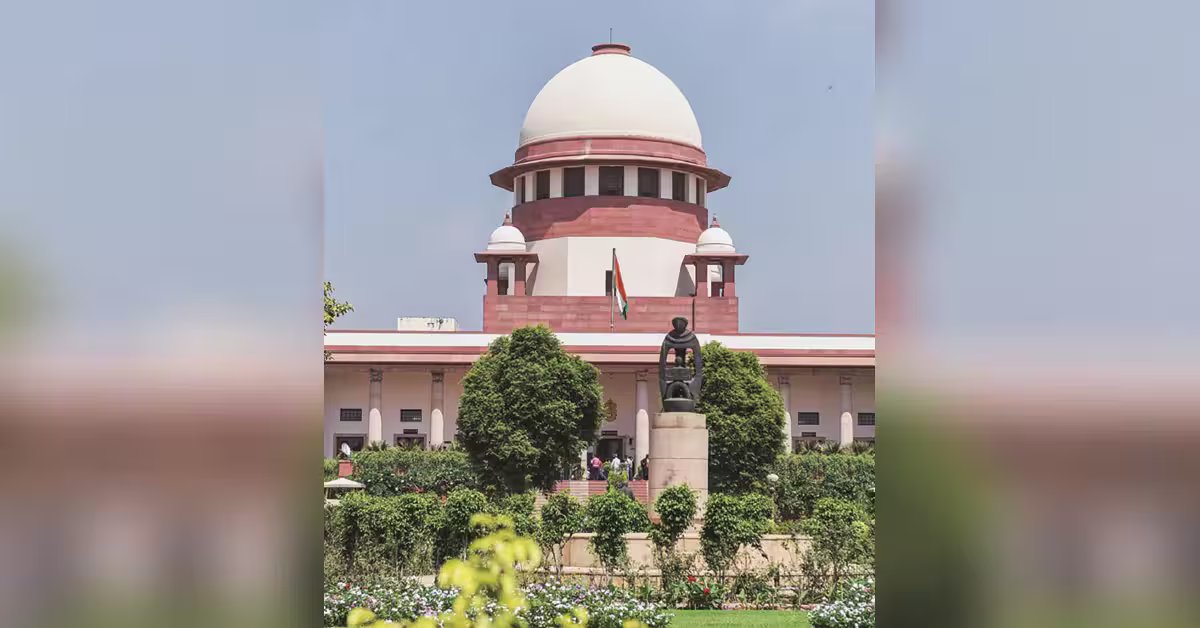

The Supreme Court on Wednesday sought responses from the Centre and its secretary general on a petition seeking greater transparency in judicial appointments, including bringing Collegium decisions within the ambit of the Right to Information (RTI) Act and finalising the Memorandum of Procedure (MoP) governing the appointment of judges to constitutional courts.
A Bench of Justices M M Sundresh and P B Varale issued notice on a plea filed by NGO Lok Prahari.
The petition also sought directions to the Chief Justice of India (CJI), in his administrative capacity, to initiate the process of revising the MoP in accordance with the Supreme Court’s 2015 judgment striking down the National Judicial Appointments Commission (NJAC).
During the hearing, Justice Sundresh initially questioned whether he should hear the matter, given his position as a member of the Supreme Court Collegium.
“Should we take this matter? Because I am also part of collegium,” he observed.
Senior advocate Sanjay Hegde, appearing for the petitioner, said he had no objection to the judge hearing the case, pointing out that several judges who might hear the petition would also be members of the Collegium.
“Many of your lordships will be members of collegium. That objection will never go away,” Hegde submitted.
The judge subsequently agreed to issue notice, while observing that the petition could have been drafted better. The court permitted the petitioner to file an amended plea.
The petition contends that the existing MoP lacks adequate transparency and objective criteria for selecting judges, affecting the quality of appointments and the performance of constitutional courts.
It argues that a clearly defined selection framework is necessary to safeguard litigants’ access to justice.
Lok Prahari has sought directions for the Centre’s Ministry of Law and Justice to finalise the MoP within a month of consulting the CJI. It has also urged that appointments be guided by the unanimous view of the Collegium, taking into account the principles laid down in the 2015 NJAC judgment.
The MoP was first framed in June 1999 following the Supreme Court’s directions in the Second Judges case. It prescribes the process for appointments to the higher judiciary under the Collegium system.
The framework came under scrutiny after Parliament enacted the NJAC Act in 2015, seeking to replace the Collegium with a commission comprising members of the judiciary and the executive.
However, a Constitution Bench of the Supreme Court struck down the law on October 16, 2015, holding that it violated the independence of the judiciary.
Following the verdict, the court invited suggestions to improve the Collegium system and, in December 2015, entrusted the Centre with revising the MoP. Differences between the government and the judiciary, however, delayed its finalisation.
In March 2017, the Supreme Court rejected the Centre’s proposal to give the government the power to reject candidates recommended for judicial appointments on grounds of national security. The court also did not accept the proposal for a permanent secretariat for the Collegium.
The delay prompted another round of judicial intervention in October 2017, when a Bench of Justices A K Goel and U U Lalit sought the Centre’s response on the prolonged delay in finalising the MoP.
The order, however, was subsequently recalled by a Bench headed by then CJI Dipak Misra.
Justice P S Narasimha had recused himself from the present matter when it was first taken up on November 2, citing his earlier appearance as an additional solicitor general in a similar dispute concerning the MoP.