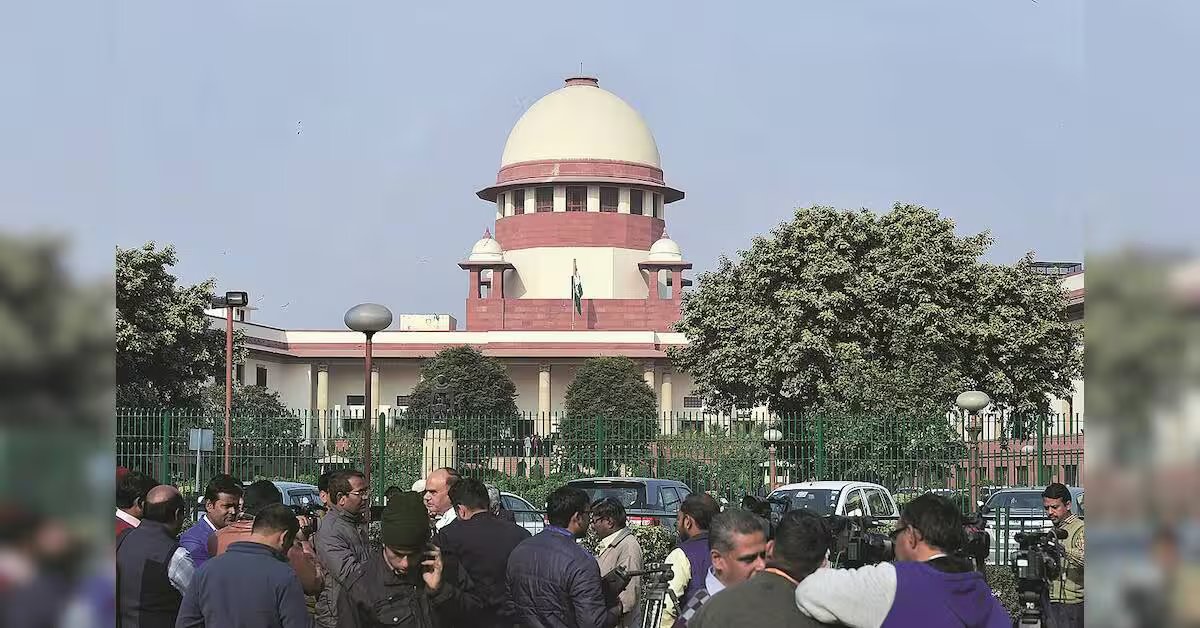

The Supreme Court on Tuesday reserved its verdict on a plea seeking stricter price controls on non-scheduled medicines and medical consumables, after questioning the Centre and private hospitals over steep mark-ups on essential drugs.
A bench comprising Justices Vikram Nath and Sandeep Mehta expressed concern over the wide gap between the prices at which medicines are procured and the amounts charged to patients, describing excessive hospital margins as “loot” and “dacoity”.
The court was hearing a public interest litigation filed by advocate Kishan Chand Jain, which seeks mandatory generic prescriptions, controls on the initial prices of non-scheduled medicines, and statutory limits on trade margins for medical devices under the Drugs (Prices Control) Order (DPCO).
During the hearing, the bench cited the example of a medical distributor whose wife was undergoing cancer treatment at a prominent private hospital. The distributor told the hospital that he could procure a chemotherapy injection for Rs 11,000, but the hospital charged Rs 1.3 lakh for the same medicine.
“Sir, I am myself a dealer and to me the (chemotherapy) injection comes at Rs 11,000 dealer price. The hospital refused to administer that injection and charged 1.30 lakh for that same injection. Can you show any justification for this loot, please? Why this difference? Where does the money go?” the court asked.
Additional Solicitor General Aishwarya Bhati, appearing for the Centre, told the bench that the government had been continuously reviewing and adjusting its pricing policies.
“Your calibration is too wayward. Rs 11,000 to Rs 1,30,000 is no calibration… When you talk of patients and life, should we have such capitalistic thinking?” the court remarked.
The bench pointed out that the Centre’s recent decision to cap trade margins on anti-cancer drugs at 30 per cent covered only a limited portion of the market. Nearly 90 per cent of medicines, it noted, remained outside the price control mechanism.
“Why is the DPCO in place at all? The government is allowing this to happen. There have been three parliamentary committees on this. And their outcome is not very convenient to people who pull the strings. Let us tell you,” the bench said.
The court also questioned the pricing of medical consumables, noting that saline drip lines with a price to the retailer of Rs 15 were being billed to patients at Rs 250.
It further observed that although government schemes such as Ayushman Bharat cover medical expenses up to Rs 5 lakh, families continue to face substantial hospital bills.
Senior advocate Mukul Rohatgi, representing private hospitals, argued that healthcare providers had to compensate for gaps in public healthcare infrastructure. He warned that forcing hospitals to reduce drug margins could undermine their operations.
“Hospitals will collapse. We cannot trust patients to bring medicine from outside. Half of the medicines in the market are anyway spurious. If I reduce drug prices, prices across the board will increase, won’t make any difference. I have to keep all my facilities functioning 24X7. I have to bear costs to keep the infrastructure ready,” Rohatgi argued.
The bench rejected this justification, saying hospitals could remain viable through other means.
“Hospitals can survive through other means. Not through this dacoity… You are a commercial hospital. You charge for everything. But why should medicine be quoted at 100, 200 times? There’s a component of corporate discount provided by manufacturers that is still under the cover. You can’t justify saying MRP is rightly quoted because I am running a private hospital,” the bench said.
The court also questioned the Centre’s reliance on market forces to explain the price differences, stressing that public health could not be treated as a commercial issue.
“You’re dealing with the lives of people. Don’t take it as commerce. There is no balancing at all,” it observed before reserving its verdict.