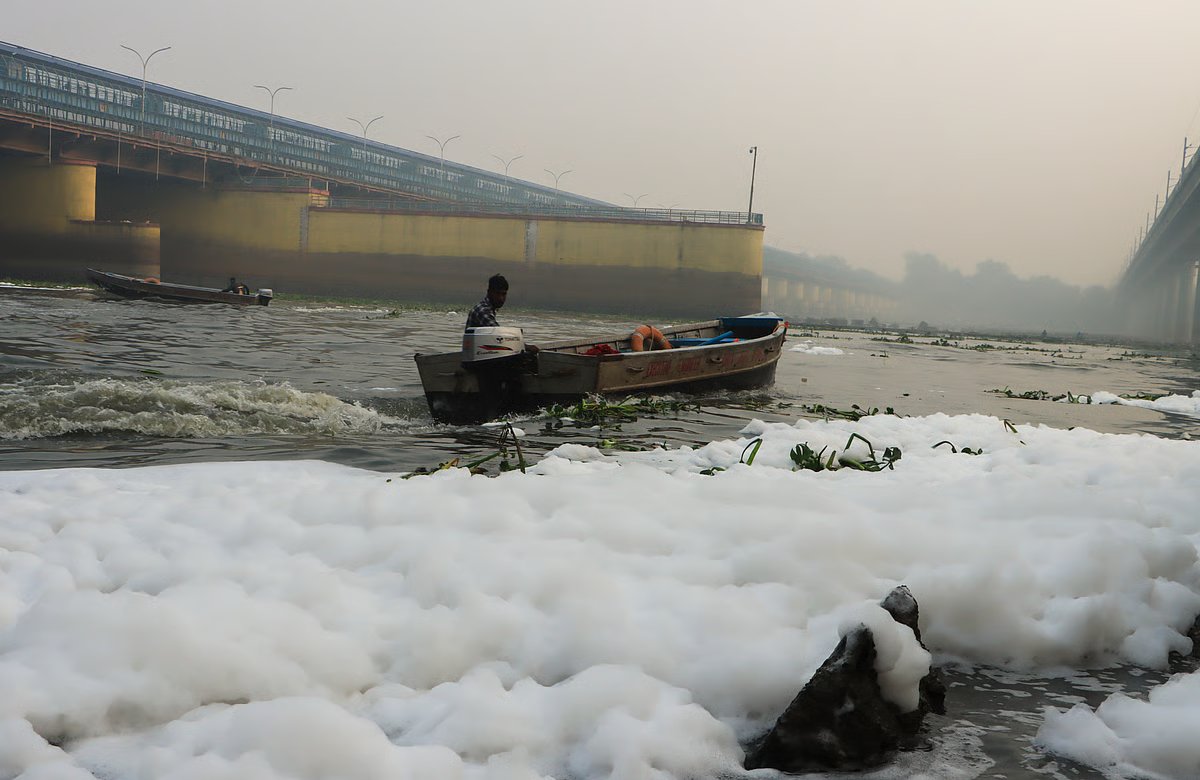

Microplastics in the Yamuna are accompanied by a complex mixture of organic chemicals, including pharmaceutical residues, pesticides and industrial pollutants, many of which are classified as potential hazards to human health and the environment, a new study by University of Delhi researchers has found.
Published in the Journal of Hazardous Materials Advances in September 2026, the study examined microplastic contamination and associated chemical profiles at eight locations along a 48.8-km stretch of the Yamuna in Delhi, from Palla, where the river enters the capital, to Asgarpur Jagir, where it exits.
The researchers recovered 2,289 microplastic particles from the samples, recording an average abundance of 3.18 particles per litre. Chemical analysis identified 321 distinct compounds, including 50 detected in extracts of recovered microplastic fractions at four or more sampling locations.
Of these 50 compounds, 36 corresponded to chemical structures carrying hazard classifications under the Globally Harmonized System (GHS), covering carcinogenicity, reproductive toxicity, acute toxicity and hazards to aquatic ecosystems.
𝟕 𝐜𝐡𝐞𝐦𝐢𝐜𝐚𝐥𝐬 𝐟𝐨𝐮𝐧𝐝 𝐚𝐭 𝐚𝐥𝐥 𝐬𝐢𝐭𝐞𝐬
The study identified seven compounds across all eight sampling locations, including 2-naphthylamine, lidocaine and monobutyl phthalate.
Researchers also detected pharmaceutical substances such as atomoxetine, domperidone and telmisartan, along with agrochemical-related compounds, including diuron and thiamethoxam.
The findings indicated that microplastic contamination in the river was accompanied by a diverse chemical mixture associated with domestic, agricultural and industrial activities.
Radhey Shyam Sharma, head of the Department of Environmental Studies at the University of Delhi and a co-author of the study, said the findings demonstrated the importance of examining the combined effects of pollutants rather than assessing microplastic particles in isolation.
“The microplastics problem, along with this cocktail of organic and inorganic substances, needs to be looked at through the lens of mixture toxicity. The land-use pattern has also been explored in the study,” Sharma said.
𝐏𝐨𝐥𝐥𝐮𝐭𝐢𝐨𝐧 𝐯𝐚𝐫𝐢𝐞𝐝 𝐚𝐜𝐫𝐨𝐬𝐬 𝐬𝐢𝐭𝐞𝐬
The researchers examined locations representing agricultural, residential, industrial, recreational and forested landscapes to understand how surrounding land use influenced contamination.
The highest concentration of microplastics was recorded at a recreational-hydraulic location near a barrage, followed by a floodplain site where several drains converge.
In contrast, the lowest concentrations were observed at the agricultural entry point at Palla and along a forested stretch of the river.
The study noted that Delhi’s Yamuna stretch receives wastewater through 22 tributary drains carrying partially treated or untreated sewage, agricultural runoff and industrial effluents.
These multiple pollution sources contribute to the chemical diversity detected in the river and help explain differences between sampling locations.
𝐏𝐥𝐚𝐬𝐭𝐢𝐜 𝐩𝐨𝐥𝐲𝐦𝐞𝐫𝐬 𝐢𝐝𝐞𝐧𝐭𝐢𝐟𝐢𝐞𝐝
Among the microplastic particles identified through spectral analysis, polyethylene accounted for 44.1 per cent and polypropylene for 27.3 per cent, making them the two predominant polymer types.
The researchers said the findings reinforced the need to assess not only the abundance of microplastic particles but also the chemical substances detected alongside them.
They cautioned, however, that identifying compounds associated with hazardous properties did not automatically establish actual exposure levels or risks to human health and aquatic organisms.
The chemical results were based on screening-level identification, and further quantitative analysis would be necessary to confirm the concentrations and assess potential effects.
𝐍𝐚𝐭𝐮𝐫𝐞-𝐛𝐚𝐬𝐞𝐝 𝐬𝐨𝐥𝐮𝐭𝐢𝐨𝐧𝐬 𝐮𝐫𝐠𝐞𝐝
Sharma emphasised the importance of protecting natural ecosystems and strengthening vegetation along riverbanks to reduce the movement of pollutants into the Yamuna.
“Vegetation ecosystems can help prevent pollution from entering the river. Natural ecosystems and riverbanks need to be strengthened to minimise these risks. The focus should be on nature-based solutions,” he said.
The researchers called for spatially detailed monitoring that accounts for both microplastic particles and associated chemical substances, particularly in areas receiving wastewater from multiple sources.
They concluded that measuring microplastic abundance alone was insufficient to capture the chemical complexity of river pollution, highlighting the need for more comprehensive assessments of contamination across the Yamuna’s Delhi stretch.