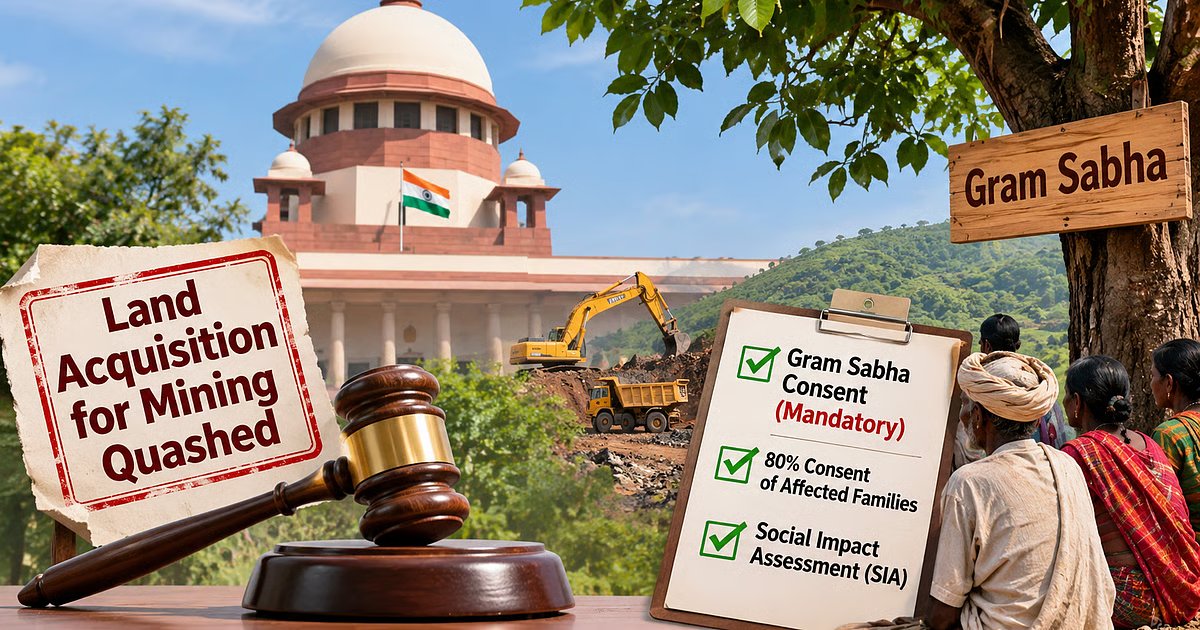

The Supreme Court on Wednesday (November 18) quashed land acquisition proceedings for a Dalmia Cement plant in the Scheduled Areas of Sundergarh district, Odisha, ruling that prior consent from the Gram Sabha is mandatory before acquiring land in such areas.
A bench of Justice Dipankar Datta and Justice Satish Chandra Sharma held that the requirement under Section 41(3) of the Right to Fair Compensation and Transparency in Land Acquisition, Rehabilitation and Resettlement Act, 2013, cannot be treated as optional. The court found that the required consent of the Gram Sabhas had not been obtained before the acquisition process moved forward.
Setting aside the Orissa High Court’s ruling, which had treated the consent requirement as directory rather than mandatory, the Supreme Court said the statutory safeguard could not be reduced to a formality.
“Unfortunately, the impugned judgment has the effect of reducing a mandatory statutory requirement into a paper formality. What is more concerning is that the present case is on an even worse footing. Far from a meaningful consent, there is not even paper consent of Gram Sabha in this case.
This consent was required to be taken on Form M as per Rule 41 of Odisha Rules, and there is no such material on record. Contrarily, it is the admitted position that both the Gram Sabha(s) had expressly rejected the proposal at the threshold through the resolutions passed on 26.01.2020. Nevertheless, the respondents proceeded unhindered on the path of illegality,” the court said.
80% consent required for private projects
The bench also clarified that land acquisition for a private company requires the consent of at least 80 per cent of affected families under Section 2(2)(b) of the 2013 Act. This consent must be secured alongside the Social Impact Assessment (SIA), before the government considers the acquisition proposal. Obtaining consent at a later stage cannot rectify an earlier failure to meet this requirement.
The court identified further procedural lapses, including the absence of an actual public hearing during the SIA exercise. It also flagged the inclusion of a company-linked advisor in the Expert Group, questioning the independence of the assessment process.
Mining lease cannot override landowners’ rights
Rejecting the company’s argument that its mining lease under the Mines and Minerals (Development and Regulation) Act, 1957, authorised the proposed mining activities, the court said such an agreement cannot override the rights of independent landowners.
“A bilateral relationship based on lease between two parties cannot affect the proprietary rights of third-party land owners, who are independent to such lease. The mineral lease provides mineral concession to the lessee and royalty to the State. The landowner has no privity with it and has no benefit to derive from the same. Suffice to note that a contractual arrangement between State and mining lessee cannot affect third parties in the manner urged by the company,” the court observed.
The Supreme Court allowed the appeal and quashed the acquisition notifications and subsequent orders. However, it clarified that fresh acquisition proceedings could be initiated if the authorities comply with the applicable legal requirements.