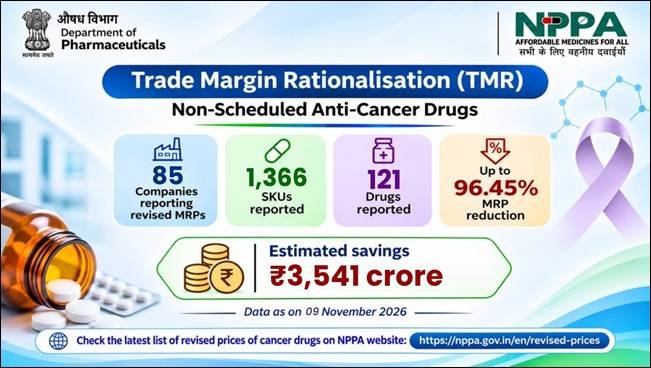

New Delhi: In a significant move to make cancer treatment more affordable, the National Pharmaceutical Pricing Authority (NPPA) on 17 October 2026 limited the trade margin on 137 non-scheduled anti-cancer drugs to a maximum of 30 per cent of the Maximum Retail Price (MRP). The revised prices came into effect from 9 November 2026.
By 9 November 2026, 85 companies had notified revised MRPs for 121 drugs covering 1,366 stock-keeping units (SKUs). The highest price reduction recorded was 96.45 per cent, while the majority of cuts fell in the 50–75 per cent range. More than 650 formulations saw reductions exceeding 50 per cent. The estimated annual savings for patients stand at ₹3,541 crore, calculated on the basis of volumes sold between April 2025 and March 2026.
The decision responds to long-standing concerns raised by state authorities, patients and citizens over the large gap between the price at which manufacturers sell to distributors and the final MRP paid by patients.
What is Trade Margin?
Trade margin is the difference between the price charged by the manufacturer to the stockist or distributor and the MRP paid by the patient (excluding GST). When this margin is excessively high, it significantly inflates the final cost of already expensive cancer medicines. Under the new order, the MRP of each drug is calculated from the average distributor price in March 2026, with the trade margin capped at 30 per cent, after which GST is added.
How Drug Prices Are Regulated
The government regulates medicine prices under the Drugs (Prices Control) Order (DPCO), 2013, framed under the Essential Commodities Act. Scheduled drugs listed in the National List of Essential Medicines (NLEM) 2022 have ceiling prices fixed by the government. NLEM 2022 contains 388 medicines, of which 63 are anti-cancer drugs. Non-scheduled drugs are not subject to ceiling prices but face a restriction that manufacturers cannot raise MRP by more than 10 per cent in any 12-month period.
In 2019, the government had successfully piloted a trade margin rationalisation exercise covering 42 non-scheduled anti-cancer drugs. Building on that experience and fresh market data showing high margins, the NPPA invoked its extraordinary powers under Paragraph 19 of the DPCO, 2013, in the public interest. Acting on the recommendation of an expert committee under the Directorate General of Health Services, it brought 137 non-scheduled anti-cancer drugs (including patented ones) under the 30 per cent trade margin cap through a gazette notification dated 17 October 2026.
Impact on Patients and Companies
Manufacturers must recalculate MRPs using their average March 2026 distributor prices (excluding free medicines under patient assistance programmes and those sold directly by the government). The new lower prices took effect on 9 November 2026. Drugs already priced below the new ceiling cannot be made more expensive.
Companies are required to inform the NPPA of the revised prices, publish the reductions in newspapers, display them on their websites and share the information with all retailers and hospitals. Hospitals and pharmacies must clearly display the new prices. Any company that fails to reduce prices will have to refund the excess amount collected along with interest. Companies cannot reduce production without permission and must give six months’ notice before discontinuing a drug.
Consumers can verify the revised prices on the NPPA website and the official Pharma Sahi Daam mobile app or portal.
Broader Government Support for Cancer Care
The trade margin cap forms part of a wider set of measures aimed at making cancer care more accessible and affordable:
- Ayushman Bharat–Pradhan Mantri Jan Arogya Yojana (AB-PMJAY) provides cashless hospitalisation cover of ₹5 lakh per family per year to the poorest 40 per cent of households and all senior citizens aged 70 and above. By 30 June 2026, the scheme had authorised 12.69 crore hospital admissions worth ₹1.92 lakh crore. Medical oncology alone accounted for 19.5 lakh admissions costing about ₹2,926 crore (as of 4 November 2026).
- Under the National Programme for Prevention and Control of Non-Communicable Diseases (NP-NCD), 770 district NCD clinics, 6,410 NCD clinics at community health centres and 524 day-care cancer centres have been established. Nineteen State Cancer Institutes and 20 Tertiary Care Cancer Centres have been approved, while Tata Memorial Centre has set up six additional hospitals. All 22 new AIIMS provide cancer treatment services.
- More than 1.86 lakh Ayushman Arogya Mandirs offer screening for oral, breast and cervical cancers. By July 2026, screenings had covered 36.11 crore people for oral cancer, 16.94 crore for breast cancer and 9.31 crore for cervical cancer.
- A nationwide free HPV vaccination campaign for girls aged 14 was launched on 28 February 2026. By 11 September 2026, more than 80 lakh doses had been administered.
- Pradhan Mantri Bhartiya Janaushadhi Pariyojana (PMBJP) operates 20,149 Jan Aushadhi Kendras stocking 2,110 medicines and 315 surgical items. From FY 2021-22 to 2025-26, sales of ₹7,873.85 crore resulted in estimated savings of ₹37,200 crore for citizens.
- AMRIT pharmacies (285 outlets across 24 states and four Union Territories) offer more than 6,500 drugs, implants and surgical products at an average 50 per cent discount on MRP. Since inception, they have served over 8.13 crore patients and generated savings of about ₹10,969 crore (as of 24 September 2026).
- The eSanjeevani telemedicine platform has facilitated more than 50 crore consultations (including cancer-related) by 21 October 2026.
By capping trade margins on a wide range of anti-cancer drugs and combining this with screening, vaccination, cashless treatment and low-cost pharmacy networks, the government aims to bring quality cancer care closer to patients and substantially reduce the financial burden on families.