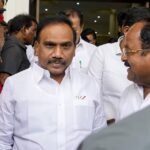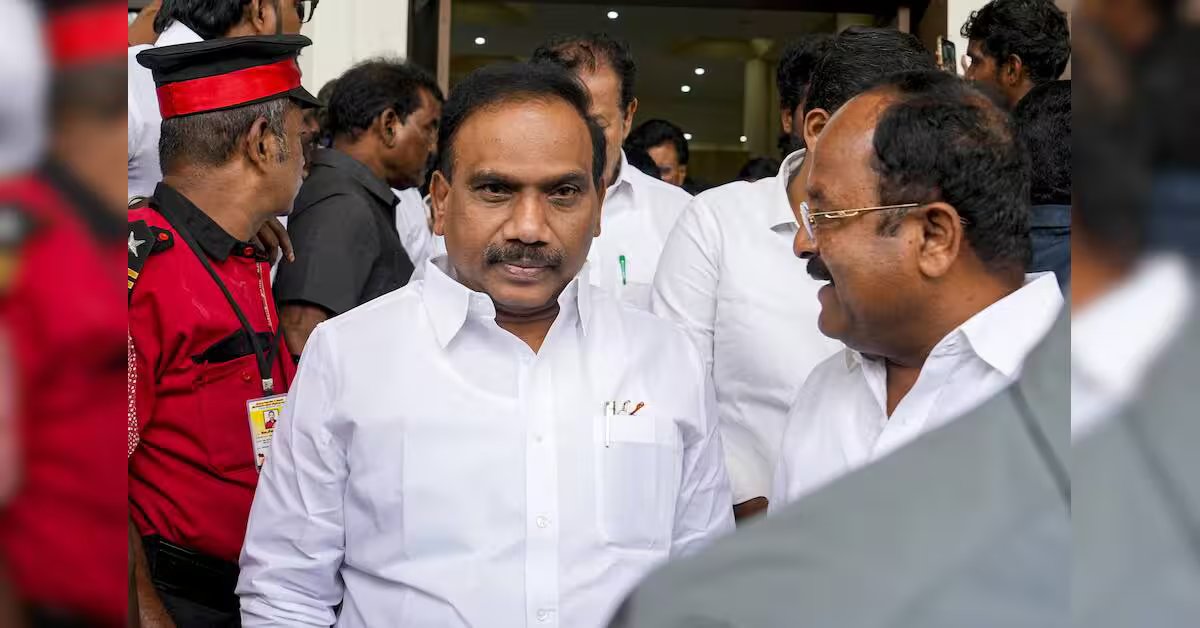

Dravida Munnetra Kazhagam (DMK) MP A Raja on Saturday said the party has decided to support the proposed 50 per cent increase in parliamentary seats across states, while reiterating that Tamil Nadu’s existing share of representation in the Lok Sabha must remain protected amid the Centre’s proposed delimitation exercise.
Speaking to ANI after the DMK meeting, Raja said the party’s consistent demand had been that Tamil Nadu’s 7.18 per cent share in the Lok Sabha should not be altered, adding that the proposed arrangement appeared to preserve the state’s representation.
“Our consistent demand is that the share of 7.18% (seat share in Lok Sabha) should not be altered. Now it is being maintained. Of course, procedural issues are there; we will address them. If necessary, we will give an amendment,” he said.
Addressing a press conference in Chennai, the DMK leader said the party had maintained a consistent position on protecting Tamil Nadu’s representation, irrespective of whether it was in power or in the Opposition and whether it was part of an alliance or not.
He said the party’s position followed discussions involving political parties and Chief Ministers from different states at a Joint Action Committee meeting convened in Chennai by former Chief Minister and DMK president M. K. Stalin.
“During the last delimitation process, during the restructuring, Tamil Nadu’s share was 7.18. In India, which consists of various states with various nationalities, various languages, and various cultures, that share was carried out the last time during Indira Gandhi’s period in 1971 without causing harm to the culture and civilisation of each linguistic state,” Raja said.
He maintained that retaining the same share was central to the idea of fair delimitation and said the DMK had not deviated from this demand.
“That the same share should continue is what ‘fair delimitation’ means, and all parties in that alliance, including the Congress party, [said], ‘We wanted to have a fair delimitation.’ Nowhere, apart from the term ‘fair delimitation’–apart from fair constituency delimitation–did anyone propose any new formula that day,” he said.
Raja also rejected allegations that the DMK had changed its position after moving away from the INDIA bloc, calling such claims politically improper.
“So far as DMK is concerned, we maintained full consistency when we were in power, and we were out of power. So notwithstanding the political entity, notwithstanding the political power, we maintained our consistency that the share of Tamil Nadu, 7.18, should not be affected,” he said.
Explaining the party’s assessment of the proposed arrangement, Raja said Tamil Nadu had lost two seats during the 1971 delimitation exercise, but the current proposal did not entail a similar reduction. He said the state’s share had instead reached 7.21 per cent from 7.18 per cent.
He further said the party had examined the proposed legislation with legal experts and lawyers and that its leadership had authorised it to consult other parties and discuss possible amendments with the government.
“Beyond this number, we agree with the number 59. Beyond that, regarding the Delimitation Commission, other processes, and wherever else there are difficulties, wherever there is apprehension, wherever we have reservations, we asked if we can bring amendments in Parliament if needed,” he said.
Raja added that the party would raise its concerns in Parliament and seek changes to specific clauses if required. He also said the proposed arrangement would retain the existing state-wise representation ratio for another 25 years.
The DMK’s position is significant as the party has 22 MPs in the Lok Sabha and its support could influence the outcome of the proposed legislation. The party had earlier demanded that Tamil Nadu’s 7.18 per cent share in the Lok Sabha remain unchanged and that the existing proportion of representation among states, based on the 1971 Census, be retained for another 25 years.
The Union Cabinet has cleared a legislative package to facilitate delimitation and the implementation of 33 per cent reservation for women in the Lok Sabha and State Legislative Assemblies. The Centre is set to introduce the Delimitation (Second) Bill, 2026, during the special session of Parliament beginning November 30.
The proposed legislation provides for a 50 per cent increase in the number of Lok Sabha seats allocated to each state and Union Territory, as well as the total number of seats in State Assemblies. If passed, the maximum strength of the Lok Sabha would increase to 850, while that of State Assemblies would rise to 650.
The Centre’s proposal links the implementation of women’s reservation, provided for under the 106th Constitutional Amendment in 2023, with the fresh delimitation exercise, with the government aiming to complete the process before the 2029 Lok Sabha elections.
The Opposition has supported women’s reservation but objected to linking its implementation with delimitation. It has also demanded the use of the latest Census data instead of the 2011 figures. The Centre has proposed using the 2011 Census for redrawing constituencies and determining SC/ST-reserved seats, while retaining the 1971 population basis for state-wise allocation of Lok Sabha seats until 2051.