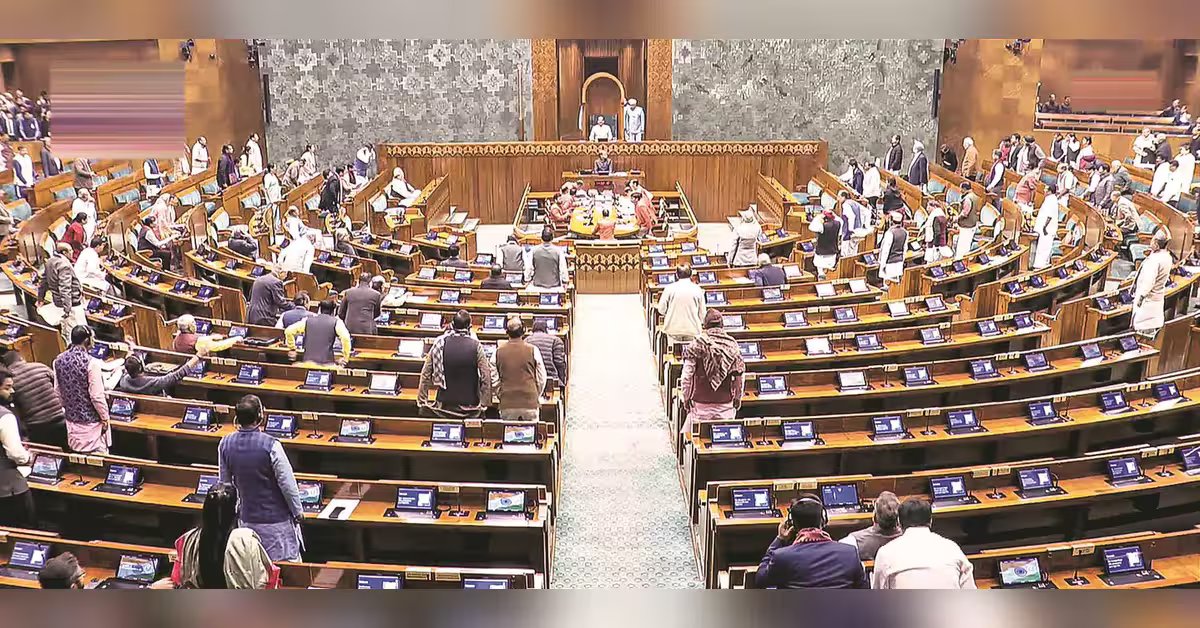

The Centre has expressed its intention to convene a special session of Parliament to introduce fresh legislation on delimitation and women’s reservation, according to a report in The Hindu. The proposal is to increase the strength of the Lok Sabha from its current 543 elected seats to a maximum of 850.
The move comes after the Constitution (131st Amendment) Bill, 2026, which was introduced with the Delimitation Bill attached as a condition, failed to secure the required majority in the Lok Sabha in April this year. The earlier proposed Bills have been rendered infructuous. According to the report, government sources have expressed confidence about securing 15-16 more votes than needed.
Amid the rising chaos in the political corridors, the question to be asked is how parliamentary representation should be distributed among the states, particularly when some states have experienced faster population growth than others.
What is delimitation, and why has Lok Sabha seat allocation been frozen for decades?
Delimitation means the act or process of fixing the limits or boundaries of territorial constituencies in a country or a province with a legislative body, based on their population. The purpose of the process is to make sure that each elected representative represents a comparable number of people.
Article 82 of the Constitution provides for the readjustment of Lok Sabha seats and constituency boundaries after every census. Article 81 also lays down the framework for allocating seats among states.
However, the 42nd Constitutional Amendment Act, 1976, froze the allocation of Lok Sabha seats based on the 1971 Census until the first census after 2000. The 84th Constitutional Amendment Act, 2001, extended this freeze until the relevant figures from the first census after 2026 are published.
The decision was backed by the intention to ensure that states which successfully curbed population growth did not lose their parliamentary representation as a consequence.
How could the proposed Delimitation Bill change the number of Lok Sabha seats?
The current constitutional framework provides for a maximum of 550 Lok Sabha members, including up to 530 from states and 20 from Union Territories.
The 131st Constitutional Amendment Bill, introduced in April 2026, proposed increasing this ceiling to 850 members, comprising up to 815 representatives from states and 35 from Union Territories.
The Delimitation Bill, 2026, proposed a Delimitation Commission authorised to redraw constituencies. It also envisaged using the latest published census figures available when the Commission was constituted. This could mean using the 2011 Census rather than waiting for the completion of Census 2027.
Why are southern states concerned about losing political influence?
The dissatisfaction arises from differences in population growth across Indian states.
Southern states such as Tamil Nadu and Kerala have made considerable progress in population control, while states such as Uttar Pradesh and Bihar in the north have seen their populations grow multifold.
This implies that if seats are allocated strictly according to population, states with larger populations could gain more parliamentary representation in the Lok Sabha.
If the Lower House retained its existing strength, Tamil Nadu’s and Kerala’s seats could fall from 39 to 32 and from 20 to 15, respectively. In contrast, Uttar Pradesh could gain seats, from 80 to 89, and Bihar from 40 to 46. This could risk states losing their political influence despite their development efforts.
“Even if Parliament expands its total seat count so that southern states do not lose seats in absolute numbers, their percentage share of the Lok Sabha would still drop,” said Supriya Majumdar, partner, Elarra Law Offices.
Majumdar further added that shifting a large bloc of parliamentary seats towards the northern belt could weaken cooperative federalism.
Will expanding Lok Sabha seats equally across states resolve the North-South dispute?
One proposal reportedly being discussed is to increase the existing Lok Sabha allocation of every state by 50 per cent, irrespective of differences in population growth.
For instance, if a state currently has 20 seats, its allocation would rise to 30. A state with 40 seats would receive 60.
Such an arrangement could prevent states from losing their existing relative share of representation while increasing the overall strength of the House.
“Proportionately increasing seats across states while broadly preserving their existing relative representation could provide a constructive solution to concerns about regional imbalance,” said Gauhar Mirza, partner, Saraf & Partners.
However, Article 81 envisages representation based on population, while Article 82 provides for readjustment after a census. A departure from this framework would require appropriate constitutional changes.
What does delimitation have to do with implementing women’s reservation?
The Constitution (106th Amendment) Act, 2023, popularly known as the Women’s Reservation Act, provides for reserving one-third of seats in the Lok Sabha and state legislative assemblies for women.
However, Article 334A makes implementation of this reservation dependent on the publication of the relevant figures from the first census conducted after the Act’s commencement.
The April 2026 proposal sought to remove this condition to enable the passage of women’s reservation based on the earlier delimitation exercise.
“Pursuing both reforms through a coordinated legislative framework would be a legitimate and potentially consequential exercise of parliamentary wisdom, advancing broader representation without necessarily displacing existing constituencies,” said Tushar Kumar, advocate, Supreme Court of India.
What needs to happen before the new electoral map can take effect?
“First, the constitutional amendment has to be passed by both Houses and ratified by at least half the states,” said Anu Sura, associate partner, PSL Advocates & Solicitors.
The second step would be to set up a Delimitation Commission, which would determine constituency boundaries and seat distribution under the appropriate law.
According to the Election Commission of India, delimitation orders have the force of law and cannot ordinarily be challenged in a court of law.
On the judicial review of Delimitation Commission orders, courts treated the Commission’s orders as untouchable for decades because of Article 329(a) and the Meghraj Kothari ruling. However, in the 2024 Kishorchandra Chhanganlal Rathod ruling, the Supreme Court made clear that this immunity is not absolute, Sura added.
The larger challenge for Parliament is to strike a balance between population-based representation and the concerns of states that have successfully stabilised their populations.