

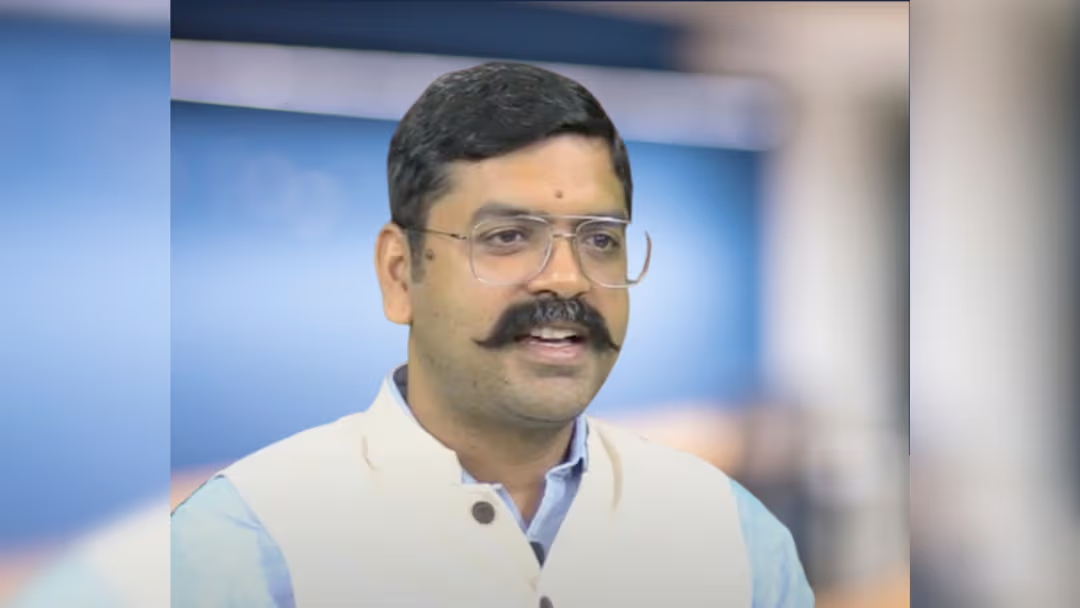

New Delhi : Serial entrepreneur, governance expert, and IIT Mandi doctoral researcher Amit Shukla has sparked a fresh debate on career opportunities in India’s public sector, claiming that millions of government positions remain underutilized because young Indians are largely unaware of them.
Speaking on the “Flirting With a Fish” podcast, hosted by Sonia Swaroop Choksi, Shukla argued that while millions of aspirants spend years preparing for highly competitive examinations such as UPSC, SSC, and Railway recruitment, they often overlook the Gram Panchayat system, which he described as India’s largest democratic institution and one of its most significant avenues for public leadership.
’32 Lakh Government Positions Exist Across India’s Villages’
According to Amit Shukla, India has nearly 32 lakh elected local government positions, including approximately 2.7 lakh Gram Panchayat President (Gram Pradhan/Sarpanch) posts spread across nearly 7 lakh villages.
He noted that because these positions operate on five-year election cycles, nearly 6 lakh positions become available every year, creating a continuous stream of leadership opportunities for eligible citizens.
Unlike many government jobs that require lengthy recruitment processes and competitive examinations, candidates only need to meet the constitutional eligibility requirements, including a minimum age of 21 years, to contest these elections.
Leadership Roles with Significant Constitutional Powers
Shukla emphasized that elected representatives at the Gram Panchayat level exercise constitutional authority over a wide range of public services that directly affect rural communities.
According to him, Panchayats oversee 29 subjects listed under the Eleventh Schedule of the Constitution, including:
- Agriculture
- Animal Husbandry
- Fisheries
- Primary Education
- Healthcare
- Housing
- Water Supply
- Sanitation
- Rural Roads
- Forestry
- Village Infrastructure
- Cottage Industries
- Social Welfare Programs
He stated that these sectors collectively account for nearly ₹25 lakh crore in annual public expenditure, making Panchayats one of the most influential institutions in rural governance.
“If you divide 32 lakh positions across five-year cycles, you get roughly 6 lakh vacancies every year. These positions carry authority over agriculture, fisheries, primary education, housing, water, and rural roads,” Shukla said during the podcast.
He further argued that a 21-year-old Ward Member or Gram Pradhan can exercise more direct influence over the day-to-day lives of villagers than many government officers during their careers.
Four Key Areas of Panchayat Governance
During the discussion, Shukla grouped the 29 constitutional subjects into four broad categories:
1. Economic Development
Including agriculture, animal husbandry, fisheries, food processing, forest produce, and cottage industries.
2. Essential Public Services
Including primary education, healthcare, housing, drinking water, and sanitation.
3. Infrastructure Development
Including roads, land management, water resources, and electricity.
4. Social Welfare
Focused on programs benefiting economically weaker sections, Scheduled Castes, Scheduled Tribes, and other marginalized communities.
Shukla noted that because agriculture remains India’s largest source of employment, Gram Panchayats hold substantial constitutional authority over the livelihoods of millions of citizens.
A Career Opportunity for Agniveers
One of the notable suggestions made during the discussion was the potential role of Agniveers after completing their military service.
Shukla suggested that former Agniveers, who possess leadership experience, discipline, and organizational skills, could contest Gram Panchayat elections in their native villages.
He described this as a practical pathway that could benefit both returning service personnel and rural communities by bringing experienced leadership into local governance.
Need to Raise Awareness Among Young Indians
Shukla questioned why these opportunities receive little attention compared to traditional government jobs.
He cited examples of young elected leaders, including a 21-year-old woman who became a Gram Pradhan, to demonstrate that leadership opportunities at the village level are accessible to young citizens.
“The question is not whether the opportunity exists. The question is why nobody is telling young people that it does,” he remarked.
According to him, greater awareness could encourage more educated and motivated youth to participate in grassroots governance.
Strengthening Decentralized Governance
The podcast also discussed the broader issue of devolution of powers under the 73rd Constitutional Amendment, which established the Panchayati Raj system.
Shukla argued that although the Constitution provides substantial authority to local governments, many administrative and financial powers remain concentrated at the state and district levels.
He suggested that greater participation by informed and capable young leaders could help strengthen decentralized governance and improve the implementation of development programs in rural India.
About Amit Shukla
Amit Shukla is the Founder of EasyGov, Empower Panchayat, and Simpler Today AI. His startup EasyGov was acquired by Reliance Jio in 2019. He is currently pursuing doctoral research at IIT Mandi, focusing on Artificial Intelligence-enabled decentralization and Gram Panchayat governance.
He has also served as a consultant to the Ministry of Electronics and Information Technology (MeitY) and has worked with several governments in India and abroad on digital governance, social protection, and public policy transformation.
The complete discussion is available on the “Flirting With a Fish” podcast hosted by Sonia Swaroop Choksi, where careers, governance, entrepreneurship, and public policy issues are explored through conversations with practitioners and policymakers.