

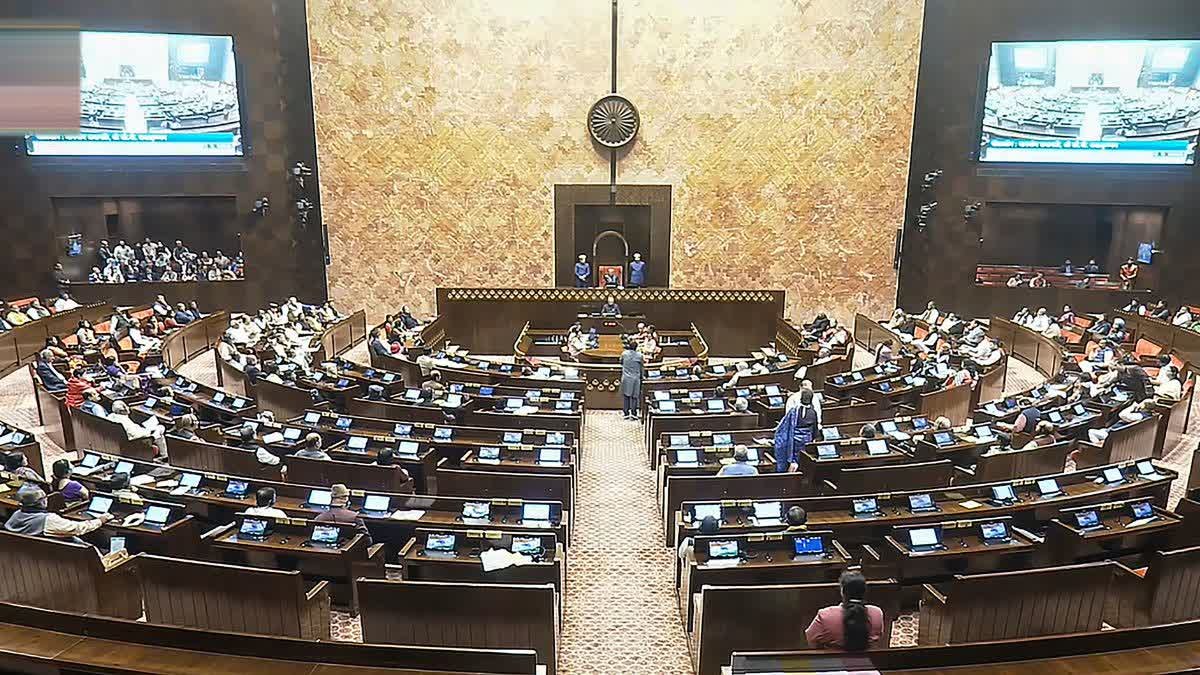
New Delhi: Opposition parties in India’s Rajya Sabha on Tuesday expressed serious concerns over rising unemployment and accused the government of failing to present concrete job-creation measures in the Union Budget 2026–27. They also demanded detailed clarification from the government on the recently announced India–United States trade agreement, citing conflicting claims made by US officials.
Participating in the budget debate, Trinamool Congress (TMC) MP Sukhendu Sekhar Ray criticized the government’s economic approach, alleging that rising public debt and policy decisions favor foreign interests over national priorities. Quoting the ancient Indian philosopher Charvaka, Ray suggested that the government appeared to be following a policy of excessive borrowing without addressing long-term consequences.
Ray claimed that the government’s total borrowing, including foreign debt, has risen to ₹2.53 lakh crore, questioning whether this truly reflected the promised “Amrit Kaal” of economic prosperity. He also expressed concern over the decision to allow 100 percent foreign direct investment in the insurance sector, warning that it could weaken public-sector insurance companies.
While welcoming the proposal to form a high-level committee to link education with entrepreneurship, Ray said similar committees in the past had delivered little tangible outcome. He also pointed to delays in implementing promises made in previous budgets.
The TMC MP highlighted widening economic inequality, alleging that the top 10 wealthiest individuals in India control nearly 51 percent of the country’s total wealth. Turning to the India–US trade deal, Ray said the agreement was being promoted aggressively without full disclosure of its terms.
He cited US claims that India may reduce oil imports from Russia in favor of supplies from the United States and Venezuela, questioning how much this shift would increase energy costs. Ray also warned that opening India’s dairy and agricultural markets to US companies and curtailing farm subsidies, as suggested by American officials, could have a devastating impact on Indian farmers.
Ray further alleged that tariffs on Indian exports to the US had risen sharply—from 3.5 percent last year to nearly 18 percent—raising doubts about how India stood to benefit from the agreement. He accused the government of distancing itself from long-time ally Russia while aligning with the US, which he claimed continues to support Pakistan.
Congress MP Neeraj Dangi echoed these concerns, calling the budget “numbers-driven but disconnected from the lives of ordinary citizens.” He said the stock market’s sharp fall of over 2,300 points after the budget presentation reflected investor disappointment.
Dangi argued that the budget focused on long-term projections while ignoring urgent challenges such as unemployment. He questioned the credibility of the government’s promise to create 20 million jobs annually, noting that recruitment in government sectors has slowed and temporary hiring has increased.
Dravida Munnetra Kazhagam (DMK) MP Kanimozhi N.V.M. Somu described the budget as “another failure,” accusing the government of maintaining “nine years of policy continuity marked by nine years of failure.” She said the budget was anti-poor and showed little concern for farmers, workers, salaried middle-class families, or the unemployed, while prioritizing large corporate interests.
Opposition leaders collectively demanded that the government provide a clear and transparent explanation of the India–US trade agreement and outline immediate, credible steps to address unemployment and economic inequality.