

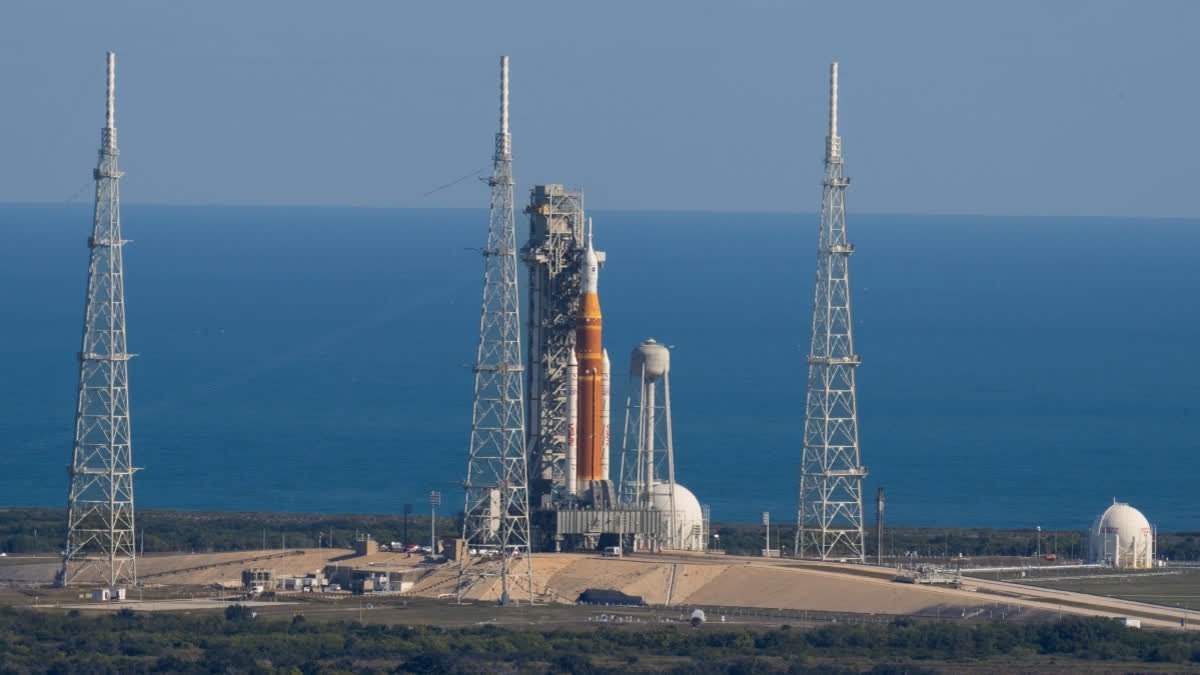
CAPE CANAVERAL, Fla. — NASA has successfully completed a second critical fueling test of its giant moon rocket, a key step that will determine whether astronauts can begin their long-awaited journey toward the Moon as early as March 6.
During the late-night test at Florida’s spaceport, launch teams loaded more than 700,000 gallons of supercooled liquid hydrogen and liquid oxygen into the Space Launch System rocket for the upcoming Artemis II mission. Engineers counted down to the final 30 seconds of the simulated launch sequence, then reset the clock to repeat the last 10 minutes — a procedure designed to closely mimic real launch-day conditions.
NASA said the test showed only minimal hydrogen leakage, well within safety limits, marking a major improvement over an earlier rehearsal this month that was halted by dangerous fuel leaks. Engineers replaced faulty seals and cleared a clogged filter ahead of the repeat test at Kennedy Space Center, and the agency said the fixes performed as expected.
The results are now under detailed review, but the successful fueling has boosted confidence that a March launch window remains achievable. In a positive sign, the four-member U.S.-Canadian crew began preparations to enter a two-week quarantine, a standard step that gives mission managers flexibility as launch day approaches. Three of the astronauts were on site Thursday to observe the test.
If all goes according to plan, Artemis II will send astronauts on a 10-day out-and-back flight around the Moon, the first human mission to venture that far from Earth since Apollo 17 in 1972. The mission will not include a lunar landing or orbit, but it is seen as a crucial bridge toward future crewed landings.
NASA’s heavy-lift rocket, officially known as the Space Launch System, has faced persistent hydrogen leak challenges — a problem dating back to the space shuttle era, when many of the engines were originally developed. The uncrewed Artemis I mission was delayed for months by similar issues before finally launching in November 2022.
NASA Administrator Jared Isaacman acknowledged the ongoing challenges, saying the agency plans to redesign the rocket’s fuel connections before the later Artemis III mission, which aims to land astronauts near the Moon’s south pole in the coming years.
“We will not launch unless we are ready, and the safety of our astronauts will remain the highest priority,” Isaacman said in a recent social media post.
His comments come amid broader scrutiny of NASA’s human spaceflight programs. Earlier this week, Isaacman released a sharply critical report on Boeing’s Starliner capsule after technical problems left two astronauts stranded for months aboard the International Space Station. The report warned that the situation could have ended in disaster and cited failures by both Boeing and NASA leadership.
For now, attention remains focused on Artemis II. With the most challenging phase of the fueling test behind them, NASA engineers say the path to the Moon is clearer — though final approval for launch will depend on a careful review of every data point from Thursday’s rehearsal.