


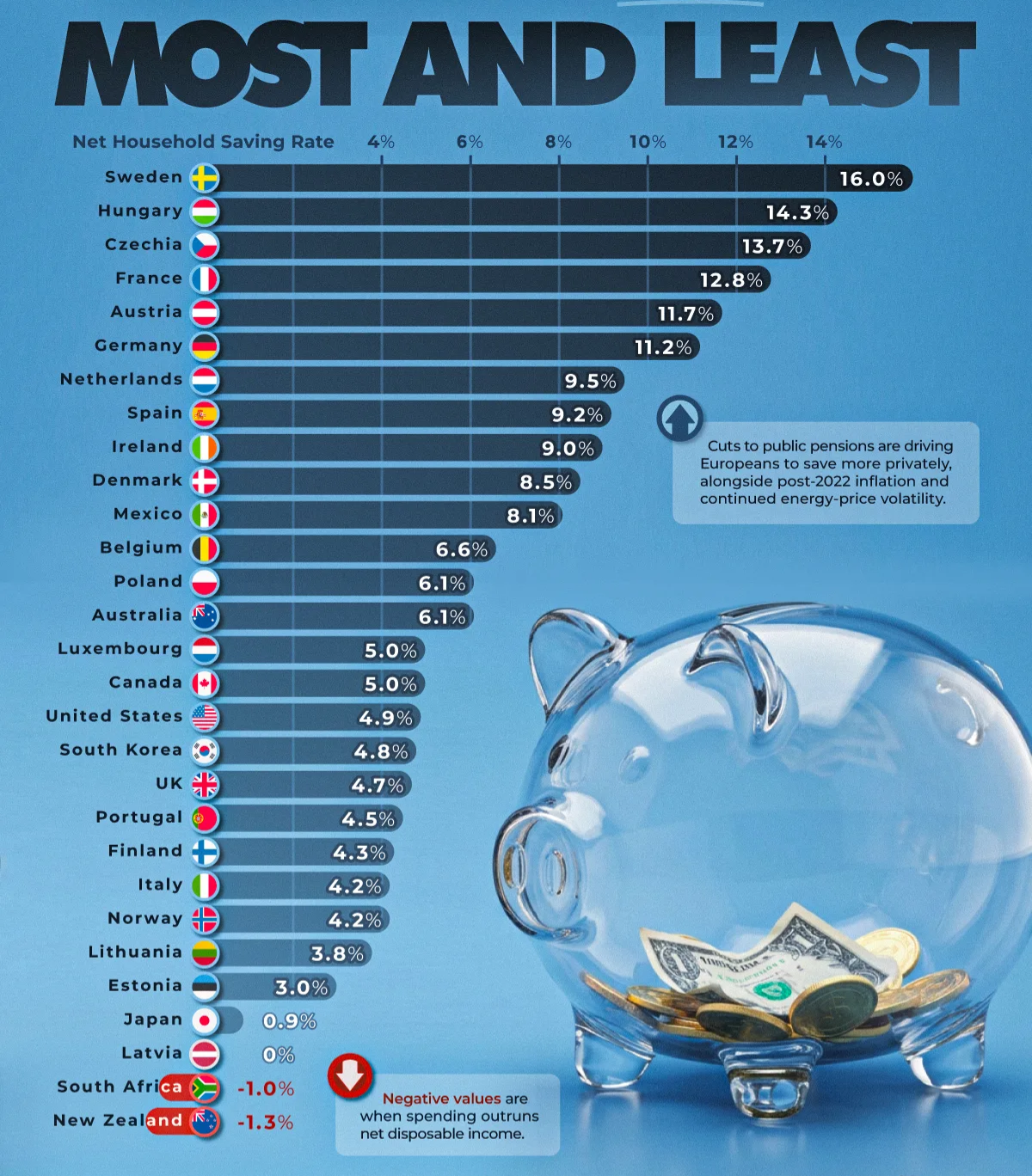

The S Bharat — A new global comparison of household savings rates reveals stark differences in how much people set aside across major economies, with European nations dominating the top ranks while countries like the United States trail far behind.
The analysis, based on the latest data from the Organisation for Economic Co-operation and Development and visualized by Dorothy Neufeld, highlights a growing divide in financial resilience among households worldwide.
Sweden Leads, U.S. Falls Behind
At the top of the list is Sweden, where households save an impressive 16% of their disposable income—more than three times the 4.9% savings rate in the United States.
Other high-saving nations are largely concentrated in Europe, including:
- Hungary — 14.3%
- Czechia — 13.7%
- France — 12.8%
- Germany — 11.2%
These elevated savings levels are often linked to strong pension systems, aging populations, and more conservative spending habits.
Middle Economies Show Moderate Savings
In the middle tier, savings rates drop significantly. Countries like Canada (5.0%), United Kingdom (4.7%), and South Korea (4.8%) cluster around the same level as the U.S.
Interestingly, Mexico outperforms the U.S. with an 8.1% savings rate, meaning Mexican households save nearly twice as much as Americans on average.
Japan Near Bottom, Some Countries in Negative Territory
At the lower end of the ranking, Japan reports a savings rate of just 0.9%, reflecting long-term demographic and economic challenges.
Even more concerning are countries with negative savings rates, including:
- South Africa — -1.0%
- New Zealand — -1.3%
Negative savings indicate that households are spending more than they earn, often relying on debt or dipping into past savings to cover expenses.
Long-Term Trends and Economic Implications
The data shows that Sweden has significantly improved its savings culture over time, with rates rising nearly eightfold from 2.3% to 16% over the past two decades.
Economists say savings rates are a crucial indicator of financial stability and economic resilience. Countries with higher savings levels are generally better equipped to handle:
- Inflation shocks
- Job losses
- Economic downturns
On the other hand, persistently low savings—like those seen in the United States—can signal higher consumer vulnerability, rising debt levels, and reduced long-term financial security.
Outlook
As global economic uncertainty continues, the gap between high-saving and low-saving nations could have far-reaching consequences. Policymakers may need to focus on income growth, cost-of-living pressures, and incentives for saving to strengthen household finances.
The findings underscore a simple but critical reality: in today’s economy, the ability to save is increasingly becoming a dividing line between financial security and vulnerability.