

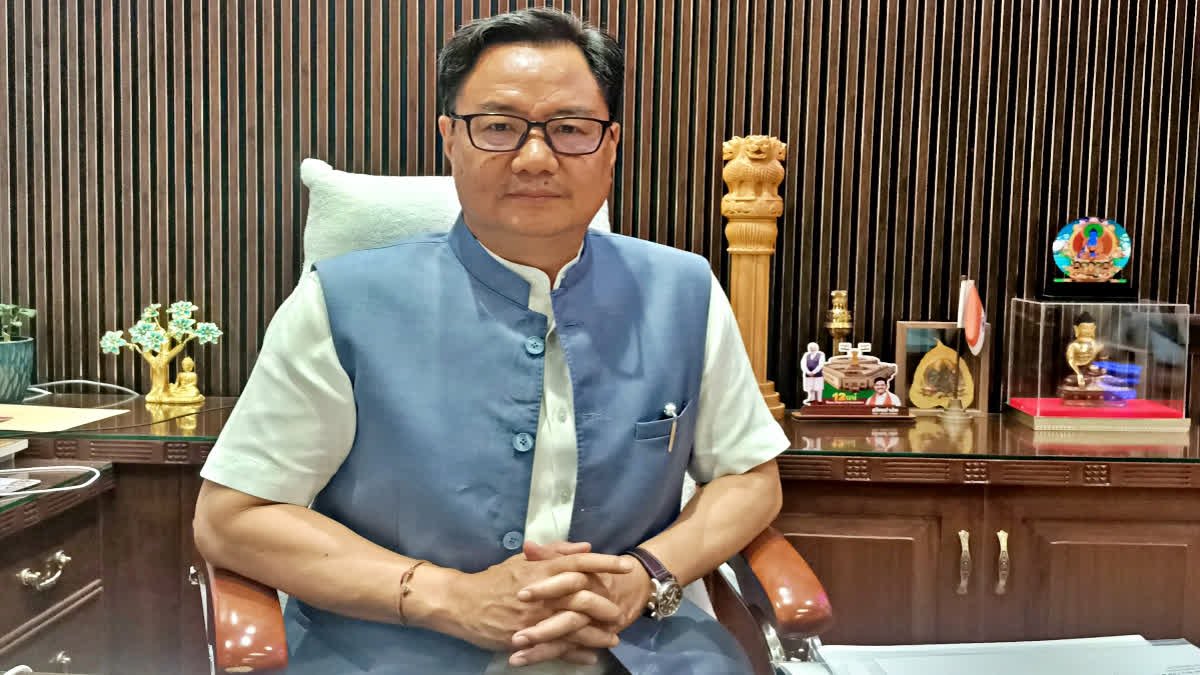

Union Parliamentary Affairs Minister Kiren Rijiju accuses Congress of becoming “leaderless and directionless”, backs PM Modi’s ‘Dimagi Naxal’ remark and defends police action against protesters
New Delhi: Union Parliamentary Affairs Minister Kiren Rijiju has launched a sharp attack on the Congress, accusing the principal Opposition party of becoming “leaderless and directionless” and claiming that it is simultaneously moving towards what he described as “Muslim League politics” and “Maoist” ideology.
In an interview in New Delhi, Rijiju also defended the police action against students protesting at Jantar Mantar, arguing that the authorities intervened only when protesters attempted to move towards Parliament.
His remarks come amid an intensifying political confrontation between the BJP and Congress over Prime Minister Narendra Modi’s recent reference to “Dimagi Naxals” and the conduct of the Opposition during Parliament proceedings. Recent reporting has also recorded Rijiju making similar allegations that Congress was moving towards a Maoist or Naxalite political orientation.
‘Congress Has Become Leaderless and Directionless’
Rijiju alleged that the Congress lacks effective leadership and has adopted an increasingly negative approach towards the government.
According to him, the party is developing “two different characters”—one that he compared to the Muslim League and another that he described as moving towards Maoist or radical left-wing politics.
“Congress today is changing into two completely different characters. On one side, it is becoming like the Muslim League, while on the other, it is taking the form of a Maoist party.”
Rijiju accused the Congress of adopting what he called an “extreme Left” position on several issues while simultaneously pursuing what he described as minority appeasement.
These are political allegations made by Rijiju, and the Congress has disputed the BJP’s broader characterisation of its politics.
Rijiju Backs PM Modi’s ‘Dimagi Naxal’ Remark
Rijiju strongly supported Prime Minister Narendra Modi’s use of the term “Dimagi Naxal” during his Independence Day address from the Red Fort.
He argued that the threat posed by Left-wing extremism cannot be viewed solely through the lens of armed insurgency.
According to Rijiju, armed Maoist groups have been substantially weakened, but he claimed that what he described as the underlying ideology continues to influence sections of the urban intelligentsia.
He said the Prime Minister’s warning was timely and argued that ideological extremism must also be confronted.
Rijiju also invoked former Prime Minister Manmohan Singh’s earlier description of Left-wing extremism as a major internal-security challenge, seeking to draw a distinction between the armed movement and the ideological influence associated with it.
Recent reporting shows that Rijiju has similarly argued that armed Naxalism has largely been eliminated while claiming that the ideology continues to exist in urban areas.
‘There Was No Lathi-Charge on Peaceful Protest’
On the police action at Jantar Mantar, Rijiju rejected the claim that police used force against a peaceful demonstration.
He said students had been allowed to continue their protest for more than 30 days without major intervention.
According to the minister, the situation changed when protesters attempted to move towards Parliament.
“There was no lathi-charge on a peaceful protest. The police stopped them only when they tried to move towards Parliament.”
Rijiju argued that preventing protesters from entering or moving towards restricted areas should be viewed as law-and-order enforcement, rather than an attempt to suppress their grievances.
The controversy over police action has been part of the wider confrontation between the government and Opposition parties during the recent political protests.
Northeast Should Not Become a ‘State vs State’ Battle
Rijiju also spoke at length about the political and social challenges facing the Northeast.
He described people in the region as highly emotional about issues concerning their states and communities but said that the broader aspirations for development and prosperity were shared across the Northeast.
He acknowledged that the region had lagged behind in development for decades and attributed this, in his assessment, to what he described as the neglect of previous Central governments.
According to Rijiju, the situation changed after 2014, when the Narendra Modi government began giving greater priority to the Northeast.
Border Disputes Need Dialogue, Not Confrontation
Rijiju referred to several inter-state disputes in the Northeast, including those involving:
- Assam and Meghalaya
- Mizoram and Nagaland
- Assam and Arunachal Pradesh
- Nagaland and Manipur
He argued that such disputes should not be allowed to turn into prolonged confrontations between states or communities.
Instead, he called for dialogue and negotiations to settle disagreements peacefully.
“Problems can be resolved peacefully and through mutual discussions. We can all live together in harmony.”
Warning Over Media and Social Media
The Union minister also expressed concern about the role of local media and social media in escalating tensions between neighbouring states.
He argued that reports or social-media narratives from one state can sometimes portray another state as responsible for a dispute, potentially inflaming public sentiment.
According to Rijiju, such narratives can particularly affect young people and create conditions in which local disputes turn into wider confrontations.
He also highlighted the historical contribution of people from Assam to the development of neighbouring Arunachal Pradesh.
China’s Claims Over Arunachal Pradesh
On China’s repeated claims over Arunachal Pradesh, Rijiju dismissed Beijing’s position and said India would not be affected by China’s attempts to rename places in the state.
The Survey of India has officially used names for geographical locations in Arunachal Pradesh, a move that has previously drawn objections from China.
Rijiju maintained that such naming exercises should not be viewed simply as a response to China but as an administrative and cartographic exercise.
He argued that the people of Arunachal Pradesh have their own historical and cultural identity and rejected China’s territorial claims over the state.
“China changing the names of places in Arunachal Pradesh does not make any difference to us.”
A Wider BJP-Congress Political Battle
Rijiju’s comments are part of a broader political confrontation between the BJP and Congress over Opposition strategy, parliamentary functioning, protests and the government’s approach to Left-wing extremism.
The BJP has increasingly used the term “Dimagi Naxal” to distinguish what it describes as ideological support for Naxalism from armed insurgency. Congress leaders, meanwhile, have criticised the terminology and accused the government of using politically charged labels against its opponents.
The dispute is therefore not limited to one statement. It reflects a wider battle over national security, ideology, protest rights, parliamentary conduct and the political direction of the Opposition.
Key Takeaways
| Issue | Kiren Rijiju’s Position |
|---|---|
| Congress | Described as “leaderless and directionless” |
| Congress ideology | Accused of moving towards “Muslim League” and Maoist politics |
| ‘Dimagi Naxal’ | Strongly supported PM Modi’s terminology |
| Jantar Mantar protest | Said police intervened when protesters moved towards Parliament |
| Northeast | Called for dialogue and cooperation between states |
| Inter-state disputes | Opposed turning them into state-vs-state conflicts |
| Social media | Warned that inflammatory narratives could escalate tensions |
| Arunachal Pradesh | Rejected China’s territorial claims and renaming efforts |
Bottom Line
Kiren Rijiju’s latest remarks represent a sharp escalation in the BJP’s political criticism of the Congress.
His allegations that the Congress is moving simultaneously towards “Muslim League” and “Maoist” politics, his defence of the “Dimagi Naxal” terminology and his justification of police action at Jantar Mantar all come against the backdrop of a wider BJP-Congress confrontation.
At the same time, his comments on the Northeast and Arunachal Pradesh underline the government’s emphasis on regional peace, inter-state dialogue and resistance to China’s territorial claims.