

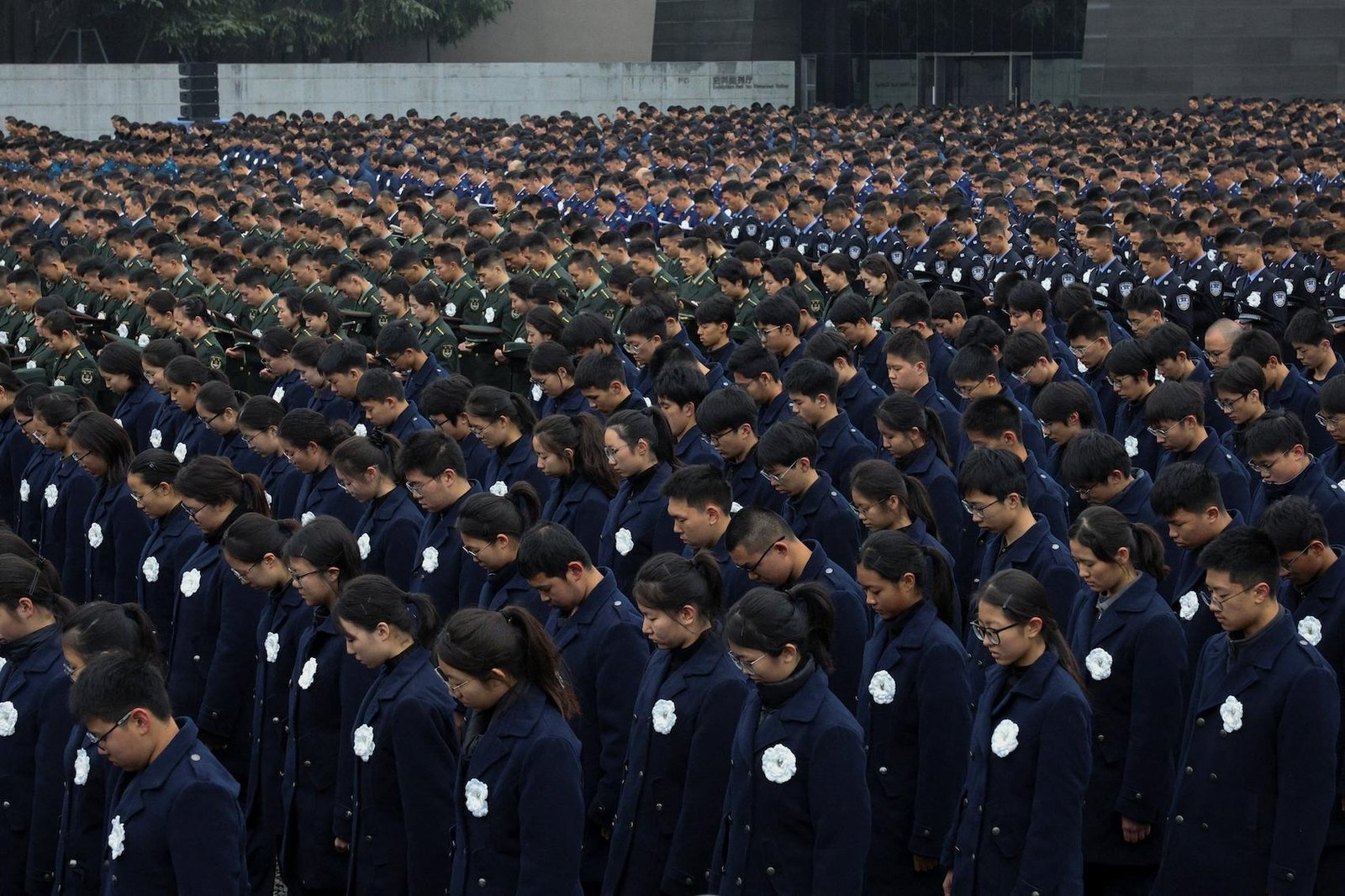

Nanjing, China: China on Saturday held a subdued memorial ceremony to commemorate the victims of the 1937 Nanjing Massacre, with President Xi Jinping notably absent, even as diplomatic tensions between Beijing and Tokyo remain high over Taiwan.
The ceremony took place at the National Memorial Hall in Nanjing and lasted less than half an hour. It was attended by senior officials, police officers, and schoolchildren. Shi Taifeng, head of the Chinese Communist Party’s powerful Organization Department, delivered the main address instead of President Xi.
Relations between China and Japan have recently deteriorated after Japanese Prime Minister Sanae Takaichi stated last month that a hypothetical Chinese attack on Taiwan could prompt a military response from Japan. Beijing strongly criticized the remarks, further straining already sensitive ties rooted in historical grievances.
China has long emphasized remembrance of the Nanjing Massacre, during which it says Japanese troops killed around 300,000 people after capturing what was then China’s capital. A post-World War II Allied tribunal estimated the death toll at about 142,000. Some conservative Japanese politicians and scholars continue to dispute that a massacre occurred, a stance that angers Beijing.
In his speech, Shi Taifeng referenced President Xi’s remarks from a September military parade marking 80 years since the end of World War II but adopted a noticeably less confrontational tone than recent Chinese government rhetoric.
“History has fully demonstrated that the Chinese nation is a great nation that fears no power and stands on its own feet,” Shi said. While he did not directly mention Prime Minister Takaichi, he warned against any attempt to revive militarism or challenge the postwar international order.
“Any effort to undermine world peace and stability will never be tolerated by peace-loving and justice-seeking peoples and is doomed to fail,” he added.
After the ceremony, doves were released over the memorial site as a symbol of peace.
China first designated December 13 as a national memorial day for the massacre in 2014, when President Xi attended and called for setting aside hatred while remembering history. Xi last attended the event in person in 2017 and has not delivered public remarks there since.
China’s State Council Information Office did not immediately respond to questions regarding Xi’s absence this year.
Despite the restrained tone of the official ceremony, China’s military signaled a harder stance. On Saturday, the People’s Liberation Army’s Eastern Theatre Command posted an image on social media depicting a blood-stained sword beheading a skeleton wearing a Japanese army cap, accompanied by a caption invoking historical animosity toward Japan.
The contrast between the low-key memorial and the provocative military imagery highlights the delicate balance Beijing is striking between diplomatic messaging and nationalist sentiment amid ongoing tensions with Japan.