

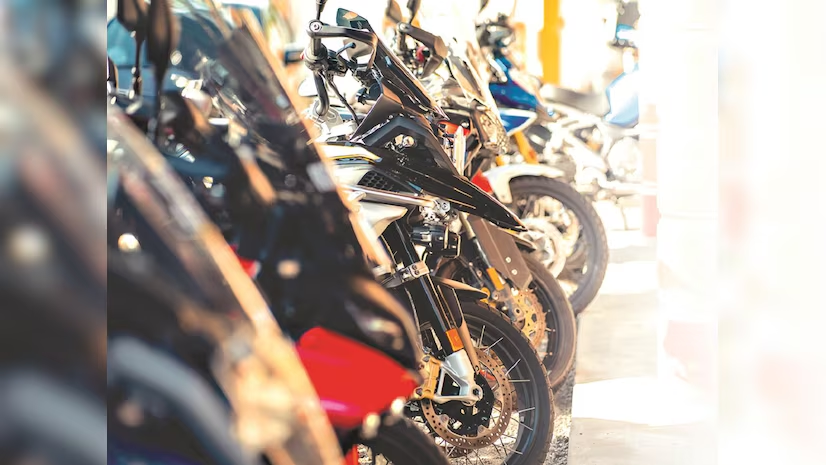

Automobile industry body SIAM is expected to resist the immediate implementation of RDE testing requirements for two-wheelers, citing concerns over equipment weight, accuracy and lack of real-world data
New Delhi: India’s two-wheeler manufacturers are preparing to oppose the immediate introduction of Real Driving Emissions (RDE) measurement norms for motorcycles and scooters under the proposed BS7 emission regime, according to industry sources.
The issue has reportedly been discussed internally by major two-wheeler manufacturers through the Society of Indian Automobile Manufacturers (SIAM). Automakers have raised concerns about whether the testing framework and technology required for RDE testing of two-wheelers are sufficiently mature for immediate implementation.
Concerns over testing equipment
One of the key concerns raised by two-wheeler manufacturers relates to the Portable Emissions Measurement System (PEMS) equipment used to measure emissions during real-world road testing.
According to industry discussions, the equipment can be relatively heavy when mounted on a motorcycle. Manufacturers argue that the additional weight itself can influence the vehicle’s performance and potentially increase emissions during the test.
This, they believe, could affect the accuracy and representativeness of the results.
For two-wheelers, the issue is particularly important because motorcycles and scooters are considerably lighter and have different weight and packaging characteristics compared with passenger cars and commercial vehicles.
Lack of a standard RDE cycle for two-wheelers
Manufacturers have also highlighted the absence of a sufficiently developed RDE cycle specifically designed for two-wheelers.
An RDE cycle essentially defines the real-world conditions under which a vehicle’s emissions are measured. It can include factors such as:
- Vehicle speed
- Acceleration and deceleration
- Traffic conditions
- Road gradients
- Ambient temperature
- Riding patterns
- Duration and distance of the test
Industry players argue that a standardised and scientifically validated testing pattern for Indian two-wheelers needs to be developed before mandatory implementation.
Insufficient real-world emissions data
Another concern is the limited availability of real-world emissions data for motorcycles and scooters.
Manufacturers believe a substantial database covering different types of two-wheelers, riding conditions and geographic environments would be necessary to establish reliable emission limits.
Without adequate real-world data, companies could face difficulties in determining whether a particular vehicle’s emissions performance accurately reflects normal usage conditions.
What is RDE?
Real Driving Emissions (RDE) testing is designed to measure pollutants emitted by vehicles while they are being driven on actual roads rather than only under controlled laboratory conditions.
The objective is to ensure that vehicles meet emission standards not only during certification tests but also under practical driving conditions.
RDE testing has become increasingly important globally as regulators seek to reduce the gap between laboratory emission results and emissions produced during everyday vehicle operation.
Why BS7 matters
India is preparing for the next generation of vehicle emission regulations, commonly referred to as BS7.
The proposed regime is expected to further tighten emission requirements for vehicles and could introduce more stringent testing and compliance requirements across vehicle categories.
For India’s two-wheeler industry, however, the transition presents particular technical challenges because motorcycles and scooters have different vehicle architectures, lower mass and different operating patterns compared with cars.
The industry therefore wants sufficient time to develop appropriate testing methodologies before RDE requirements are introduced.
Industry’s likely position
The industry’s position is not necessarily opposition to RDE testing itself. Instead, manufacturers are seeking a phased and technically robust approach.
Their concerns centre on ensuring that:
- Testing equipment is sufficiently lightweight and accurate for two-wheelers.
- A scientifically validated RDE cycle is developed specifically for motorcycles and scooters.
- Adequate real-world emissions data is collected.
- Testing procedures are standardised before mandatory compliance begins.
- Manufacturers receive adequate time to adapt their products and testing infrastructure.
Balancing cleaner mobility with industry readiness
India’s two-wheeler sector plays a crucial role in everyday mobility, particularly in urban and semi-urban areas. At the same time, tightening emission standards are essential for improving air quality and reducing vehicular pollution.
The challenge for policymakers will therefore be to balance environmental objectives with technological readiness.
If RDE requirements are introduced without a sufficiently mature testing framework, manufacturers argue that the results could be affected by factors unrelated to the actual emissions performance of the vehicle.
The industry’s discussions with policymakers are expected to focus on developing a testing system that is both stringent and scientifically reliable.
Key Takeaway
India’s major two-wheeler manufacturers, through SIAM, are preparing to push back against the immediate implementation of RDE norms for two-wheelers under BS7.
Their primary concerns include the weight and accuracy of portable emissions-testing equipment, the absence of a mature two-wheeler-specific RDE cycle and insufficient real-world emissions data.
The industry is likely to seek more time and a phased approach so that the RDE framework can be properly developed before becoming a mandatory requirement.