

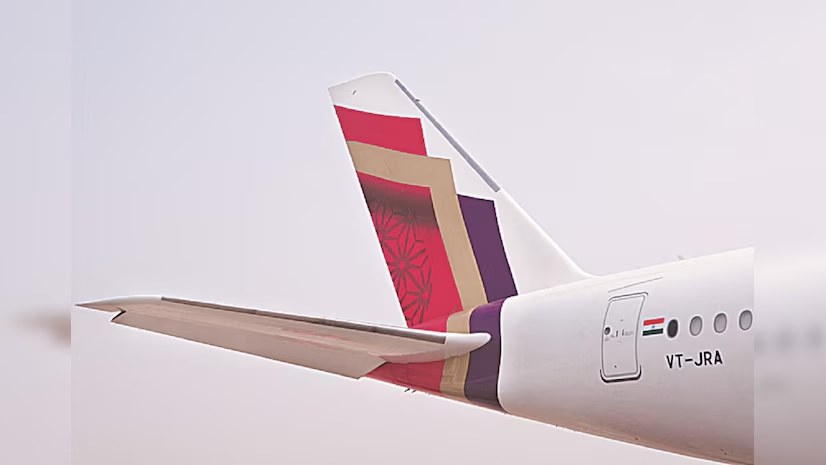

New Delhi: The pilot-in-command of Air India flight AI2379, which experienced a sudden loss of altitude while flying from Phuket to Delhi on August 4, has reportedly failed a second post-flight test for psychoactive substances, according to people familiar with the development.
The pilot’s second test was reportedly non-negative for marijuana, raising further questions as the investigation into the serious aviation incident continues.
“The pilot-in-command has failed the second dope test. His result was non-negative for marijuana,” a person familiar with the matter said.
The Ministry of Civil Aviation (MoCA) has not officially commented on the reported test result.
24 People Injured After Sudden Altitude Loss
Air India flight AI2379, an Airbus A320 operating from Phuket to Delhi, experienced a sudden loss of approximately 300 feet in altitude on August 4.
The incident resulted in injuries to 24 people, including 20 passengers and four crew members.
The aircraft was carrying 137 passengers, including three infants, along with eight crew members, comprising two pilots and six cabin crew.
The aircraft subsequently landed safely in Delhi. Following the incident, both pilots underwent the mandatory screening process for psychoactive substances.
Initial Test Was Reportedly Non-Negative
The development comes shortly after the Ministry of Civil Aviation confirmed that the initial screening of the pilot-in-command was “non-negative.”
The sample was subsequently sent to a designated laboratory for confirmatory testing.
Both pilots were also removed from the flying roster pending the outcome of the investigation.
AAIB Leads Investigation
Based on information received from the Directorate General of Civil Aviation (DGCA) and considering the nature of the incident, the Aircraft Accident Investigation Bureau (AAIB) has taken up the investigation.
The AAIB has classified the Phuket-Delhi incident as a “serious incident.”
The investigation has also received participation from France’s aviation accident investigation agency, the Bureau of Enquiry and Analysis for Civil Aviation Safety (BEA), as well as aircraft manufacturer Airbus.
The AAIB has urged the media and public not to draw conclusions from incomplete or unverified information while the investigation remains underway.
The agency said that certain records, statements, medical information and other material collected during the investigation are protected and confidential under the applicable investigation framework.
Air India CEO Campbell Wilson Summoned by MoCA
Meanwhile, Air India CEO Campbell Wilson was summoned to the Ministry of Civil Aviation on Tuesday to brief senior government officials about the incident.
Wilson met senior officials from the MoCA and DGCA and provided an update on the investigation into flight AI2379.
Officials also asked Wilson to address various departments within the airline regarding the incident, amid concerns over passenger confidence in Air India.
The latest incident comes against the backdrop of the Air India AI171 crash in June 2025, which killed 260 people, including 241 people on board and 19 people on the ground.
The crash involved a Boeing 787-8 operating from Ahmedabad to London Gatwick and occurred shortly after take-off.
Wilson: Investigation Update Provided to Ministry
Speaking to reporters after leaving the ministry on Tuesday, Campbell Wilson said the meeting was focused on providing an update on the status of the investigation.
“We were just giving an update on the status of the investigation,” Wilson said, adding that it was up to the Civil Aviation Minister to provide any further update.
Investigation Continues
The reported second non-negative test involving the pilot is now another significant development in the investigation into the Phuket-Delhi flight incident.
However, authorities have yet to establish whether the reported test result had any connection with the aircraft’s sudden altitude loss.
The AAIB investigation remains ongoing, and officials have stressed that conclusions should be drawn only after the relevant evidence and technical findings have been fully examined.