


Solar, wind and hybrid projects within 50 km of the LoC, LAC and International Border will require security clearance
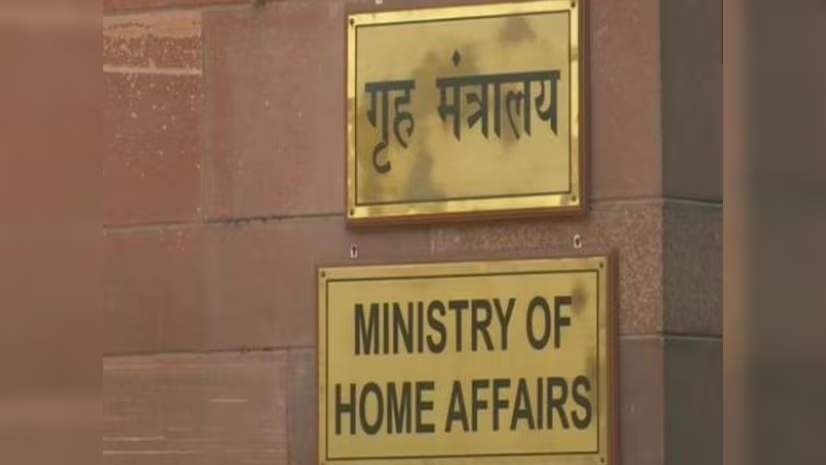
New Delhi : The Ministry of Home Affairs (MHA) has issued new national security guidelines for renewable energy projects proposed in border areas, restricting the development of new solar, wind and hybrid energy projects within 1 kilometer of India’s International Border, Line of Control (LoC) and Line of Actual Control (LAC).
The guidelines, issued by the MHA’s Internal Security Wing, designate areas within 50 km of the LoC, LAC and International Border as “sensitive areas” and introduce additional security-clearance requirements for renewable energy projects proposed in these zones.
The move comes amid an increasing number of applications for solar, wind and hybrid renewable energy projects in border regions and concerns that some such developments could have national security implications.
No Project Activity Within 1 Km of Border
Under the new guidelines, the 1-km zone along the LoC, LAC and International Border will be strictly restricted.
No new solar, wind or hybrid renewable energy project activity will be permitted within this area.
For projects proposed between 1 km and 50 km from the border, security clearance from the Ministry of Home Affairs will be mandatory.
A separate No-Objection Certificate (NOC) from the Ministry of Defence (MoD) will be required for projects located between 1 km and 20 km from the International Border.
Projects Within 50 Km Classified as Sensitive
The MHA has established the following broad security framework:
| Distance from Border | Requirement |
|---|---|
| 0–1 km | No project activity permitted |
| 1–20 km | MHA security clearance and MoD NOC, assessed case by case |
| 20–50 km | MHA security clearance required |
The ministry said applications in the permitted zones will be examined on a case-by-case basis, taking into account national security considerations.
Restrictions on Foreign Personnel
The guidelines also introduce restrictions concerning the employment of personnel from countries sharing a land border with India.
Engineers, staff, employees and labourers from such countries—including Pakistan, Bangladesh and China—cannot be engaged for project implementation without prior permission from the Central Government.
Project applicants will also be required to ensure that their employees involved in implementation are pre-verified before entering project sites.
Personnel must follow instructions issued by the local police and Border Security Force (BSF) operating along the International Border.
Land Cannot Be Transferred to Foreign Companies Without Approval
The MHA guidelines also place restrictions on the transfer of project land.
Applicants will not be permitted to transfer land to a foreign company without prior approval of the Central Government, including the necessary security clearance from the MHA.
Where a proposed project involves foreign investment, a separate application must also be submitted to the Department for Promotion of Industry and Internal Trade (DPIIT) under India’s Foreign Direct Investment policy.
MNRE to Act as Nodal Ministry
Applications for renewable energy projects covered by the guidelines will have to be submitted through the Ministry of New and Renewable Energy (MNRE).
MNRE will forward the proposal to the MHA for security clearance and to the Ministry of Defence for an NOC wherever required.
The application will be accompanied by the concerned State Government’s in-principle approval for land allotment, including the project’s precise latitude and longitude.
MNRE will communicate the final decision to the project developer only after receiving the required MHA security clearance and MoD NOC.
Projects Should Not Create Long Parallel Structures Along Borders
The guidelines specifically direct MNRE to ensure that land is allocated in a way that prevents project construction from extending over a long distance parallel to the International Border.
This provision is intended to address potential security and operational concerns arising from large infrastructure installations running alongside sensitive border zones.
Anti-Drone Systems and Security Infrastructure Mandatory
Renewable energy projects located in sensitive areas will be required to establish comprehensive security arrangements.
These may include anti-drone systems and related security equipment, which will be operated by the Central Industrial Security Force (CISF) or State Police, as applicable.
The project developer will bear the cost of the required security equipment.
Dedicated Police Posts Required
The guidelines also require projects in sensitive areas to have a dedicated police post attached to the project site.
The police post will be responsible for checking and monitoring construction activities.
The guidelines further require monitoring of foreign nationals entering project areas and strengthened verification of personnel involved in project implementation.
Roads Must Also Support Security Forces
Project developers have been instructed to consider adequately wide roads while planning construction.
These roads should be capable of being used by the Border Security Force and Armed Forces during emergency situations, if required.
The provision effectively requires renewable energy infrastructure in sensitive areas to take national security and emergency mobility requirements into account during the planning stage.
Restrictions on Accommodation and Crowded Facilities
The MHA has also introduced restrictions on residential and commercial facilities within sensitive project areas.
Facilities such as:
- Accommodation
- Hotels
- Housing facilities
- Crowd-attracting establishments
will not be permitted in locations where security arrangements could be compromised.
The guidelines specify that accommodation and hotels should be located at least 5 km from the border.
However, cafeterias may be located within the plant premises, subject to applicable security requirements.
Height Restrictions for Civil Infrastructure
The guidelines also establish maximum height limits for civil infrastructure used for project operation and maintenance in sensitive zones.
| Sensitive Zone | Maximum Infrastructure Height |
|---|---|
| 1–8 km | 3 metres |
| 8–20 km | 5 metres |
| 20–50 km | 15 metres |
These restrictions are intended to ensure that renewable energy infrastructure does not create additional security or surveillance concerns in strategically sensitive locations.
Existing Cleared Projects Exempt
The MHA has clarified that projects which have already received security clearance from the Ministry of Home Affairs before the issuance of the new guidelines will not have to reapply.
Similarly, projects that have already obtained an NOC from the Ministry of Defence will not be required to seek a fresh NOC under the new framework.
This provision is expected to provide certainty to developers whose projects had already completed the required security-clearance process.
Uniform Guidelines Aim to Balance Security and Ease of Doing Business
The MHA said the new framework has been formulated as uniform and transparent guidelines after consultations with relevant stakeholders.
According to the ministry, the guidelines seek to balance national security requirements with ease of doing business and provide greater clarity to renewable energy developers planning projects in border areas.
The framework is particularly significant as India continues to expand its solar and wind energy capacity while simultaneously strengthening security infrastructure along its sensitive borders.
Key Highlights
- No new solar, wind or hybrid renewable energy projects within 1 km of the LoC, LAC or International Border.
- Projects within 50 km of these borders are classified as sensitive.
- MHA security clearance is mandatory for projects within the 1–50 km zone.
- Projects within 1–20 km of the International Border require an additional MoD NOC.
- Engagement of personnel from land-border countries requires Central Government permission.
- Foreign investment requires separate compliance under the FDI framework.
- Anti-drone and other security systems may be mandatory, with costs borne by project developers.
- Sensitive projects must have a dedicated police post and verified personnel.
- Roads should be designed to facilitate emergency movement of security forces.
- Hotels and accommodation must be located at least 5 km from the border.
- Civil infrastructure height is capped at 3 m, 5 m and 15 m depending on distance from the border.
- Projects that already have valid MHA security clearance or MoD NOC do not need to reapply.
The new guidelines establish a significantly tighter security framework for renewable energy development in India’s border regions while providing a standardized approval mechanism for projects that can safely operate in sensitive areas.