


Discovery solves a century-old mystery and could change scientists’ understanding of when the famous red supergiant will explode
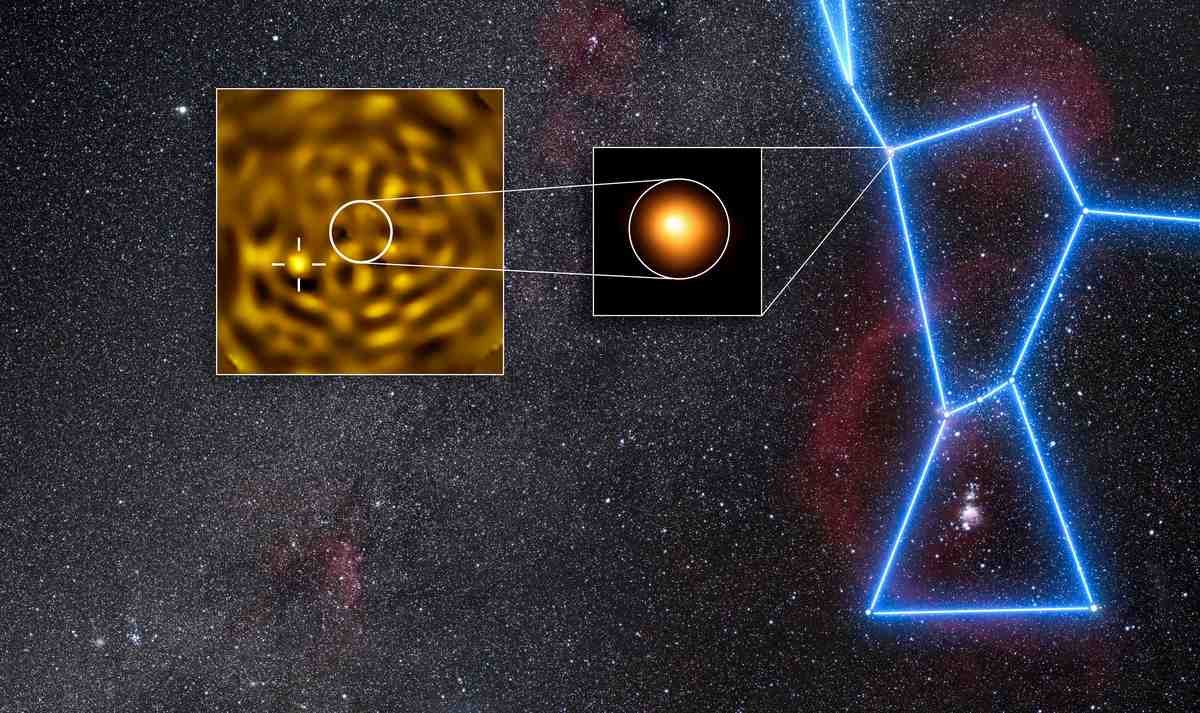
WASHINGTON — : Betelgeuse, one of the brightest and most recognizable stars in the night sky, is not alone. Astronomers have obtained the first unambiguous direct image of a companion star orbiting Betelgeuse, confirming that the famous red supergiant is part of a binary star system.
The discovery was made using the Very Large Telescope (VLT) operated by the European Southern Observatory (ESO) in Chile. The finding resolves a mystery that astronomers have investigated for approximately a century and could have important implications for understanding Betelgeuse’s evolution and eventual supernova explosion.
The study was led by astronomer Miguel Montargès of the Laboratory of Instrumentation and Research in Astrophysics (LIRA) at the Paris Observatory and was published in the journal Astronomy & Astrophysics.
Betelgeuse Is Not a Lone Star
Betelgeuse, pronounced “beetle juice,” is a massive red supergiant located in the constellation Orion.
Astronomers have long suspected that the star might have a companion because of variations in its brightness and other observed characteristics. However, previous evidence had not provided a direct and definitive image of another star orbiting it.
The new observations have now provided that confirmation.
Montargès described the discovery as particularly remarkable because Betelgeuse has been observed by humans for thousands of years, yet one of its fundamental characteristics—its companion—has only now been directly detected.
A Giant Star With an Even Smaller Companion
Betelgeuse is enormous compared with the Sun.
Researchers estimate that Betelgeuse has a mass approximately 16.5 to 19 times that of the Sun, while its physical size is estimated to be roughly 750 to 850 times the Sun’s diameter.
The companion is considerably smaller but still a substantial star, with an estimated mass of approximately 2.6 to 3.1 times the Sun’s mass and a diameter roughly 1.8 to 2 times that of the Sun.
Betelgeuse is estimated to shine approximately 100,000 times brighter than the Sun, while its companion has a luminosity of up to approximately 92 times that of the Sun.
The Two Stars Are Gravitationally Bound
Betelgeuse and its companion are gravitationally bound and orbit one another.
Their separation is roughly comparable to the distance of Saturn’s orbit around the Sun, or approximately 8.8 times the average distance between Earth and the Sun.
The two stars are located approximately 500 to 600 light-years from Earth.
Despite this enormous distance, the exceptional brightness of Betelgeuse has allowed astronomers to study the system in extraordinary detail.
A Century-Old Astronomical Mystery
Scientists have suspected for roughly 100 years that Betelgeuse might have a companion.
Several studies in recent years produced increasingly strong evidence for another star, but the new observation represents the first direct and unambiguous detection.
The discovery is also consistent with what astronomers understand about massive stars.
Massive stars frequently occur in binary or multiple-star systems, and researchers believe that extremely massive stars may rarely—or perhaps never—form completely alone.
According to Montargès, models of massive-star formation suggest that such stars should generally have companions.
The Companion Could Affect Betelgeuse’s Future
The discovery may have a major impact on predictions concerning when Betelgeuse will explode as a supernova.
Betelgeuse is believed to be in the late stages of its stellar life. It has expanded dramatically and is expected eventually to end its life in a powerful supernova explosion.
Before the companion was confirmed, astronomers generally estimated that the explosion could occur sometime within approximately 10,000 to 100,000 years.
That estimate may now be much less certain.
Because the two stars interact gravitationally, their relationship could influence Betelgeuse’s evolution. Depending on how the stars interact, the companion could potentially accelerate or delay the timing of the eventual supernova.
Researchers therefore say that determining exactly when Betelgeuse will explode has become more complicated.
Why Does Betelgeuse Change Brightness?
Betelgeuse is famous for its dramatic changes in brightness.
Earlier research suggested that at least some of these variations are caused by large amounts of material expelled from the star. As the material cools, it can form dust that temporarily blocks some of Betelgeuse’s light from reaching Earth.
The newly confirmed companion adds another factor that astronomers will need to consider when studying the system’s behavior.
Future observations could help determine whether interactions between the two stars contribute to some of the changes observed in Betelgeuse.
A Star Near the End of Its Life
Betelgeuse is estimated to be approximately 10 million years old, making it extremely young compared with the Sun.
The Sun is approximately 4.5 billion years old and is expected to have a total lifetime of roughly 10 billion years.
Massive stars such as Betelgeuse consume their nuclear fuel much faster than smaller stars like the Sun. As a result, although Betelgeuse is only a fraction of the Sun’s age, it has already reached the final stages of stellar evolution.
Its enormous size illustrates just how extreme the star is: if Betelgeuse were placed at the center of our solar system, its surface would extend beyond the orbit of Jupiter.
The Supernova Timeline Is Now Uncertain
The discovery does not mean that Betelgeuse is about to explode.
Instead, it highlights how difficult it is to predict the exact timing of a supernova for a massive star.
The newly identified companion could have interacted with Betelgeuse in the past or could interact with it in the future. Either scenario could alter the star’s evolutionary path.
As Montargès put it, scientists can no longer be as confident about the previously estimated supernova timeline.
Key Facts About the Betelgeuse System
- Betelgeuse: A massive red supergiant in the constellation Orion.
- Distance from Earth: Approximately 500–600 light-years.
- Mass: About 16.5–19 times the Sun’s mass.
- Size: Approximately 750–850 times the Sun’s diameter.
- Brightness: Roughly 100,000 times the Sun’s luminosity.
- Companion mass: Approximately 2.6–3.1 solar masses.
- Companion size: Around 1.8–2 times the Sun’s diameter.
- Orbital separation: Roughly comparable to Saturn’s distance from the Sun.
- Age: Approximately 10 million years.
- Expected fate: A future supernova explosion, although its timing is now more uncertain.
- Discovery: First direct and unambiguous imaging of Betelgeuse’s companion.
The discovery gives astronomers a new opportunity to study one of the most famous stars in the sky—and could provide valuable clues about how massive binary stars evolve, interact and ultimately die.