

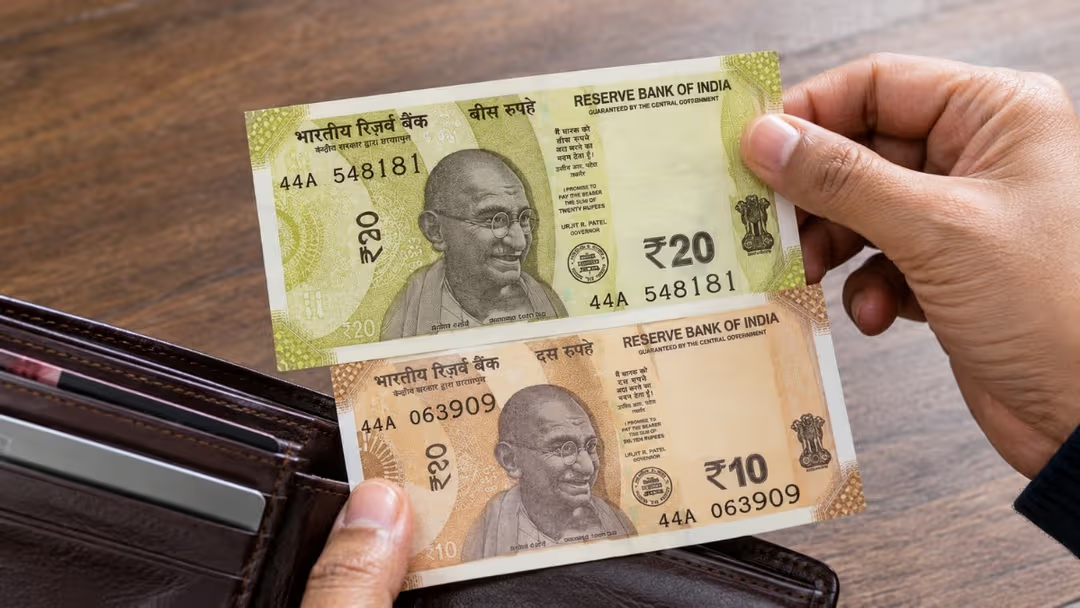

New Delhi |: India is preparing to introduce its first-ever polymer (plastic) currency notes, with the Reserve Bank of India (RBI) targeting a rollout from April 2027, subject to the successful completion of field trials. The announcement was made by RBI Governor Shri Sanjay Malhotra following the Monetary Policy Committee (MPC) meeting held on August 5, 2026.
The move marks a significant step towards enhancing the durability, security, and efficiency of India’s currency system. However, the RBI has clarified that the pilot phase will be limited to ₹10 and ₹20 denominations, and there are no plans to replace existing paper currency.
Pilot to Begin with ₹10 and ₹20 Notes
According to the RBI Governor, the central bank will initially introduce polymer notes only in the ₹10 and ₹20 denominations to evaluate their performance under real Indian conditions.
The Government of India has already approved the printing of:
- 1 billion ₹10 polymer notes
- 1 billion ₹20 polymer notes
This brings the total number of polymer notes planned for the pilot phase to 2 billion pieces.
These notes will circulate alongside existing paper currency, and both versions will remain legal tender.
No Plan to Replace Existing Paper Currency
The RBI has emphasized that the introduction of polymer notes is not a currency replacement programme.
Instead, the new notes will coexist with traditional paper notes, allowing the central bank to study their durability, public acceptance, and operational performance before making any decision on wider adoption.
Higher denomination notes such as ₹50, ₹100, ₹200, ₹500, and ₹2,000 (where applicable) will continue to be printed on paper for the foreseeable future.
Why ₹10 and ₹20 Notes Were Chosen
The RBI has strategically selected ₹10 and ₹20 notes because they are among the most frequently used currency denominations in India.
Although these notes account for a large share of the total number of banknotes in circulation, they represent only a small percentage of the overall currency value.
Due to constant handling, they:
- Wear out quickly
- Become dirty faster
- Tear more easily
- Require frequent replacement
Testing polymer technology on these high-circulation denominations allows the RBI to assess durability while minimizing financial risk.
Advantages of Polymer Notes
Polymer banknotes have already been successfully adopted by several countries, including Australia, Canada, the United Kingdom, New Zealand, and Singapore.
Compared to traditional paper currency, polymer notes offer several benefits:
- Last two to four times longer
- Greater resistance to water, moisture, dirt, and dust
- Higher resistance to tearing and damage
- Enhanced security features against counterfeiting
- Lower long-term printing and replacement costs
These advantages make polymer currency particularly suitable for India’s diverse climatic conditions and heavy cash usage.
Global Tender for Polymer Material
As part of the preparation for the pilot project, the RBI’s printing subsidiary, Bharatiya Reserve Bank Note Mudran Private Limited (BRBNMPL), has already floated a global tender for procuring the specialized polymer substrate required to manufacture the new notes.
This marks an important milestone in the implementation process.
What It Means for the Public
The RBI has clarified that people will not see an overnight replacement of currency.
Instead, once introduced, both paper and polymer ₹10 and ₹20 notes will circulate simultaneously.
Consumers can expect to receive either version from:
- Banks
- ATMs (where compatible)
- Retail stores
- Local markets
- Commercial establishments
As polymer notes become more common, banks and ATM operators may gradually upgrade their systems to accommodate the new material if the pilot proves successful.
A Revival of an Earlier Proposal
India had previously considered introducing polymer currency more than a decade ago.
A pilot project was proposed between 2009 and 2014, but the initiative was eventually shelved due to technical challenges and other implementation issues.
With advancements in polymer technology, improved security features, and a stronger supply chain, both the Government of India and the Reserve Bank of India have now revived the initiative with renewed confidence.
RBI’s Road Ahead
If the pilot project demonstrates satisfactory performance under Indian conditions, the RBI may consider expanding the use of polymer notes to additional denominations in the future.
For now, the focus remains on evaluating the performance of ₹10 and ₹20 polymer notes before taking any further decisions.
With the proposed launch targeted for April 2027, India is set to join a growing list of countries using advanced polymer banknotes, aiming to enhance currency durability, security, and cost efficiency, while ensuring a smooth transition without disrupting the existing paper currency system.