

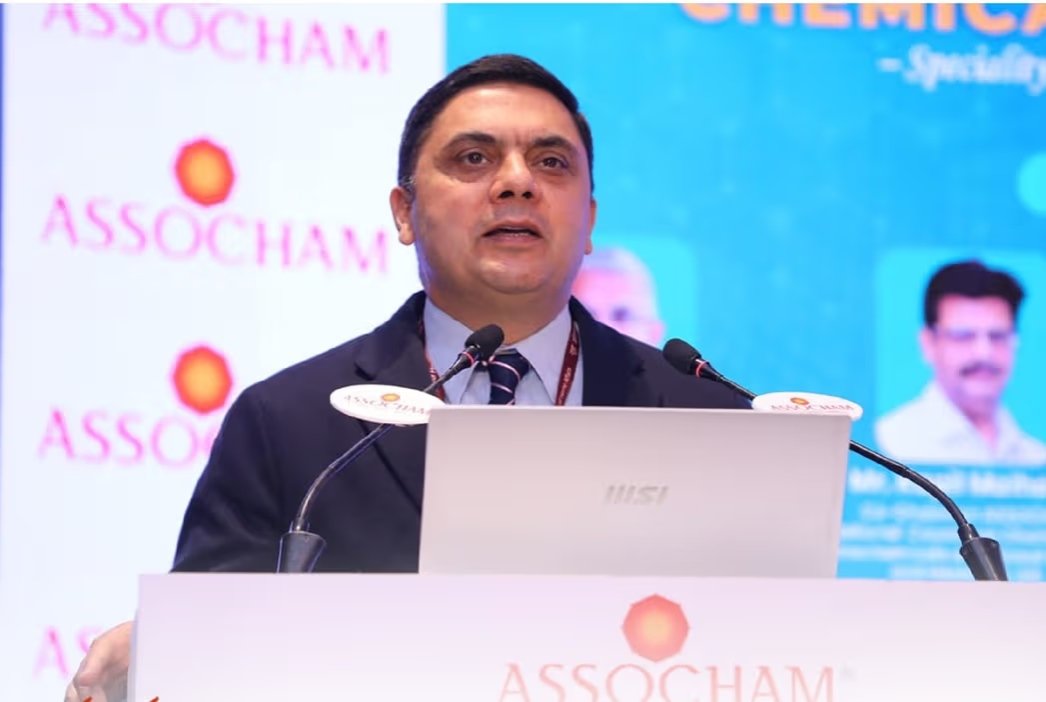

New Delhi — Amid rising geopolitical tensions and continuing disruptions in global supply chains, India’s specialty chemicals industry must accelerate its journey toward self-reliance and capacity expansion, according to senior government officials and industry leaders speaking at the India Specialty Chemicals Conclave organized by ASSOCHAM in New Delhi.
The conclave brought together policymakers, industry executives, and experts to discuss the future roadmap for one of India’s fastest-growing industrial sectors, which has increasingly emerged as a globally competitive and reliable manufacturing destination.
Addressing the gathering, Tejveer Singh, Secretary, Department of Chemicals & Petrochemicals (DOCP), Government of India, highlighted the strategic importance of the specialty chemicals sector in the current global environment.
“The West Asia crisis has triggered significant supply chain disruptions, and in an era of global uncertainty, it is essential for the specialty chemicals sector to become more self-reliant,” Singh said. “This sector carries the second-largest import bill after petroleum, and India’s trade deficit in chemicals has expanded substantially over the years. Its importance cannot be overstated, as it supports the entire industrial foundation of the country.”
Singh also outlined several government initiatives aimed at strengthening India’s chemicals ecosystem. In line with the Union Budget announcement, the government is establishing three dedicated chemical parks, each spanning approximately eight square kilometers, with an investment allocation of ₹1,000 crore over a five-year period.
In addition, he noted that 18 Centers of Excellence established across technical institutions in India are conducting advanced research and innovation work. He encouraged industry stakeholders to collaborate closely with these institutions to strengthen industry-academia partnerships and accelerate technological advancement.
The Secretary further revealed that industry data collection for the Ministry of Statistics and Programme Implementation’s Index of Industrial Production (IIP) will now be conducted monthly, with the number of reporting units expanded from 245 to nearly 400, making the index more representative of the sector’s actual performance.
Opening the conclave, Sagar Kaushik, Chairman of ASSOCHAM National Council on Chemicals & Petrochemicals, emphasized the enormous growth potential of the industry.
“A transformative journey is underway to reposition India’s chemicals and specialty chemicals sector toward achieving the targeted $1 trillion output milestone by 2040,” Kaushik stated. “This growth will require unprecedented capacity creation because domestic demand is expanding rapidly. Failure to meet that demand could significantly increase imports. The industry needs a level playing field to unlock its full potential.”
Industry leaders also raised concerns regarding trade policies and international competition.
Kapil Malhotra, Co-Chairman of the council, cautioned that free trade agreements (FTAs) with smaller economies could widen India’s trade deficit if not structured carefully.
“Many smaller countries may not provide a sufficiently large market for Indian products, while India itself represents a massive market for them,” Malhotra said. “FTAs should be designed to ensure a balanced and mutually beneficial outcome for all participating countries.”
Meanwhile, Nilesh A. Kulkarni highlighted the resilience of India’s domestic chemical market despite mounting global challenges.
“India’s chemical market continued to show strong resilience in 2025 and is steadily moving toward the projected $250–300 billion milestone by 2030,” Kulkarni said. “However, the West Asia crisis has intensified margin pressures due to destocking and aggressive capacity dumping from China and other countries. India must strengthen its feedstock and downstream specialty chemical ecosystem to create high-value products and enhance self-reliance.”
During the conclave, ASSOCHAM and PwC jointly launched a comprehensive knowledge report on the sector. Discussions throughout the event focused on innovation, export-led growth, advanced chemical applications in emerging industries, improved safety standards, energy-efficient manufacturing, and sustainable industrial practices.
India’s specialty chemicals industry has rapidly evolved into a critical pillar of the country’s manufacturing and export ecosystem. With increasing global demand diversification away from traditional manufacturing hubs, industry experts believe India has a unique opportunity to position itself as a long-term global chemicals powerhouse.