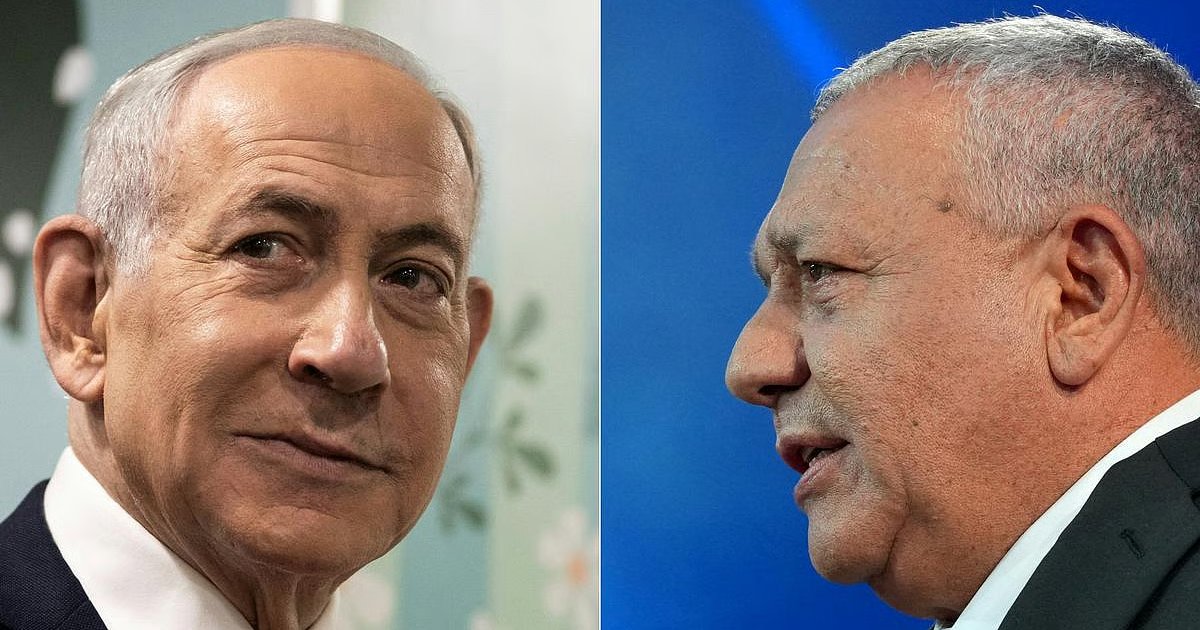

Talks between Israeli caretaker Prime Minister Benjamin Netanyahu and Yashar party chairman Gadi Eisenkot over the formation of a national unity government appeared to collapse on Sunday, with senior Likud leaders attacking Eisenkot and warning his prospective coalition partners against joining his government.
The two leaders held nearly two hours of discussions at the Kirya military headquarters in Tel Aviv. The meeting began with a security briefing before moving to negotiations over the formation of a government.
In a joint statement, Likud and Yashar described the meeting as “businesslike”, acknowledging that significant differences remained between the two sides.
However, no further meetings between their negotiating teams were reportedly scheduled.
Eisenkot conveyed to Netanyahu that he remained committed to his existing political allies and that Likud could join his government after its formation, provided it accepted the coalition’s guiding principles.
𝗟𝗶𝗸𝘂𝗱 𝗺𝗶𝗻𝗶𝘀𝘁𝗲𝗿𝘀 𝘁𝗮𝗿𝗴𝗲𝘁 𝗘𝗶𝘀𝗲𝗻𝗸𝗼𝘁
Following the apparent breakdown of negotiations, senior Likud ministers launched a series of attacks against Eisenkot and his prospective coalition partners.
Culture Minister Miki Zohar warned United Torah Judaism (UTJ), a former Netanyahu ally currently negotiating with Eisenkot, that joining the proposed government could permanently damage its relationship with Israel’s right-wing bloc.
Education Minister Yoav Kisch argued that a government dominated by one political camp would deepen divisions within Israeli society.
Communications Minister Shlomo Karhi also targeted Eisenkot over his efforts to secure the support of Arab lawmakers. Karhi shared an AI-generated image on X depicting Arab politicians Ahmad Tibi and Mansour Abbas burning an Israeli flag with a Hanukkah candle handed to them by Eisenkot.
The attacks came amid growing resistance within Likud to the possibility of Eisenkot forming a government with support from Arab political parties.
𝗡𝗲𝘁𝗮𝗻𝘆𝗮𝗵𝘂’𝘀 𝗽𝗼𝘄𝗲𝗿-𝘀𝗵𝗮𝗿𝗶𝗻𝗴 𝗼𝗳𝗳𝗲𝗿
On Saturday, Netanyahu offered to allow Eisenkot to serve first as prime minister under a rotation agreement, with Netanyahu initially occupying the position of alternate prime minister.
The proposal marked a concession by Israel’s longest-serving prime minister as Eisenkot moved closer to assembling a government that could end Netanyahu’s tenure.
Eisenkot responded by giving Likud 24 hours to demonstrate its willingness to reach a coalition agreement.
However, Israeli media reported that Netanyahu had sought to remain prime minister for an unspecified period before the rotation arrangement took effect, a condition reportedly rejected by Eisenkot.
𝗧𝗵𝗲 𝗻𝘂𝗺𝗯𝗲𝗿𝘀 𝗯𝗲𝗵𝗶𝗻𝗱 𝗜𝘀𝗿𝗮𝗲𝗹’𝘀 𝗽𝗼𝗹𝗶𝘁𝗶𝗰𝗮𝗹 𝗱𝗲𝗮𝗱𝗹𝗼𝗰𝗸
Israel’s October 27 parliamentary elections produced a fractured mandate, with neither of the principal political blocs securing a majority in the 120-member Knesset.
Netanyahu’s alliance of right-wing and ultra-Orthodox parties secured 53 seats, while Eisenkot’s four-party bloc won 48 seats. Two Arab-led parties collectively secured the remaining 19 seats.
A political alliance requires at least 61 lawmakers to command a parliamentary majority.
Eisenkot has already signed coalition agreements with Yair Golan’s Democrats and Avigdor Liberman’s Yisrael Beiteinu. Negotiations with former prime minister Naftali Bennett’s B’Yachad party are continuing.
However, differences over mandatory military service for ultra-Orthodox Jewish men remain a major obstacle to securing additional coalition partners.
While Bennett has opposed sweeping military service exemptions for ultra-Orthodox religious students, such exemptions remain a key demand of United Torah Judaism.
Eisenkot also faces opposition from some of his allies over possible cooperation with Arab political parties.
𝗗𝗲𝗰𝗲𝗺𝗯𝗲𝗿 𝟲 𝗱𝗲𝗮𝗱𝗹𝗶𝗻𝗲
Israeli President Isaac Herzog has given Eisenkot until December 6 to form a government, with a provision for an additional 14-day extension.
Eisenkot has pledged to complete the government formation process without seeking an extension.
The apparent collapse of unity government negotiations has narrowed Netanyahu’s immediate options for retaining power, although Eisenkot is yet to secure the parliamentary majority required to form the next Israeli government.