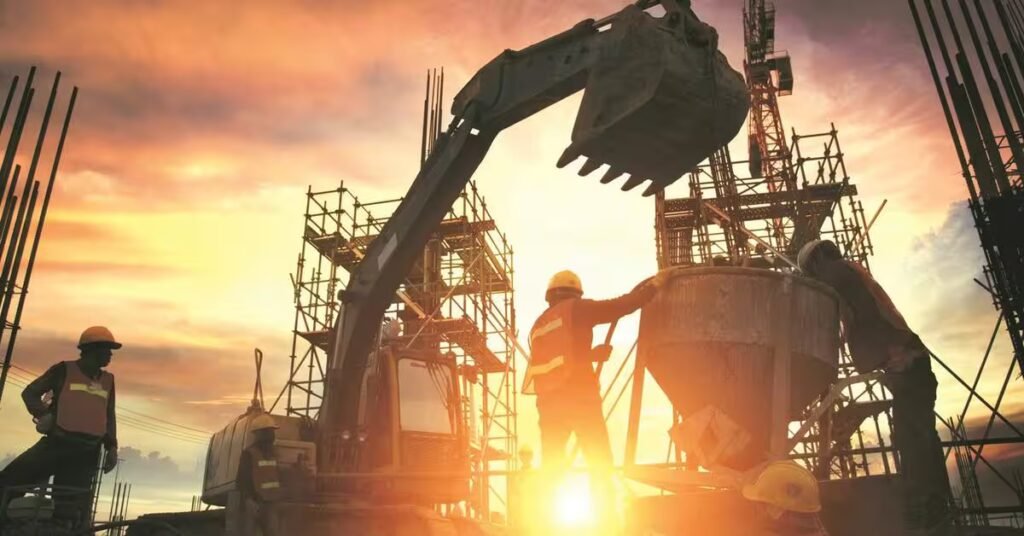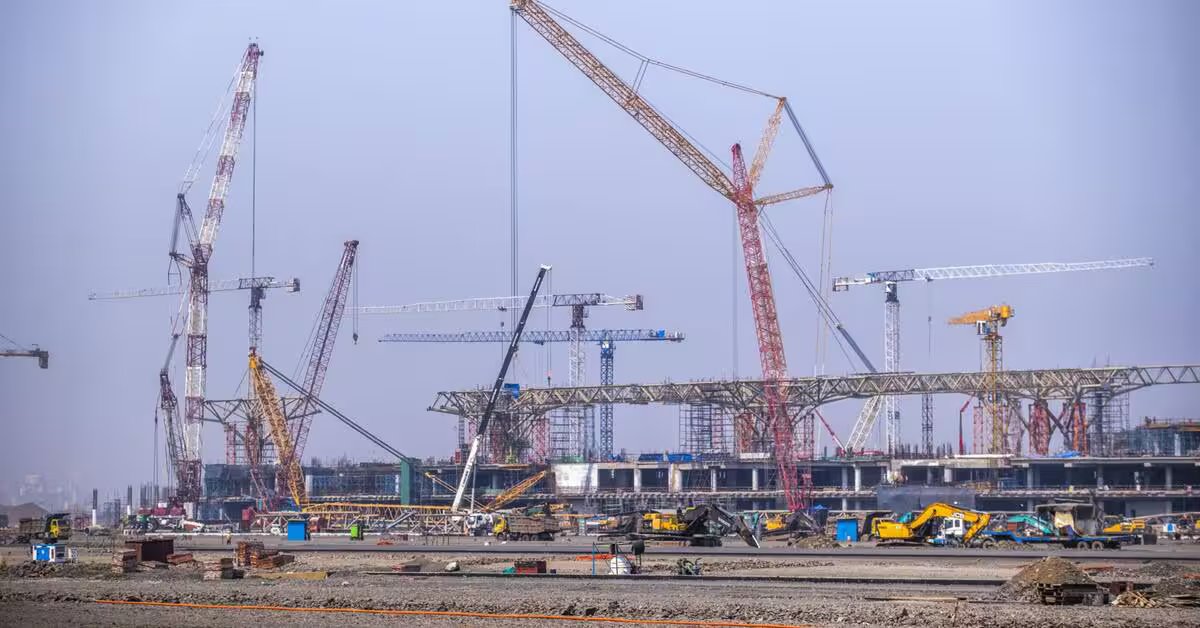

The Union Cabinet on Wednesday approved an ₹11,000 crore scheme to incentivise domestic manufacturing of construction and infrastructure equipment (CIE), including tunnel-boring machines (TBMs), hydraulic excavators and ship-to-shore cranes. The scheme will provide incentives to manufacturers over five years, following a two-year period for setting up manufacturing facilities.
The scheme comes at a time when China has introduced export restrictions on TBMs and related equipment, raising concerns about India’s dependence on foreign suppliers for specialised machinery used in major infrastructure projects (such as the high-speed rail project between Mumbai and Ahmedabad). The restrictions, which came into effect on November 18, require exporters to obtain licences from Chinese authorities before shipping the equipment.
The Indian government on Wednesday, however, did not explicitly link the new incentive scheme — which will be administered by the Ministry of Heavy Industries — to China’s restrictions. “The scheme aims to incentivize domestic manufacturing of CIE and its components and to establish a dedicated CIE testing facility in the country, thereby enhancing self-reliance and positioning India as a key player in the Global CIE market,” the Indian government stated.
India’s CIE industry is currently the world’s third-largest, after China and the United States, with a market size of around ₹97,500 crore in FY25. The government expects the market to more than double to approximately ₹2.28 trillion by FY30, driven by investments in roads, ports, housing and other infrastructure projects.
“Driven by rapid growth in the construction and infrastructure sector, the scheme aims to incentivize manufacturing of technologically advanced equipment such as ship-to-shore cranes, tunnel boring machines, hydraulic excavators, off-highway trucks, etc. The scheme has also provision of establishment of state-of-the-art dedicated CIE testing facilities in the country,” the government stated.
The scheme will run for eight years, starting in 2026-27 (FY27). The first two years, FY27 and FY28, will be a gestation period during which companies can establish manufacturing facilities. This will be followed by five years of incentive disbursements, from FY29 to FY33. The final year, FY34, will be used to settle incentives based on incremental sales recorded in FY33.
The scheme has two components. Under the first, eligible original equipment manufacturers (OEMs) and component manufacturers will receive sales-linked incentives ranging from 8 per cent to 13 per cent of incremental sales over a five-year period. Incremental sales refer to the increase in sales compared with a prescribed base year.
The second component provides a grant of up to ₹375 crore, in the form of viability gap funding, to establish a dedicated testing facility. Viability gap funding is financial support provided by the government to make a project financially feasible when it may not be commercially viable on its own.
The approval follows nearly two years of discussions between the construction equipment industry and the government on providing financial incentives to boost domestic manufacturing. In July 2024, the Indian Construction Equipment Manufacturers’ Association (ICEMA) proposed a dedicated production-linked incentive (PLI) scheme with an outlay of ₹10,000 crore during a meeting with then Finance Secretary T V Somanathan. He is now the Cabinet Secretary.
A PLI scheme provides financial rewards to companies based on additional production or sales, encouraging them to manufacture more products domestically. In the second half of 2025, the government started holding interministerial consultations and preparing the scheme for the CIE sector. The proposal was subsequently announced in the Union Budget for FY27 in February 2026.
Among the companies looking to develop indigenous tunnel-boring machines is state-owned BEML. The company has drawn up plans to manufacture the machines in India, initially focusing on smaller models used in metro rail, hydropower, irrigation and water projects.
BEML plans to initially develop machines with diameters ranging from 3.5 metres to 6.5 metres. Its chairman and managing director, Shantanu Roy, told Bloomberg earlier this month that the company was onboarding a global consultant to support the development process.
The company intends to develop its own technology rather than merely assemble machines using imported components. “It will be an indigenous technology…The IP will be Indian,” Roy stated.
The need to develop domestic manufacturing capabilities has come into focus following China’s restrictions. In 2024, two tunnel-boring machines manufactured by German company Herrenknecht at its facility in Guangzhou, China, for the Mumbai-Ahmedabad bullet train project were held up at a Chinese port for more than a year. The machines eventually arrived in India in March 2026.
Tunnel-boring machines are giant mechanical drills used to excavate underground passages through soil and rock. They are essential for building metro rail corridors, railway tunnels, road tunnels and underground infrastructure.
The new scheme could provide an additional incentive for companies such as BEML to invest in domestic manufacturing. However, their eligibility for benefits will depend on the detailed guidelines and approval process under the scheme.