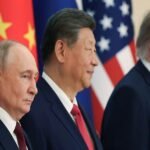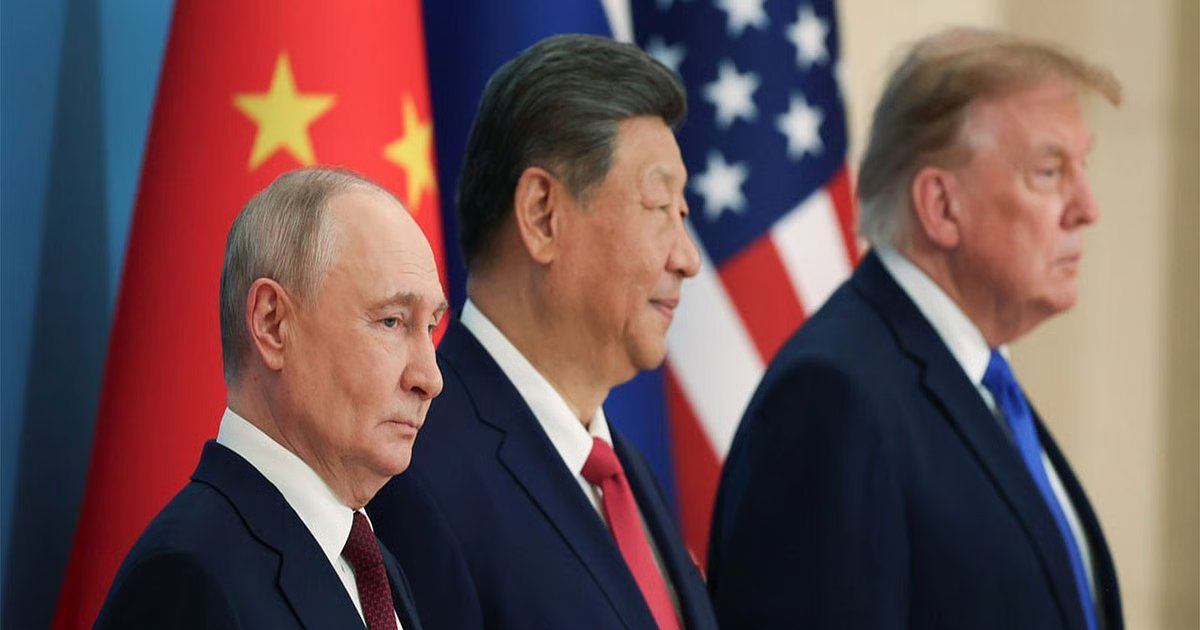

US President Donald Trump, Chinese President Xi Jinping and Russian President Vladimir Putin on Thursday adopted a joint declaration committing their countries to reducing nuclear risks, preventing the proliferation of nuclear weapons and maintaining stable global energy supplies following their first-ever trilateral summit in Shenzhen, China.
The three leaders met at Kylin Villa on the sidelines of the Asia-Pacific Economic Cooperation (APEC) summit, holding discussions lasting approximately 80 minutes before issuing a four-point document titled Declaration toward Peace.
The declaration, released by the Kremlin, Chinese state media and the White House, outlined commitments on United Nations reform, energy cooperation, international legal jurisdiction and nuclear security.
The leaders also expressed their intention to maintain strategic stability and strengthen international security amid continuing geopolitical tensions.
𝐍𝐮𝐜𝐥𝐞𝐚𝐫 𝐫𝐢𝐬𝐤 𝐫𝐞𝐝𝐮𝐜𝐭𝐢𝐨𝐧
One of the central commitments in the declaration concerned the prevention of nuclear conflict.
The three leaders reaffirmed that a nuclear war could not be won and must never be fought, while agreeing to initiate dialogue aimed at reducing nuclear risks and preventing further proliferation.
The commitment comes amid renewed international concern over nuclear arms control, particularly as existing agreements face uncertainty and relations among major nuclear powers remain strained.
Trump had previously expressed interest in pursuing broader nuclear arms control discussions involving both Russia and China.
However, the declaration did not specify a timetable, negotiating framework or concrete targets for reducing nuclear arsenals.
It also made no explicit reference to North Korea’s nuclear weapons programme or the denuclearisation of the Korean Peninsula.
𝐂𝐨𝐦𝐦𝐢𝐭𝐦𝐞𝐧𝐭 𝐭𝐨 𝐔𝐍 𝐫𝐞𝐟𝐨𝐫𝐦
As permanent members of the United Nations Security Council, the United States, China and Russia also committed themselves to pursuing reforms within the international organisation.
According to the declaration, the objective would be to enable the UN to respond more effectively to global challenges while fulfilling its responsibility for maintaining international peace and security.
The three countries acknowledged the importance of strengthening the organisation’s ability to address emerging security threats and international crises.
However, the document did not outline specific institutional changes or indicate whether the proposed reforms would involve the composition of the Security Council, voting arrangements or the exercise of veto powers.
𝐒𝐭𝐚𝐛𝐥𝐞 𝐞𝐧𝐞𝐫𝐠𝐲 𝐟𝐥𝐨𝐰𝐬 𝐩𝐫𝐢𝐨𝐫𝐢𝐭𝐢𝐬𝐞𝐝
Energy security formed another major component of the joint declaration.
The three countries announced plans to increase the production and supply of refined petroleum products for the benefit of nations worldwide.
They also reaffirmed the importance of maintaining stable energy flows at a time when geopolitical conflicts have disrupted international supply chains and created uncertainty in global oil markets.
The commitment comes against the backdrop of continuing tensions in West Asia, including disruptions affecting the movement of energy supplies through strategically important maritime routes.
During separate discussions with Xi, Trump highlighted the shared interest of Washington and Beijing in ensuring uninterrupted energy flows through the Strait of Hormuz.
However, the joint declaration did not identify specific production targets, supply commitments or mechanisms for implementing the proposed cooperation.
𝐈𝐧𝐭𝐞𝐫𝐧𝐚𝐭𝐢𝐨𝐧𝐚𝐥 𝐜𝐨𝐮𝐫𝐭𝐬 𝐚𝐝𝐝𝐫𝐞𝐬𝐬𝐞𝐝
The declaration also addressed the jurisdiction of international judicial institutions, particularly the International Criminal Court (ICC).
The leaders emphasised the importance of state consent and respect for the immunities of government officials under international law.
They further stated that the ICC and similar institutions should not misuse their jurisdiction.
The provision is significant because the ICC has issued an arrest warrant against Putin over allegations relating to the unlawful deportation and transfer of Ukrainian children during Russia’s war in Ukraine.
Russia rejects the court’s jurisdiction and has disputed the allegations.
The United States has also criticised the ICC over investigations involving American personnel and US allies, including Israel.
The declaration did not specify any proposed changes to the ICC’s governing framework or explain how the three countries intended to pursue their stated position.
𝐔𝐤𝐫𝐚𝐢𝐧𝐞 𝐰𝐚𝐫 𝐨𝐦𝐢𝐭𝐭𝐞𝐝
Despite expectations that the summit would address major international conflicts, the four-point declaration made no specific reference to Russia’s war in Ukraine or the conflict involving the United States and Iran.
The omission was notable because Trump had indicated that discussions would include major security challenges and ongoing wars.
Putin referred to the importance of resolving regional conflicts, while Xi emphasised cooperation among major powers as essential to global stability.
Trump described the meeting as an opportunity for the three countries to maintain dialogue despite their differences.
The leaders did not hold a joint press conference following the discussions, and no separate agreement on resolving the Ukraine conflict was announced.
𝐅𝐢𝐫𝐬𝐭 𝐭𝐫𝐢𝐥𝐚𝐭𝐞𝐫𝐚𝐥 𝐬𝐮𝐦𝐦𝐢𝐭
The Shenzhen meeting marked an unprecedented diplomatic engagement among the leaders of the world’s three major nuclear powers.
Xi hosted the summit following a series of bilateral meetings involving Trump and Putin.
The discussions took place amid differences over international security, trade, energy markets and regional conflicts.
While the declaration established broad areas for cooperation, it contained few details about implementation, leaving questions about how the commitments would translate into concrete policy measures.
Nevertheless, the meeting provided a platform for renewed engagement among Washington, Beijing and Moscow at a time of heightened international uncertainty.
The declaration’s significance will depend on whether the three governments follow their stated commitments with negotiations and practical measures on nuclear security, energy cooperation and international governance.