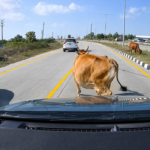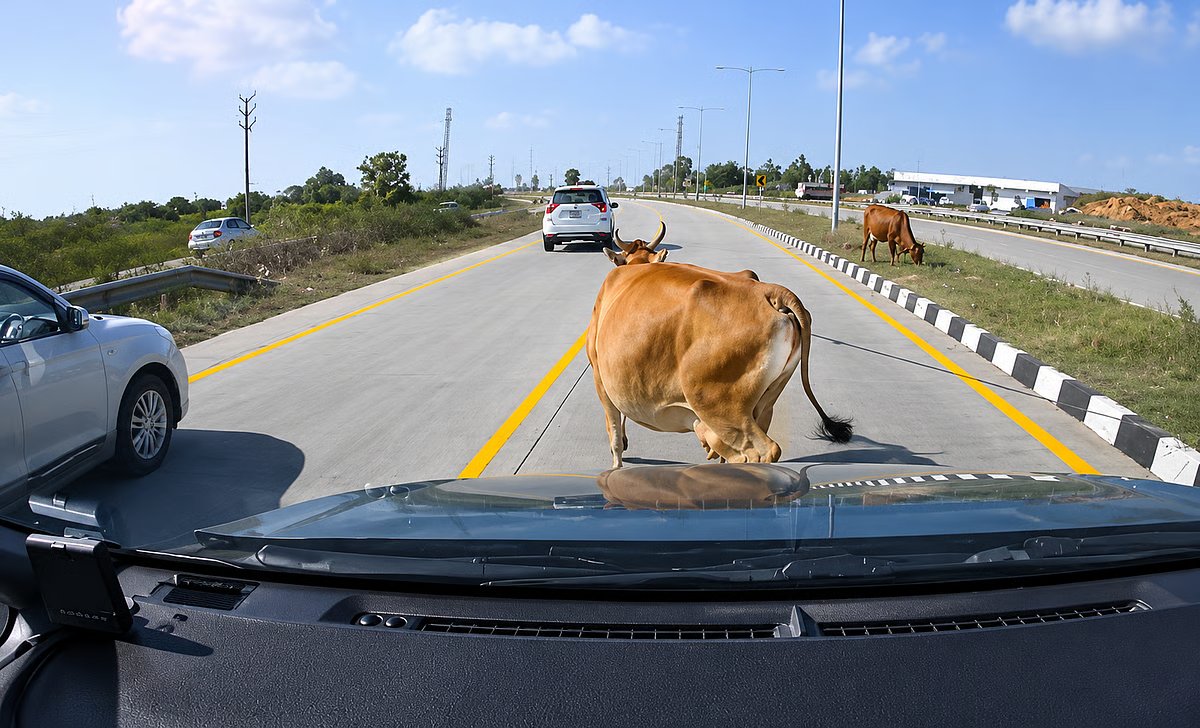

Expressing concern over deaths caused by stray cattle roaming on roads, the Supreme Court on Tuesday asked the National Highways Authority of India (NHAI) to consider establishing animal shelters near toll plazas, while examining the authority’s objections to its earlier directions on managing stray animals along national highways.
A bench of Justices Vikram Nath, Sandeep Mehta and N V Anjaria was hearing an application filed by the NHAI seeking clarification of the court’s May 19 directions requiring it to coordinate with states and Union Territories to address the problem of stray cattle and other animals on highways.
Solicitor General Tushar Mehta, appearing for the NHAI, submitted that the authority faced practical difficulties in constructing cattle shelters because it lacked statutory powers to acquire land for such facilities.
“We understand the direction, and it should be done. Stray cattle on the road is a real danger. But the problem is that we don’t acquire any land, and have our own practical difficulties. The NHAI is just an authority which constructs roads,” he told the bench.
𝐒𝐂 𝐬𝐞𝐞𝐤𝐬 𝐍𝐇𝐀𝐈 𝐜𝐨𝐧𝐭𝐫𝐢𝐛𝐮𝐭𝐢𝐨𝐧
Justice Sandeep Mehta observed that the court had previously directed public sector undertakings to contribute towards animal shelters under the Corporate Social Responsibility (CSR) model and suggested that the NHAI could also provide financial assistance.
“Lives are being lost due to cattle roaming on roads. We have not asked you to spend a specific amount. You are a corporation, so we only asked you to contribute something under the CSR corpus by constructing shelters for stray cattle found on the roads,” Justice Mehta said.
The solicitor general argued that implementing the May 19 directions across the country could impose a financial burden exceeding Rs 5,000 crore on the highways authority.
Justice Mehta also raised concerns about certain toll plazas allegedly continuing to collect charges even after the cost of constructing the roads had been recovered.
Responding to the observation, the solicitor general said such a situation should not arise and that any instance of toll collection continuing improperly after cost recovery would be wrong.
𝐍𝐇𝐀𝐈 𝐜𝐢𝐭𝐞𝐬 𝐥𝐞𝐠𝐚𝐥 𝐡𝐮𝐫𝐝𝐥𝐞𝐬
The NHAI maintained that its statutory responsibilities primarily involved the development, maintenance, management and regulation of national highways rather than establishing and operating animal shelters.
In its application, the authority sought clarification that the court’s earlier directions should not be interpreted as imposing an independent obligation on it to establish, own or operate gaushalas, animal holding facilities or dedicated transport fleets across the national highway network.
The authority relied on provisions of the National Highways Authority of India Act, 1988, and the Control of National Highways (Land and Traffic) Act, 2002, to support its position.
It argued that designated highway administrations, state governments and local authorities were primarily responsible for removing and taking custody of animals obstructing highways.
The solicitor general requested permission to discuss the matter with amicus curiae Advocate Gaurav Agarwal to identify a legally and practically workable arrangement.
The bench asked Agarwal to consult the solicitor general and submit his response to the NHAI’s application. It listed the matter for further hearing in January 2027.
𝐒𝐭𝐫𝐚𝐲 𝐝𝐨𝐠 𝐜𝐨𝐦𝐩𝐥𝐢𝐚𝐧𝐜𝐞 𝐫𝐞𝐯𝐢𝐞𝐰𝐞𝐝
During the hearing, the Supreme Court also examined compliance with its earlier directions concerning stray dogs, particularly their presence on public and institutional premises.
The bench pointed out that dogs wearing collars had been found roaming within the premises of the Gujarat and Delhi High Courts, raising questions about the implementation of its orders.
Agarwal informed the court that compliance reports had been received from 19 states.
He said the situation in Assam and Bihar required improvement, while measures undertaken by Delhi remained inadequate.
Rajasthan and Uttar Pradesh had submitted affidavits containing additional figures, which were also placed on record.
After considering the submissions, the bench reserved its order on compliance with its directions relating to stray dogs.
It also asked intervenors seeking to become parties to the proceedings to approach the respective high courts with their grievances.
𝐌𝐚𝐲 𝟏𝟗 𝐨𝐫𝐝𝐞𝐫 𝐮𝐧𝐝𝐞𝐫 𝐬𝐜𝐫𝐮𝐭𝐢𝐧𝐲
The proceedings arise from the Supreme Court’s May 19 judgment in the suo motu case titled In Re: City Hounded by Strays, Kids Pay Price.
In that judgment, the court permitted euthanasia of rabid, incurably ill, dangerous and aggressive dogs as part of measures intended to protect human lives.
The court also laid down a broader framework for managing stray animals on highways and public premises, linking the issue to public safety and the constitutional right to life under Article 21.
It directed the NHAI, in coordination with states, to formulate and implement a comprehensive, time-bound mechanism to address the presence of stray cattle and other animals on national highways.
The NHAI’s latest application seeks to clarify the extent of its responsibilities under that order, particularly whether it must directly establish and operate animal shelters.
The court will examine the issue further after receiving submissions from the solicitor general and the amicus curiae.