
Jitish Kallat’s Conjectures on a Paper Sky, a major solo exhibition curated by Alexandra Munroe, opened on November 14 at the Dr Bhau Daji Lad Museum in Mumbai and runs until February 14, 2027. Presented in collaboration with the Kiran Nadar Museum of Art, it brings together a decade of paintings, drawings, sculptures, lenticular works, and installations that place earthly histories within a cosmic frame.
The show marks Kallat’s return to the museum 15 years after Fieldnotes: Tomorrow Was Here Yesterday (2011). It first opened at Bikaner House, New Delhi, in February and has arrived in Mumbai in an extended and reconfigured form. The venue is a fitting choice. Founded as a museum of industrial arts and crafts, the Bhau Daji Lad evolved into a repository of Mumbai’s anthropological history. It is a fitting home for an artist whose practice draws on five areas of knowledge: history, the human sciences, the natural sciences, mathematics, and the arts. Throughout the exhibition, Kallat overlays emotion onto fact, whether scientific, anthropological, political or historical.
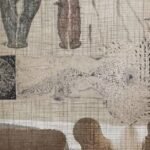
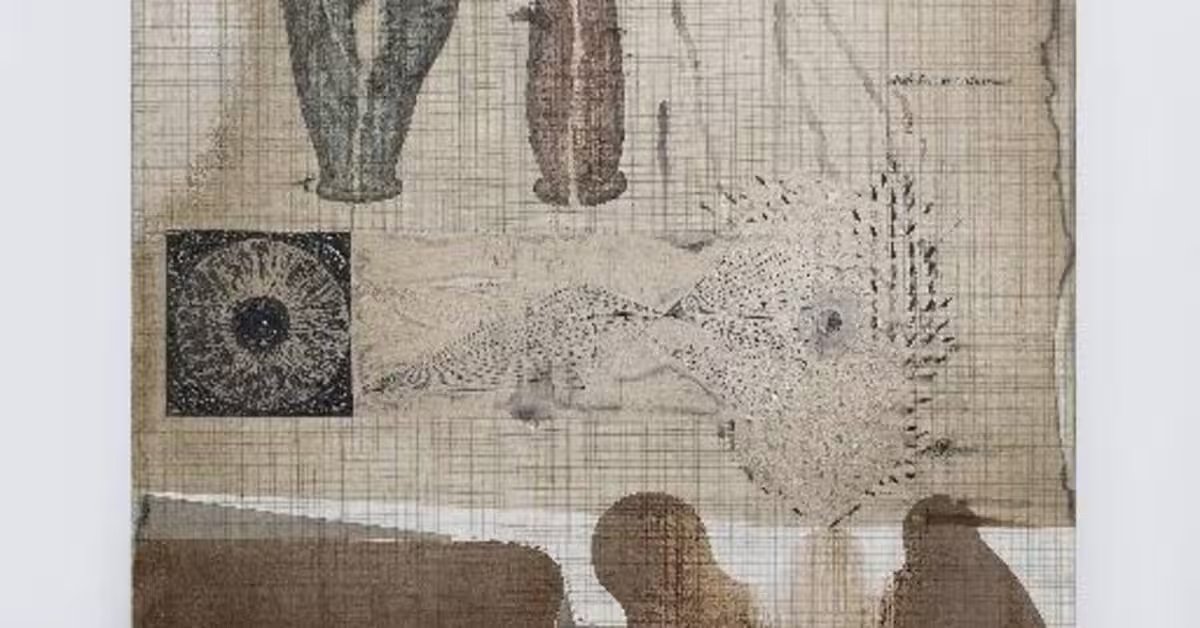
The title work best illustrates this approach. Conjectures on a Paper Sky (2023–25) is a 10-part suite of paintings that grew out of Project A119, a once-classified American proposal from the 1950s to detonate a nuclear device on the Moon. On hand-drawn grids, Kallat overlays ballistic trajectories and blast-like formations with botanical, geological, suboceanic, and celestial forms. Fact and conjecture share the same pictorial field. It is an epistemological exercise: Kallat brings a posteriori knowledge, acquired through experience, into dialogue with a priori knowledge, based on what is held to be true.
Integer Study (drawing from life) (2021) by Jitish Kallat
The most intimate encounter awaits in the Special Exhibition Space, where all 365 drawings from Integer Study (drawing from life) (2021) are being shown together for the first time. Kallat made one drawing each day throughout 2021, beginning with three algorithmically estimated figures: the global human population at a given instant, and the births and deaths recorded up to that point in the day. Paired with a timestamp, these figures generated an evolving form, turning the series into a daily meditation on birth, death, and time.
Wind Study (Hilbert Curve) (2022) by Jitish Kallat
Nearby, Wind Study (Hilbert Curve) (2022) extends his exploration of drawing as a durational, elemental process. It is accompanied by an interactive drawing platform developed with programmers at Google Arts & Culture Lab. Its patterns fold into one another and expand, suggesting that every molecule and every being reflects the cosmos, just as the cosmos is reflected in them.
Lunar Redux (2024–26), Epicycles (2021–25), the Albedo (Point of Incidence) paintings and new bronze sculptures, which were not shown in Delhi, extend these enquiries. Tasneem Mehta of the museum, who curated Kallat’s 2011 exhibition, says that in these turbulent times, the show invites viewers to step back and consider events of varying magnitudes from a different perspective, filling them with “an extraordinary sense of wonder”.