
New Delhi: The One Nation One Ration Card (ONORC) scheme, launched in 2019 by the Department of Food and Public Distribution, has transformed access to subsidised foodgrains under the National Food Security Act (NFSA). By enabling nationwide portability of ration cards, it allows beneficiaries to draw their entitled foodgrains from any Fair Price Shop (FPS) in the country without needing a new ration card.
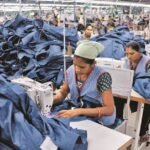
The scheme particularly benefits migrant workers and families who frequently change residence, ensuring they continue to receive public distribution system (PDS) benefits wherever they live or work. It has strengthened social security for the migrant population and moved welfare delivery towards a more integrated, inclusive and beneficiary-centric model.
Key Achievements of Portability
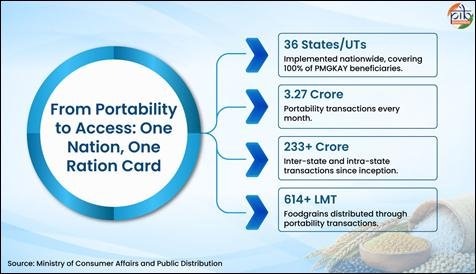
ONORC has been fully implemented across all 36 States and Union Territories, covering 100 per cent of beneficiaries under the Pradhan Mantri Garib Kalyan Anna Yojana (PMGKAY).
Around 3.27 crore portability transactions take place every month. Since its inception, the scheme has recorded more than 233 crore inter-state and intra-state portability transactions, through which over 614 lakh metric tonnes (LMT) of foodgrains have been distributed.
Strengthening Transparency and Delivery Systems
Alongside portability, the government has reinforced the PDS through digitisation, data-driven targeting and technology-enabled supply chains:
- Full digitisation: By October 2026, ration card and beneficiary databases across all States and Union Territories had been 100 per cent digitised, covering approximately 78.65 crore beneficiaries. The data is available on public transparency portals. Of the 20.51 crore ration cards in the central system, 98.8 per cent (20.27 crore) are Aadhaar-seeded. A total of 76.97 crore beneficiaries are Aadhaar-linked, and e-KYC has been completed for 71.52 crore beneficiaries (91 per cent as of 30 September 2026).
- Grievance redressal: All States and Union Territories operate transparency portals, online grievance systems and toll-free helplines.
- Computerised supply chain: Online allocation of foodgrains is operational nationwide, and supply chains have been computerised in 31 States and Union Territories.
- e-PoS enabled FPS: Out of 5.51 lakh Fair Price Shops, 99.8 per cent (5.50 lakh) function with electronic Point of Sale devices.
- Targeting and data cleaning: Advanced Aadhaar and PDS data analytics flagged 5.95 crore suspect records, leading to the removal of 2.58 crore duplicate or ineligible entries. Under Rightful Targeting version 3.63, an additional 68 lakh records were identified and removed.
- Sarthak-PDS framework: Under the broader scheme for automation of ration transport and handling (Sarthak-PDS), the Nirmal initiative strengthens data architecture and analytics, while Saksham enables real-time data integration from procurement to distribution, including vehicle location tracking. Sarthak-PDS provides financial support for intra-state movement, handling and FPS dealer margins and aims to ensure last-mile delivery under NFSA, minimise leakage and strengthen food security by 31 March 2031.
- SMART-PDS: This component under Sarthak-PDS digitally integrates ration cards, distribution, supply chain and grievance redressal, while addressing technology gaps at the State and Union Territory level through a unified central system.
Mera Ration App: Food Security at Fingertips
As part of technology-driven TPDS reforms under ONORC, the Department launched the Mera Ration mobile application, available in 13 languages. Key features include:
- Viewing monthly foodgrain entitlement details
- Checking past transaction history
- Verifying Aadhaar-seeding status
- Checking eligibility for national portability
- Voluntary registration for ONORC
- Locating nearby Fair Price Shops using GPS
- Getting navigation directions to the nearest FPS on a map
The app particularly helps migrant beneficiaries locate nearby shops and access their entitlements in a new area.
Towards Inclusive and Dignified Food Security
By making foodgrain access portable, nationwide and technology-enabled, ONORC has brought about a significant transformation in the public distribution system. Its implementation across all 36 States and Union Territories, together with the high volume of portability transactions, underscores its growing role in strengthening food security.
Digitised beneficiary databases, e-PoS enabled Fair Price Shops, the Sarthak-PDS framework and the Mera Ration app are making the system more transparent, integrated and beneficiary-centric. Collectively, these reforms are reinforcing last-mile delivery and ensuring that beneficiaries receive food security wherever they live and work.