

Tehran/Washington:
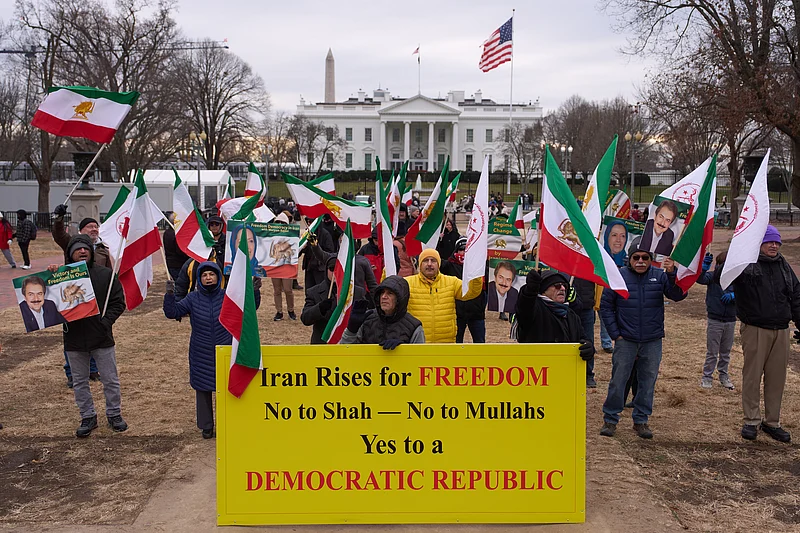
As anti-government protests in Iran entered their third week, killing between 438 and 500 people according to rights groups, attention has increasingly shifted from the streets of Tehran to Washington, where U.S. President Donald Trump has sent mixed and often contradictory signals about his intentions toward the Islamic Republic.
The Iranian leadership, facing its gravest internal challenge in years, appears to be pursuing a dual strategy — issuing stern warnings to the United States while quietly exploring the possibility of talks. President Trump claimed on Sunday that Iranian officials had reached out to him to seek negotiations, even as he warned that military action could precede any such meeting.
“The leaders of Iran called yesterday… a meeting is being set up… They want to negotiate,” Mr. Trump said, before adding, “we may have to act before a meeting.” The remarks have reinforced uncertainty over Washington’s next move, fuelling speculation that the U.S. President may be deliberately keeping Tehran guessing.
Earlier, Mr. Trump had warned Iranian authorities against using force on demonstrators, as images of violent crackdowns continued to emerge despite restrictions on media and internet access. Ordinary Iranians, analysts note, appear increasingly frustrated with what they see as an unresponsive and authoritarian political system amid economic hardship and social restrictions.
Iran, for its part, has sought to project defiance while stopping short of closing the door to diplomacy. “The Islamic Republic of Iran is not seeking war, but is fully prepared for war,” Foreign Minister Abbas Araghchi said while addressing foreign ambassadors in Tehran, in remarks broadcast on state television. His statement reflected Tehran’s long-standing position of deterrence combined with conditional openness to dialogue.
Regional actors are watching developments closely. Israel, a key player in West Asia and a vocal critic of Iran, has so far refrained from public intervention but is understood to be monitoring the situation with concern, given the potential regional fallout of any U.S.-Iran confrontation.
With the Iranian regime under unprecedented domestic pressure and Washington maintaining strategic ambiguity, the coming days may prove critical. Whether President Trump opts for talks, coercive diplomacy, or military action remains unclear, but the uncertainty itself appears to be an instrument of policy — one that keeps Tehran, and the wider region, on edge.