

New Delhi | Defence Desk
The Indian Navy’s First Training Squadron (1TS) has embarked on a long-range training deployment to Southeast Asia, with scheduled port visits to Singapore, Indonesia, and Thailand. The deployment aims to enhance operational training, maritime cooperation, and regional security engagement in line with India’s Act East Policy.
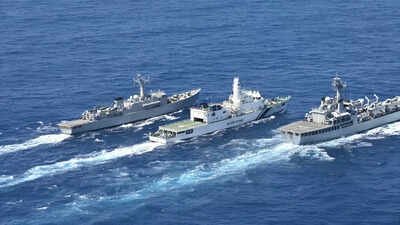
The naval flotilla comprises INS Tir, INS Shardul, INS Sujata, along with the Indian Coast Guard Ship (ICGS) Sarathi. The squadron is undertaking this mission as part of the 110th Integrated Officers Training Course, a flagship training programme of the Indian Armed Forces.
Objective of the Mission
According to the Indian Navy, the primary objective of this deployment is to provide officer trainees with first-hand exposure to operational efficiency, maritime procedures, and diverse sea environments. The long-distance voyage is designed to strengthen seamanship skills, navigation expertise, and real-world operational understanding.
The mission also serves as a platform for:
- Training in international maritime practices
- Exposure to multi-national naval environments
- Enhancing jointness among the armed forces
Personnel from the Indian Army and Indian Air Force are also part of the deployment, further strengthening tri-services integration.
Joint Maritime Exercises and Engagements
During the port visits, Indian Navy personnel will engage in:
- Joint maritime exercises with host nation navies
- Cross-deck visits and professional exchanges
- Training interactions with maritime agencies
- Expert-level discussions and operational briefings
These engagements aim to improve mutual trust, operational understanding, and interoperability among regional navies.
Strengthening India’s Act East Policy
The Indian Navy stated that this deployment reinforces India’s commitment to a free, open, and inclusive Indo-Pacific and Indian Ocean Region (IOR). The mission reflects India’s growing role in regional maritime diplomacy and security cooperation with Southeast Asian nations.
The presence of Indian naval vessels in the region underscores New Delhi’s focus on:
- Maritime stability
- Freedom of navigation
- Rules-based international order
International Participation and Capacity Building
Notably, six international officer trainees are participating in the 110th Integrated Officers Training Course. Their presence highlights India’s continued commitment to capacity building and professional military education for friendly foreign nations.
Defence experts believe that such deployments play a critical role in projecting India as a reliable maritime partner and strengthening defence ties across the Indo-Pacific.
Previous Deployments Highlight Growing Maritime Outreach
This Southeast Asia deployment follows a series of successful overseas missions by the First Training Squadron. Earlier, Indian Navy ships visited:
- Maputo, Mozambique, marking 50 years of India–Mozambique diplomatic relations
- La Réunion (France) and Port Louis, Mauritius, as part of long-range training deployments in the Southwest Indian Ocean Region
In these missions as well, INS Tir, INS Shardul, and ICGS Sarathi were key participants.
Expert View
Defence analysts say such long-range training deployments enhance:
- Training excellence of the Indian Navy
- Maritime diplomacy and goodwill
- Regional maritime security cooperation
They also serve as a strategic signal of India’s readiness to work closely with partner nations to ensure peace, stability, and security at sea.
Conclusion
The ongoing deployment of Indian Navy ships to Singapore, Indonesia, and Thailand is not just a training exercise, but a strategic initiative combining operational readiness, diplomacy, and regional security cooperation. As India expands its maritime footprint, such missions are expected to play an increasingly vital role in shaping the security architecture of the Indo-Pacific.