

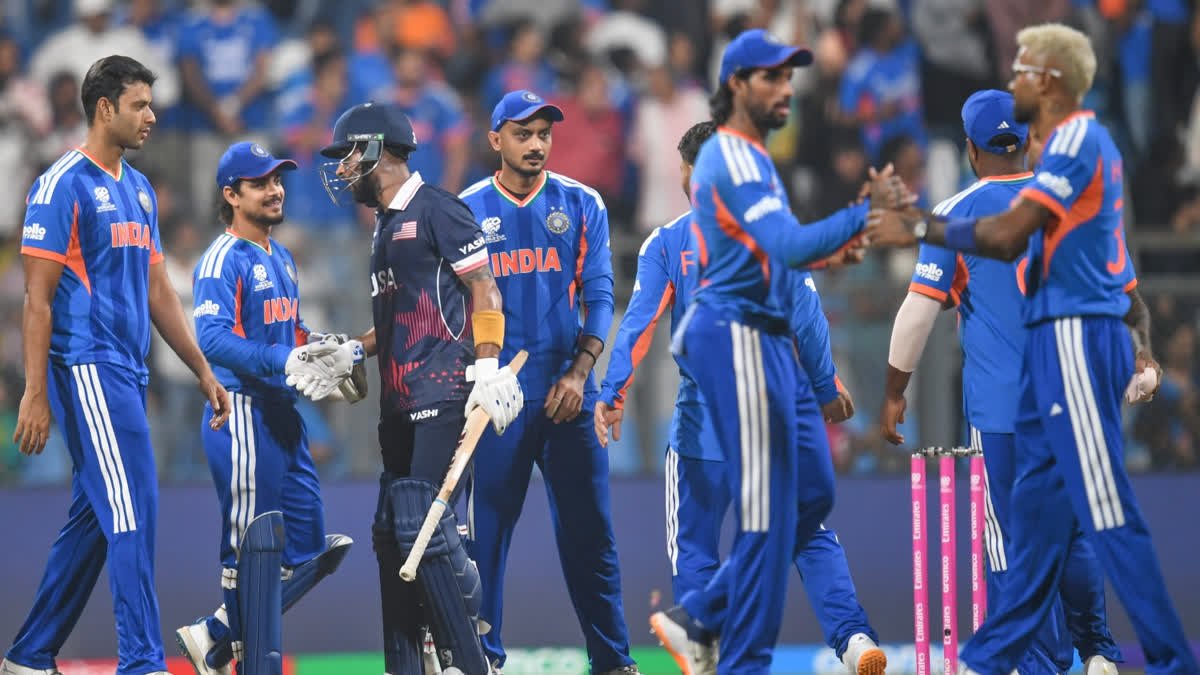
Mumbai: India may have started their T20 World Cup campaign with a win, but their opening match against the United States delivered a timely and necessary warning. The victory came through experience and composure under pressure, not dominance—and it exposed areas that stronger opponents will be quick to exploit.
India will face Namibia in their second group match on February 12 in Delhi, and the lessons from the USA game are likely to shape their approach moving forward.
The match against the USA was not one to celebrate, but one to analyze. It tested India’s batting depth, temperament, and decision-making under pressure, revealing that this T20 World Cup cannot be won on talent alone.
Lack of a Defined Anchor in the Batting Line-up
On paper, India boast one of the deepest batting line-ups in the tournament. In reality, the early collapse against the USA exposed a structural vulnerability. At 46 for 4 inside the powerplay, India did not lose to luck or brilliance, but to rushed shot selection against disciplined pace-off bowling.
Six wickets fell for single-digit scores, including two ducks. This was not a failure of a particular phase—it was a failure of intent and planning. India’s top order is designed for speed and momentum, an approach that works on flat pitches but falters when bowlers deny pace and space.
In such conditions, the absence of a clearly defined anchor—someone tasked with stabilizing the innings between overs 7 and 14—became evident.
Suryakumar Yadav naturally filled that role, scoring a composed 84 off 49 balls that blended control with authority. Against Namibia, India would benefit from practicing deliberate restraint alongside aggression. Winning correctly may matter more than winning comfortably.
Middle Overs: The Deciding Phase
If there is one phase India must address before the tournament intensifies, it is the middle overs. Between the 7th and 15th overs at Wankhede, India oscillated between stagnation and haste. Singles dried up, boundaries were forced, and scoreboard pressure became psychological rather than numerical.
Namibia, while less experienced, are disciplined and patient. They wait for mistakes rather than forcing outcomes. India should treat this match as a laboratory for control—prioritizing rotation of strike, building partnerships, and managing tempo.
A consistent 45–55 runs in this phase with minimal wicket loss would allow India’s finishing power to be decisive. This is not a retreat from aggression, but a refinement of it.
Leadership Under Pressure
One of the positives from the USA match was Suryakumar Yadav’s calm leadership. His innings reflected clarity rather than flair—reading the pitch, trusting patience, and responding late instead of early.
That clarity now needs to extend across the playing XI. At this level, T20 cricket is about execution more than freedom. Roles must be precise, and resistance valued as much as range-hitting. Delhi’s slower surface will test that understanding once again.
Bowling Provides Stability
While batting raised questions, India’s bowling inspired confidence. Mohammed Siraj’s return after Harshit Rana’s injury restored control with the new ball. Alongside Arshdeep Singh, India now have a left-right pace combination capable of building early pressure.
More importantly, the spin duo of Axar Patel and Varun Chakravarthy reaffirmed India’s control in the middle overs. Their accuracy, subtle variations, and wicket-to-wicket discipline remain among India’s biggest strengths in this format. With dew expected to play a limited role in Delhi, consistency—not experimentation—should be the guiding principle.
Fielding and Focus
India’s fielding against the USA was sharp and energetic. Maintaining that intensity against Namibia will be crucial. On larger grounds, decision-making and communication matter as much as athleticism. Namibia thrive on capitalizing on errors rather than being overpowered, and any lapse could prove costly.
Respect the Process
Namibia may not command headlines, but they are organized, patient, and tactically aware. India’s approach must be professional rather than flashy. This is not a statement game—it is a consolidation game.
Rather than attempting to erase the USA scare with a high-octane batting display, India should aim for a controlled powerplay, a stable middle phase, and calculated acceleration. The warning has come early. What matters now is how India respond.