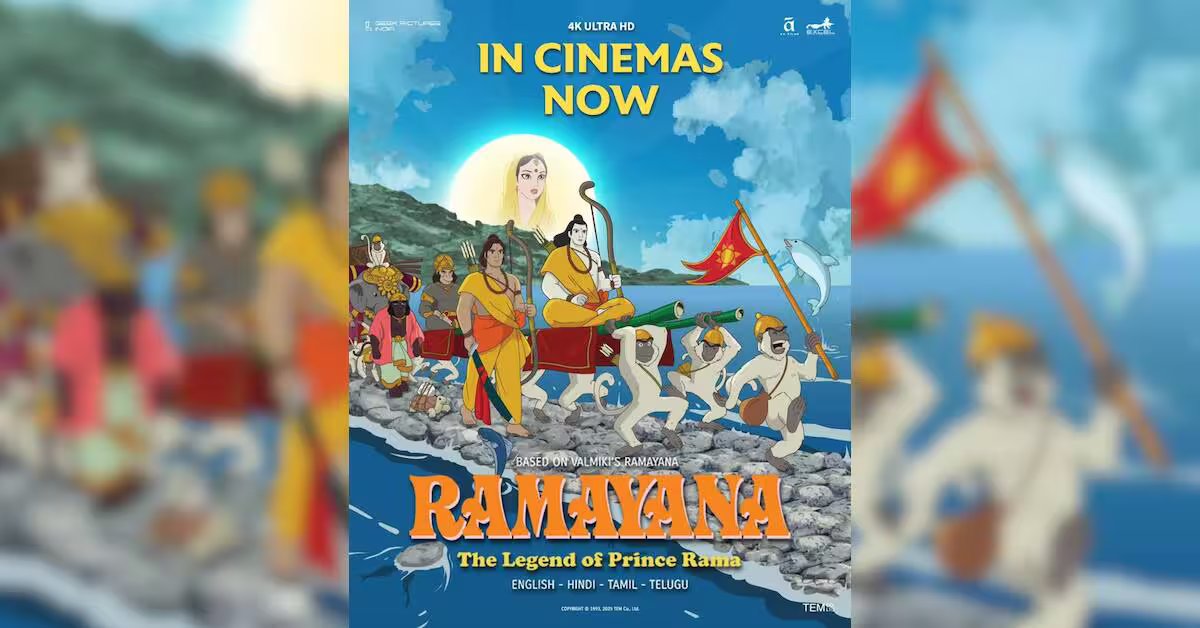
At the end of a day of battle between Rama’s army of monkeys and Ravana’s army of rakshasas, the healers care for the wounded and cremate the dead. Seeing the dead rakshasas being cremated along with the fallen monkey soldiers, Lakshman protests. “Brother, how could you cremate the bodies of our enemies with those of our own soldiers?” he asks. Rama replies that in death, everyone — rakshasas, monkeys, humans — deserves dignity. As the funeral pyres on the shore of the ocean are lit, Rama declares that he will continue to fight his battles as a warrior, but he will also pray for a world free from all wars.
The scene takes place a little more than halfway through ‘Ramayana: The Legend of Prince Ram’ (1993), an Indo-Japanese anime adaptation of the Sanskrit epic, produced and co-directed by Japanese filmmaker Yugo Sako. The making of the film and its reception in India are, in themselves, quite epic and merit a retelling. Born in 1928, Sako reportedly encountered the ancient Sanskrit epic of the Ramayana in a Japanese translation in 1968 and then went on to produce several TV documentaries on India for Japanese networks after travelling to the country for the first time in 1970.
One of the last documentaries Sako produced was in association with Indian archaeologist B.B. Lal (1921-2022), focusing on the so-called Ramayana relics at Shringaverapura, a village about 45 km northeast of Prayagraj. Lal had served as the director-general of the Archaeological Survey of India from 1968 to 1972, and he
controversially claimed to have found the remains of a Hindu temple beneath the 16th-century Babri Masjid, which was illegally demolished by a Hindutva mob on 6 December 1992. In the mid-1980s, as Sako was planning his adaptation of the Ramayana, he ran into trouble with the Hindu right-wing. The Vishwa Hindu Parishad (VHP) lodged a complaint with the Japanese embassy in New Delhi against any new interpretation of the ancient text.
The importance of the Ramayana for the Hindu right-wing project of state-making has been studied extensively by several scholars. In a
1993 essay, ‘Ramayana and Political Imagination in India’, written in the aftermath of the Babri Masjid demolition and communal riots across the country, Sanskrit scholar Sheldon Pollock argued that since pre-modern times, the Ramayana supplied “a repertory of imaginative instruments for articulating a range of political discourses”, and in the 1980s and 1990s, as the Ram Janmabhoomi movement grew, its supporters were “less interested in the text… than in the divisive politics it can articulate.” For political actors, the text of the Ramayana was less important than how it could be instrumentalized for their purposes.
Popular representations of the Ramayana, such as the seventy-eight-episode-long adaptation of the epic by Ramanand Sagar, telecast to 80-100 million people on the state TV channel Doordarshan, between 25 January 1987 and 31 July 1988, evoked “spontaneous outbursts of popular piety,” writes Australian historian Carole M. Cusack in a
2012 essay. Cusack adds that the popular piety of watching Ramayana on TV was “deeply imbricated with Hindu nationalism”, with many “moved to political action, including violence… [against] the perceived enemies of Hindutva… that existed within India itself.” Pollock writes that the TV series “is only the most recent in a long series of attempts… to establish a hegemonic version” of the epic. It is in this context that we must understand the problems Sako encountered in creating his adaptation.
In a
2022 essay on the film, media scholar Rea Amit writes that failing to find any funding in India, Sako eventually secured about 800 million yen in Japan. About 450 illustrators were hired for the project, while Sako also collaborated with Indian artists, such as animator Ram Mohan (often called the “father of Indian animation”), writer Pandit Narendra Sharma, composer Vanraj Bhatia and lyricist Vasant Dev. Completed in 1993, the film made its debut at the Delhi International Film Festival, also travelling to the International Children’s Film Festival in Udaipur in the same year, but it could not be released widely because of socio-political reasons.
In
an article on the Delhi film festival, journalist Madhu Jain reports on speculation that Sako’s film was funded by the VHP, and contrasts it with another film at the festival, the documentary Ram Ke Naam (1992), directed by Anand Patwardhan, which closely documented the Ram Janmabhoomi movement. If the conditions in India were unfavourable, it was not much better in Japan: Amit writes that the attitudes of Japanese people towards Hinduism changed significantly after the 1995 Tokyo sarin gas attack. “The group that carried out the attack, Aum Shinrikyō, associated itself with some aspects of Hinduism and… its leader, Asahara Shōkō, had frequently travelled to India for alleged spiritual retreats,” he adds.
Facing such adversity, the film might have disappeared into the black hole of obscurity. However, the release of a Hindi-dubbed version on Cartoon Network in 2002 earned it a new generation of viewers, including this author. It was telecast before Diwali, which celebrates Rama’s return to Ayodhya, for several years, and in 2022, Prime Minister Narendra Modi
met the film’s producers Atsushi Matsuo and Kenji Yoshii. A digitally remastered version of the film was released and screened in multiple film festivals around the world. A
recent article in the Vulture describes it as the “best Ramayana movie” and “a definitive version of the epic — not to mention the best entry point for outsiders unfamiliar with the story”.
Three decades since its making, ‘Ramayana: The Legend of Prince Ram’ is a testimony to the many lives of an artistic work. The Indian poet and scholar A K Ramanujan claimed in his
1991 essay ‘Three Hundred Ramayanas’ that the ancient Sanskrit epic, originally composed in an oral and aural tradition, did not have any hegemonic version, and resisted appropriation and instrumentalization for particular purposes. The enduring popularity of Sako’s version lies not only in how it narrates the immortal story of Rama, but also in its vision of compassion, dignity and peace, which is, perhaps, its most important legacy.
_________________________________________________________________________________________________
Uttaran Das Gupta is an independent writer and journalist