

Raipur : The Chhattisgarh government is facing mounting pressure over its prolonged delay in reimbursing private schools under the Right to Education (RTE) Act, with school managements warning of a statewide non-cooperation movement if an immediate decision is not taken.
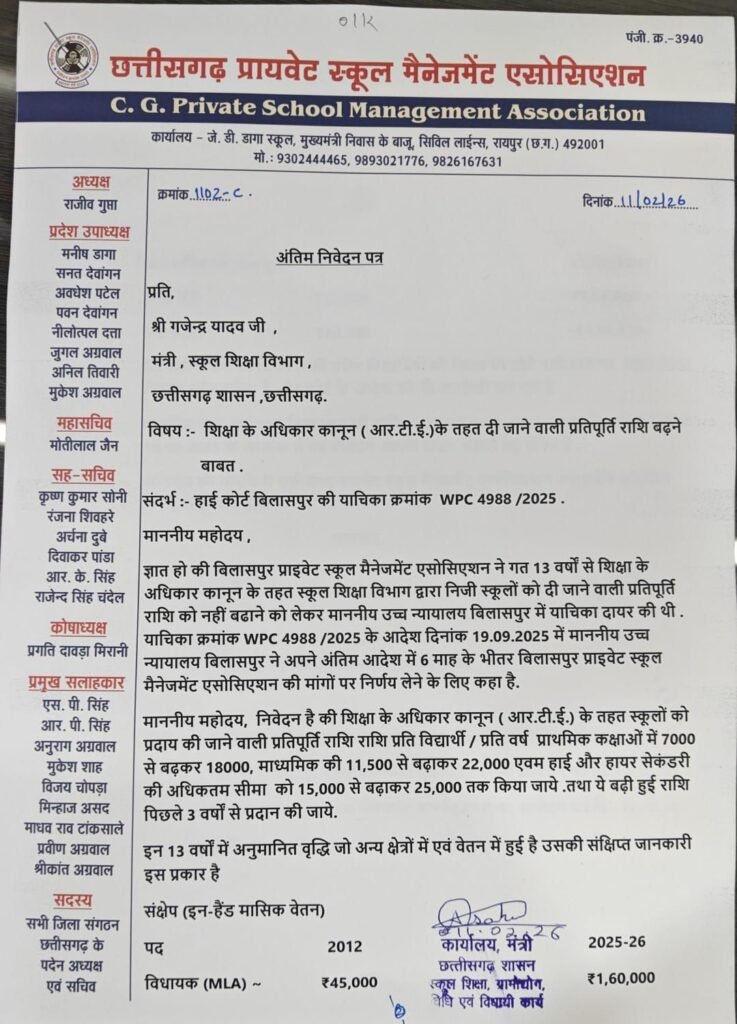
The Chhattisgarh Private School Management Association has submitted a final memorandum to the State Education Minister, expressing strong displeasure over what it calls “continued government apathy” toward RTE compensation that has remained unchanged for the last 13 years.
High Court Order Ignored, Say School Associations
In its letter, the association cited the Bilaspur High Court’s order dated September 19, 2025 (WPC 4988/2025), which directed the School Education Department to take a decision within six months on the issue of RTE reimbursement. However, even after the stipulated period, no concrete policy decision has been announced.
The association alleges that the delay amounts to contempt of court and has severely undermined the state’s education system.
No Revision in RTE Compensation for Over a Decade
Private school operators argue that while operational costs have risen sharply over the years, RTE reimbursement rates have remained frozen since 2012. Rising inflation, staff salaries, infrastructure costs, and administrative expenses have made it increasingly difficult for schools to sustain RTE admissions.
Key Demands of Private Schools
The association has demanded a substantial revision in reimbursement rates:
- Primary level: Increase from ₹7,000 to ₹18,000 per student
- Middle school level: Increase from ₹11,500 to ₹22,000
- Higher secondary level: Increase from ₹15,000 to ₹25,000
- Revised rates to be implemented retrospectively for the last three years
Salary Hikes for Officials, But Not for Education?
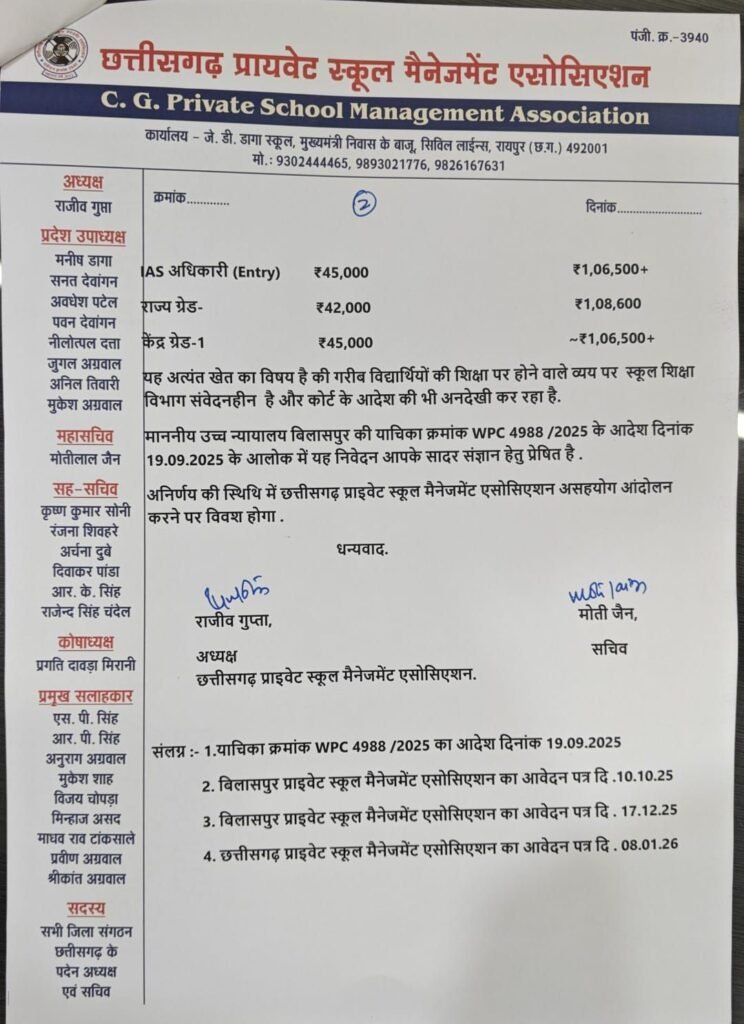
Drawing comparisons, the association highlighted that between 2012 and 2025–26, the salary of MLAs increased from ₹45,000 to ₹1.60 lakh, while IAS officers’ salaries crossed ₹1 lakh. In contrast, expenditure on educating economically weaker students under RTE has not seen any revision.
“This clearly shows misplaced priorities,” the association said in its statement.
Direct Impact on Poor Students
School managements claim that the government’s reluctance to revise RTE compensation is directly affecting the quality of education for underprivileged students. Many private schools are forced to bear additional costs from their own funds, affecting infrastructure, teacher retention, and overall academic standards.
Statewide Protest on the Cards
The association has issued a clear warning that if the government fails to act promptly, private schools across Chhattisgarh will consider launching a statewide non-cooperation movement. Responsibility for any disruption in the education system, it said, would rest entirely with the School Education Department and the state government.
The Question Remains
Despite a High Court directive, repeated representations, and now a final ultimatum, the government’s silence continues to raise serious questions. Has the Right to Education been reduced to a policy on paper? And is the education of poor children no longer a priority for the state?