

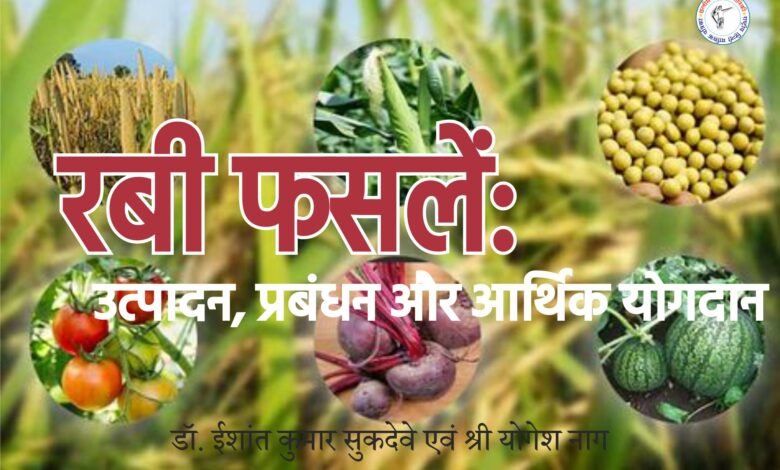
Raipur: Agricultural scientists Dr. Ishant Kumar Sukdeve from the Department of Agricultural Extension and Ph.D. Scholar Yogesh Nag from the Department of Entomology (IGKV Raipur) have emphasized the growing importance of Rabi crops in ensuring India’s food security and boosting rural income. In a detailed report, they outlined how improved farming practices and modern technologies are helping farmers achieve higher productivity during the Rabi season.
India, being an agrarian nation, grows a wide range of crops throughout the year. Among these, Rabi crops—sown from October to December and harvested during March–April—play a crucial role. Wheat, chickpea, lentil, mustard and barley remain the major crops of the season, thriving in cool and dry climatic conditions.
According to experts, India is one of the world’s leading wheat producers, while pulses like chickpea and lentil serve as an affordable protein source for millions. Mustard continues to be a backbone of the country’s edible oil economy.
The report highlights that productivity of Rabi crops depends heavily on timely sowing, use of quality seeds, balanced fertilizer application, and efficient irrigation. New technologies such as zero tillage, micro-irrigation, mulching and direct-seeded wheat have significantly reduced input costs while increasing yields. Research organizations and Krishi Vigyan Kendras have also contributed by providing high-yielding and disease-resistant varieties.
Scientific crop management practices—such as soil testing–based nutrient application, Rhizobium culture in pulses, sulfur in mustard, and nitrogen–phosphorus management in wheat—have shown remarkable results. Critical-stage irrigation, especially at tillering and grain-filling in wheat and flowering in chickpea and mustard, has proven essential. Integrated Pest Management (IPM) methods, including pheromone traps and neem-based bio-pesticides, are helping farmers control pests sustainably.
Economically, Rabi crops remain vital for India’s agricultural stability. They contribute significantly to food grain availability, edible oil production, and rural employment. Continuous market demand throughout the year ensures stable and reliable income for farmers. The sector also supports industries related to seeds, fertilizers, agro-machinery, storage and processing, forming a major pillar of the rural economy.
In the context of climate change, Rabi crops are emerging as more stable and less risky options for farmers. With modern technologies and water-conservation measures, there is still vast potential to enhance productivity further.
The experts conclude that strengthening scientific management of Rabi crops is essential for elevating India’s agricultural growth and securing livelihoods in rural areas.
— Report by Dr. Ishant Kumar Sukdeve and Yogesh Nag, IGKV Raipur